
A, B and C can do a piece of work in 20, 30 and 60 days, respectively. A works every day. B assists A on all odd-numbered days, while C assists A on all even-numbered days. In how many days will the work be completed?
13 \( \frac{1}{5} \)
13 \( \frac{1}{3} \)
13 \( \frac{1}{4} \)
13 \( \frac{1}{2} \)
The problem involves calculating the time taken to complete a work when multiple individuals work with varying assistance on different days. We will determine the individual work rates, calculate the work done in a 2-day cycle, and then find the number of cycles and remaining work to determine the total time.
Calculate individual work rates:
Determine work done on odd and even days:
Calculate work done in a 2-day cycle:
A cycle consists of one odd day and one even day. So, in 2 days, the total work done is:
\[ \text{Work}_{\text{2-days}} = \text{Work}_{\text{odd}} + \text{Work}_{\text{even}} = \frac{1}{12} + \frac{1}{15} = \frac{5 + 4}{60} = \frac{9}{60} = \frac{3}{20} \]Find the number of 2-day cycles to complete most of the work:
Let \(N\) be the number of 2-day cycles. We want to find \(N\) such that the work done is close to, but not exceeding, 1 (total work).
Work done in \(N\) cycles \(= N \times \frac{3}{20}\).
Let's try to find how many cycles complete a significant portion of the work. If \(N=13\), work done \[= 13 \times \frac{3}{20} = \frac{39}{20}\], which is greater than 1. So, we need fewer than 13 cycles.
If \(N=6\), work done \[= 6 \times \frac{3}{20} = \frac{18}{20} = \frac{9}{10}\].
After 6 cycles (which is \(6 \times 2 = 12\) days), \(\frac{9}{10}\) of the work is completed.
Remaining work \[= 1 - \frac{9}{10} = \frac{1}{10}\].
Calculate the time for the remaining work:
The 13th day is an odd-numbered day. On odd days, A and B work together, completing \(\frac{1}{12}\) of the work.
Since \[\frac{1}{10} > \frac{1}{12}\], the remaining work \(\frac{1}{10}\) cannot be completed on the 13th day alone.
Work remaining after 12 days \(= \frac{1}{10}\).
On day 13 (odd day), work done \(= \frac{1}{12}\).
Work remaining after 13 days \[= \frac{1}{10} - \frac{1}{12} = \frac{6 - 5}{60} = \frac{1}{60}\].
The 14th day is an even-numbered day. On even days, A and C work together, completing \(\frac{1}{15}\) of the work.
Time taken to complete the remaining \(\frac{1}{60}\) work on day 14 is:
\[ \text{Time} = \frac{\text{Remaining Work}}{\text{Work rate on even day}} = \frac{1/60}{1/15} = \frac{1}{60} \times 15 = \frac{15}{60} = \frac{1}{4} \text{ day} \]Total time taken:
Total time \[= 12 \text{ days (for 6 cycles)} + 1 \text{ day (13th day)} + \frac{1}{4} \text{ day (on 14th day)}\]
Total time \[= 12 + 1 + \frac{1}{4} = 13 \frac{1}{4} \text{ days}\].
C) \(13 \frac{1}{4}\)
To find the new price of the TV set, we need to apply the discount first and then the price increase. This involves calculating percentages sequentially on the modified price.
The original price is ₹9,000. It is discounted by 20%.
\[ \text{Discount amount} = 20\% \text{ of } \text{₹}9,000 \]\[ \text{Discount amount} = \frac{20}{100} \times 9000 = 20 \times 90 = \text{₹}1,800 \]\[ \text{Price after discount} = \text{Original price} - \text{Discount amount} \]\[ \text{Price after discount} = 9000 - 1800 = \text{₹}7,200 \]The discounted price (₹7,200) is then raised by 10%.
\[ \text{Increase amount} = 10\% \text{ of } \text{₹}7,200 \]\[ \text{Increase amount} = \frac{10}{100} \times 7200 = 10 \times 72 = \text{₹}720 \]\[ \text{New price} = \text{Price after discount} + \text{Increase amount} \]\[ \text{New price} = 7200 + 720 = \text{₹}7,920 \]Correct Option: D) ₹7,920
The question asks to identify the type of satellite GSAT-12, launched by PSLV-C17 from Sriharikota. This requires knowledge of specific Indian satellite missions and their purposes.
Correct Option: C) GSAT-12 is a communication satellite. The "GSAT" prefix itself stands for Geostationary Satellite, which are typically used for communication purposes due to their ability to remain over a fixed point on the Earth's surface.
The question asks to identify the athlete who broke the world record for 300 m at the Ostrava Golden Spike in June 2019. This requires knowledge of specific athletic achievements and records.
Correct Option: D) Shaunae Miller-Uibo broke the world record for 300 m at the Ostrava Golden Spike in June 2019 with a time of 34.41 seconds, surpassing the previous record set by Ana Guevara in 2003.
The problem involves finding the total monetary value in a box given the ratio of different coin denominations and the actual count of one type of coin. We will first use the given count of 50 paise coins and the ratio to find the number of one rupee and 25 paise coins. Then, we will convert the number of coins of each denomination into their respective monetary values and sum them up to find the total amount.
Understand the Ratio: Let the number of one rupee, 50 paise, and 25 paise coins be \(N_1\), \(N_{50}\), and \(N_{25}\) respectively. The ratio of these coins is given as \(1 : 2 : 3\). So, we can write:
\[ N_1 : N_{50} : N_{25} = 1 : 2 : 3 \]This means \(N_1 = k\), \(N_{50} = 2k\), and \(N_{25} = 3k\) for some constant \(k\).
Find the Value of \(k\): We are given that the number of 50 paise coins is eighty. So, \(N_{50} = 80\).
\[ 2k = 80 \] \[ k = \frac{80}{2} \] \[ k = 40 \]Calculate the Number of Each Coin: Using the value of \(k\):
Calculate the Value of Each Denomination in Rupees:
Calculate the Total Money in the Box: Add the values from all denominations:
\[ \text{Total Money} = \text{₹}40 + \text{₹}40 + \text{₹}30 \] \[ \text{Total Money} = \text{₹}110 \]Correct Option: D) ₹110
The question asks to identify the artist who is NOT a Sitar exponent among the given options. This requires knowledge of prominent Indian classical musicians and their respective instruments.
Correct Option: C) Pt Shiv Kumar Sharma is a renowned Santoor maestro, not a Sitar player. He is credited with popularizing the Santoor as a classical instrument.
Select the Venn diagram that best represents the relationship between the following classes.
Scientists, Researchers, Professors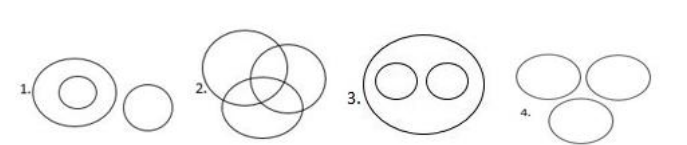
To determine the correct Venn diagram, we need to understand the relationship between the classes: Scientists, Researchers, and Professors. These categories can overlap, as individuals can belong to more than one category.
Correct Option: D) Diagram 2
The question asks to identify the official bird of the Andaman and Nicobar Islands. This is a factual question related to the symbols of Indian Union Territories. Knowledge of official state/UT symbols is important for competitive exams.
D) Wood Pigeon — The Andaman Wood Pigeon (Columba palumboides) is indeed the official state bird of the Andaman and Nicobar Islands. It is an endemic species found only in this archipelago.
To find a factor of the given quadratic polynomial \( x^{2} - x - 20 \), we can factorize the polynomial. A common method for factoring quadratic polynomials of the form \( ax^2 + bx + c \) is to find two numbers that multiply to \( ac \) and add up to \( b \).
Identify the coefficients of the polynomial \( x^{2} - x - 20 \). Here, \( a = 1 \), \( b = -1 \), and \( c = -20 \).
We need to find two numbers that multiply to \( ac \) and add up to \( b \). In this case, \( ac = (1)(-20) = -20 \) and \( b = -1 \).
Let's list pairs of factors for \(-20\):
\((1, -20)\), \((-1, 20)\)
\((2, -10)\), \((-2, 10)\)
\((4, -5)\), \((-4, 5)\)
Now, check which pair sums to \(-1\):
\(1 + (-20) = -19\)
\(-1 + 20 = 19\)
\(2 + (-10) = -8\)
\(-2 + 10 = 8\)
\(4 + (-5) = -1\)
\(-4 + 5 = 1\)
The pair of numbers that satisfies both conditions is \(4\) and \(-5\).
Rewrite the middle term (\( -x \)) using these two numbers:\[ x^{2} + 4x - 5x - 20 \]
Group the terms and factor by grouping:\[ (x^{2} + 4x) - (5x + 20) \]
\[ x(x + 4) - 5(x + 4) \]
Factor out the common binomial factor \((x + 4)\):\[ (x + 4)(x - 5) \]
Thus, the factors of the polynomial \( x^{2} - x - 20 \) are \( (x + 4) \) and \( (x - 5) \).
Compare these factors with the given options.
The factor \( (x - 5) \) matches option B.
This problem involves compound interest. We are given the principal amount becomes 8 times itself in 3 years. We need to find the annual rate of interest. We will use the compound interest formula to establish a relationship between the final amount, principal, rate, and time, and then solve for the rate.
Let the principal amount be \(P\). The problem states that the sum of money becomes 8 times itself. So, the final amount \(A\) will be \(8P\).
The time period \(n\) is 3 years.
The compound interest formula is given by:
\[ A = P \left(1 + \frac{R}{100}\right)^n \]where \(A\) is the final amount, \(P\) is the principal, \(R\) is the annual rate of interest, and \(n\) is the number of years.
Substitute the given values into the formula:
\[ 8P = P \left(1 + \frac{R}{100}\right)^3 \]Divide both sides by \(P\):
\[ 8 = \left(1 + \frac{R}{100}\right)^3 \]Take the cube root of both sides:
\[ \sqrt[3]{8} = 1 + \frac{R}{100} \] \[ 2 = 1 + \frac{R}{100} \]Subtract 1 from both sides:
\[ 2 - 1 = \frac{R}{100} \] \[ 1 = \frac{R}{100} \]Multiply by 100 to find \(R\):
\[ R = 1 \times 100 \] \[ R = 100\% \]A) 100% is the correct rate of interest. This means that for every 100 units of principal, an interest of 100 units is earned each year, effectively doubling the amount each year (when compounded annually).
B) Data inadequate — The data provided (amount becomes 8 times, 3 years, compounded annually) is sufficient to calculate the rate of interest.
C) 8% — If the rate were 8%, the amount would be \(P(1 + 0.08)^3 = P(1.08)^3 \approx 1.26P\), which is not 8 times the principal.
D) 5% — If the rate were 5%, the amount would be \(P(1 + 0.05)^3 = P(1.05)^3 \approx 1.1576P\), which is not 8 times the principal.