
Select the Venn diagram that best represents the relationship between the following classes.
Flower, Rose, Bee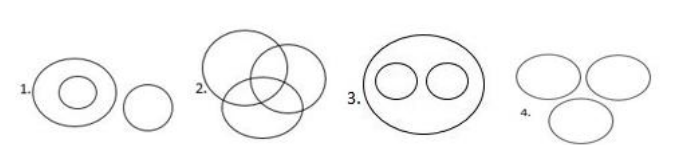
To determine the correct Venn diagram representation for the classes 'Flower', 'Rose', and 'Bee', we need to understand the relationships between these categories.
Correct Option: B) Diagram 1 correctly represents 'Rose' as a subset of 'Flower', with 'Bee' as a separate entity.
To find the fourth proportional to three given numbers, we set up a proportion where the ratio of the first two numbers is equal to the ratio of the third number to the unknown fourth proportional. We then solve for the unknown value.
Let the three given numbers be \(a = 4\), \(b = 9\), and \(c = 12\).
Let the fourth proportional be \(x\).
According to the definition of proportion, the ratio of the first two numbers is equal to the ratio of the third and fourth numbers. So, we can write the proportion as:
\[ \frac{a}{b} = \frac{c}{x} \]Substitute the given values into the proportion:
\[ \frac{4}{9} = \frac{12}{x} \]To solve for \(x\), cross-multiply:
\[ 4 \times x = 9 \times 12 \]Calculate the product on the right side:
\[ 4x = 108 \]Divide both sides by 4 to find \(x\):
\[ x = \frac{108}{4} \]Perform the division:
\[ x = 27 \]Thus, the fourth proportional to 4, 9, and 12 is 27.
B) 27 is the correct answer, as calculated by setting up the proportion and solving for the unknown fourth term.
The question asks to identify the founder of the Indian League, established in Calcutta in 1875. This is a factual question related to the history of political organizations in India during the pre-independence era. Recalling key figures and their contributions to early political associations is essential.
Correct Option: A) Sisir Kumar Ghosh was the founder of the Indian League in 1875. He was a prominent journalist and a social reformer, known for founding the Amrita Bazar Patrika.
The question asks to identify the legislation that does NOT deal with environmental protection. We need to examine the purpose of each given Act to determine its primary focus.
Correct Option: B) The Port Laws Amendment Act, 1997. This Act primarily deals with the administration and management of ports, not environmental protection.
The problem asks us to identify the odd one out from a given list of four words: Patna, Bengaluru, Itanagar, Chandigarh. We need to find a common characteristic shared by three of them and identify the one that does not share that characteristic.
A) Chandigarh is the odd one out because it is a Union Territory and serves as the capital for two states (Punjab and Haryana), whereas Patna, Bengaluru, and Itanagar are capitals of single states.
This is a logical reasoning problem involving scheduling. We need to arrange six lectures (A, B, C, D, E, F) over seven days (Monday to Sunday), with one day off. We will use the given conditions to deduce the exact schedule of lectures and then find the number of lectures between F and E.
List the days: Monday, Tuesday, Wednesday, Thursday, Friday, Saturday, Sunday.
Condition 1: A should be organised on Saturday.
Saturday: A
Condition 2: C should be organised immediately before D.
This means C and D are together: (C, D)
Condition 3: E should be before D and there should be a gap of two days between E and D.
This implies the sequence: E, _, _, D. The two days in between can be empty or have other lectures. Combining with (C, D), we get E, _, C, D.
Condition 4: D should be organised before Friday.
Since D is before Friday, it can be on Monday, Tuesday, Wednesday, or Thursday. Given the sequence E, _, C, D, the earliest D can be is Wednesday (if E is Monday). If D is on Thursday, then C is Wednesday, and E is Monday (with Tuesday as the gap day). This fits the E, _, C, D sequence.
Condition 5: No lecture should be organised immediately after E.
This means the day after E must be the 'no lecture' day or a day with another lecture that is not immediately after E in the sequence. However, if we consider the sequence E, _, C, D, the day after E is a gap day. This gap day cannot have a lecture. So, the day after E must be the 'no lecture' day.
Condition 6: F should not be organised on the last day (Sunday).
Let's try to place E, _, C, D using D before Friday:
If D is on Thursday, then C is on Wednesday. The two-day gap between E and D means E is on Monday. The day after E (Tuesday) must be the 'no lecture' day (from Condition 5).
So far:
Monday: E
Tuesday: No Lecture
Wednesday: C
Thursday: D
Friday: ?
Saturday: A
Sunday: ?
Place the remaining lecture (B) and F:
The remaining days are Friday and Sunday. The remaining lectures are B and F.
Condition 6 states F should not be on Sunday. So, F must be on Friday.
This leaves B for Sunday.
Final Schedule:
Monday: E
Tuesday: No Lecture
Wednesday: C
Thursday: D
Friday: F
Saturday: A
Sunday: B
Check all conditions:
- One lecture on each day, one day no lecture: Yes (Tuesday is no lecture).
- C immediately before D: Yes (Wednesday C, Thursday D).
- E before D, two days gap between E and D: Yes (Monday E, Tuesday No Lecture, Wednesday C, Thursday D - two days between E and D are Tuesday and Wednesday).
- D before Friday: Yes (Thursday D).
- No lecture immediately after E: Yes (Tuesday is No Lecture).
- A on Saturday: Yes.
- F not on last day (Sunday): Yes (F on Friday, B on Sunday).
Answer the question: How many lectures are organised between F and E?
E is on Monday.
F is on Friday.
Lectures between Monday (E) and Friday (F) are C (Wednesday) and D (Thursday). There are two lectures.
C) Two
The question asks to identify a Harappan site located in Gujarat from the given options. This requires knowledge of the geographical distribution of major Harappan (Indus Valley Civilization) sites.
Correct Option: A) Dholavira is a significant Harappan site located in the Kutch district of Gujarat, India. It was one of the largest cities of the Indus Valley Civilization and is famous for its advanced water management system and unique urban planning.
The question asks to identify the active volcano known as the "Light House of the Mediterranean." This is a common geographical fact often tested in competitive exams. We need to recall the characteristics and popular nicknames of the given volcanoes.
Correct Option: B) Stromboli is an active volcano in Italy, located on an island in the Tyrrhenian Sea. It is famous for its persistent, mild eruptions which are visible from a distance, especially at night, making it a natural beacon for sailors. This characteristic has earned it the nickname "Light House of the Mediterranean."
To find the L.C.M. of XY, YZ, and ZX, we first need to calculate the values of XY, YZ, and ZX using the given expressions for X, Y, and Z. Then, we express these products in their prime factorized form. Finally, we find the L.C.M. by taking the highest power of each prime factor present in any of the terms.
Given values:
Calculate XY, YZ, and ZX:
\(XY = (3^2 \times 2) \times (2^3 \times 3)\)
\(XY = 2^{1+3} \times 3^{2+1} = 2^4 \times 3^3\)
\(YZ = (2^3 \times 3) \times (3^2 \times 2^2)\)
\(YZ = 2^{3+2} \times 3^{1+2} = 2^5 \times 3^3\)
\(ZX = (3^2 \times 2^2) \times (3^2 \times 2)\)
\(ZX = 2^{2+1} \times 3^{2+2} = 2^3 \times 3^4\)
Find the L.C.M. of \(XY, YZ, ZX\):
The L.C.M. is found by taking the highest power of each prime factor present in \(XY, YZ,\) and \(ZX\).
Therefore, \(L.C.M.(XY, YZ, ZX) = 2^5 \times 3^4\)
Calculate the final value:
\(2^5 = 32\)
\(3^4 = 81\)
\(L.C.M. = 32 \times 81\)
\[ \begin{array}{c} \phantom{\times} 81 \\ \times 32 \\ \hline 162 \quad (81 \times 2) \\ 2430 \quad (81 \times 30) \\ \hline 2592 \end{array} \]
Correct Option: D) 2592
This problem involves a man traveling a certain total distance in a given total time, partly on foot and partly by bicycle, each at a different speed. We need to find the distance traveled on foot. We can set up equations based on the relationship between distance, speed, and time for each part of the journey and then solve for the unknown distance.
Let the distance travelled on foot be \(x\) km.
The speed on foot is 4 km/h. So, the time taken to travel on foot is:
\[ \text{Time on foot} = \frac{\text{Distance on foot}}{\text{Speed on foot}} = \frac{x}{4} \text{ h} \]The total distance travelled is 61 km. If \(x\) km is travelled on foot, then the distance travelled on bicycle is \((61 - x)\) km.
The speed on bicycle is 9 km/h. So, the time taken to travel on bicycle is:
\[ \text{Time on bicycle} = \frac{\text{Distance on bicycle}}{\text{Speed on bicycle}} = \frac{61 - x}{9} \text{ h} \]The total time taken for the journey is 9 h. Therefore, the sum of the time taken on foot and the time taken on bicycle must equal 9 h:
\[ \frac{x}{4} + \frac{61 - x}{9} = 9 \]To solve for \(x\), find a common denominator for the fractions, which is \(4 \times 9 = 36\):
\[ \frac{9x}{36} + \frac{4(61 - x)}{36} = 9 \]Combine the fractions:
\[ \frac{9x + 4(61 - x)}{36} = 9 \]Multiply both sides by 36:
\[ 9x + 4(61 - x) = 9 \times 36 \]\[ 9x + 244 - 4x = 324 \]Simplify the equation:
\[ 5x + 244 = 324 \]Subtract 244 from both sides:
\[ 5x = 324 - 244 \]\[ 5x = 80 \]Divide by 5 to find \(x\):
\[ x = \frac{80}{5} \]\[ x = 16 \]So, the distance travelled on foot is 16 km.
B) 16 km