
The problem asks for the ratio of the height to the radius of a right circular cylinder, given the ratio of its curved surface area (CSA) to its total surface area (TSA). We will use the standard formulas for CSA and TSA of a cylinder, set up an equation based on the given ratio, and then solve for the ratio of height to radius.
Let \(r\) be the radius and \(h\) be the height of the right circular cylinder.
The formula for the curved surface area (CSA) of a cylinder is:
\[ \text{CSA} = 2 \pi r h \]The formula for the total surface area (TSA) of a cylinder is the sum of the curved surface area and the areas of the two circular bases:
\[ \text{TSA} = 2 \pi r h + 2 \pi r^2 \]We are given that the ratio of the curved surface area to the total surface area is 2 : 5. So, we can write the equation:
\[ \frac{\text{CSA}}{\text{TSA}} = \frac{2}{5} \]Substitute the formulas for CSA and TSA into the equation:
\[ \frac{2 \pi r h}{2 \pi r h + 2 \pi r^2} = \frac{2}{5} \]Factor out \(2 \pi r\) from the denominator:
\[ \frac{2 \pi r h}{2 \pi r (h + r)} = \frac{2}{5} \]Cancel out the common term \(2 \pi r\) from the numerator and the denominator:
\[ \frac{h}{h + r} = \frac{2}{5} \]Now, cross-multiply to solve for the relationship between \(h\) and \(r\):
\[ 5h = 2(h + r) \]\[ 5h = 2h + 2r \]Subtract \(2h\) from both sides of the equation:
\[ 5h - 2h = 2r \]\[ 3h = 2r \]We need to find the ratio of the height to the radius, which is \(\frac{h}{r}\). Divide both sides by \(3r\):
\[ \frac{3h}{3r} = \frac{2r}{3r} \]\[ \frac{h}{r} = \frac{2}{3} \]Therefore, the ratio of the height to the radius of the cylinder is 2 : 3.
Correct Option: D) 2 : 3
\( \text{Mean} = \frac{3\,\text{Median} - \text{Mode}}{2} \)
\( \text{Mean} = \frac{2}{3\,\text{Median} - \text{Mode}} \)
\( \text{Mean} = \frac{3\,\text{Median} - 2\,\text{Mode}}{2} \)
\( \text{Mean} = \frac{3\,\text{Median} + \text{Mode}}{2} \)
This question asks about the empirical relationship between the mean, median, and mode for a moderately skewed frequency distribution. This relationship is often referred to as the "empirical formula" or "empirical relation" and is a key concept in statistics.
Recall the empirical relationship between mean, median, and mode. For a moderately skewed distribution, the relationship is approximately given by:
\[ \text{Mode} \approx 3\,\text{Median} - 2\,\text{Mean} \]Rearrange the formula to solve for the Mean, as the options are presented in terms of Mean.
Add \(2\,\text{Mean}\) to both sides:
\[ 2\,\text{Mean} + \text{Mode} \approx 3\,\text{Median} \]Subtract \(\text{Mode}\) from both sides:
\[ 2\,\text{Mean} \approx 3\,\text{Median} - \text{Mode} \]Divide by 2 to isolate \(\text{Mean}\):
\[ \text{Mean} \approx \frac{3\,\text{Median} - \text{Mode}}{2} \]Compare this derived formula with the given options.
Correct Option: A) \[\text{Mean} = \frac{3\,\text{Median} - \text{Mode}}{2}\]
The question asks to identify the astronaut after whom the Cygnus Spacecraft was named in October 2020. This is a factual question related to space exploration and notable figures.
Correct Option: B) Kalpana Chawla
Select the Venn diagram that best represents the relationship between the following classes.
Peacock, Sparrow, Bird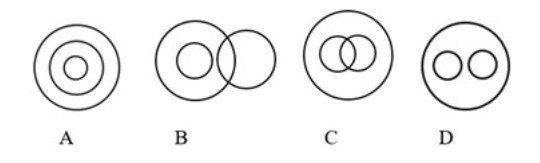
To solve this question, we need to understand the hierarchical relationship between the classes: Peacock, Sparrow, and Bird. Both peacocks and sparrows are types of birds, so they should be represented as subsets within the larger set of birds.
Correct Option: C) The diagram shows two circles within a larger circle, representing peacocks and sparrows as subsets of birds.
The question asks about the number of schedules in the Wild Life (Protection) Act, 1972, as it stood in 2021. It's important to note the specific year mentioned, as the Act has undergone amendments.
Correct Option: D) VI
The problem asks for the value of \(A + B\) given that \(A\) and \(B\) are acute angles and \(\tan A = \cot B\). We will use the trigonometric identity that relates tangent and cotangent of complementary angles.
We are given the equation:
\[ \tan A = \cot B \]Recall the trigonometric identity for complementary angles, which states that \(\cot \theta = \tan (90^\circ - \theta)\). Using this identity, we can rewrite \(\cot B\) as \(\tan (90^\circ - B)\).
Substitute this into the given equation:
\[ \tan A = \tan (90^\circ - B) \]Since \(A\) and \(B\) are acute angles, \(A\) must be equal to \(90^\circ - B\). If \(\tan X = \tan Y\) and \(X, Y\) are acute, then \(X = Y\).
\[ A = 90^\circ - B \]Rearrange the equation to solve for \(A + B\):
\[ A + B = 90^\circ \]Since \(A\) and \(B\) are acute angles (i.e., \(0^\circ < A < 90^\circ\) and \(0^\circ < B < 90^\circ\)), their sum \(A+B\) must be between \(0^\circ\) and \(180^\circ\). Our result \(A+B = 90^\circ\) falls within this range and is consistent with the conditions.
Correct Option: A) 90° is the correct value for \(A + B\).
This problem involves calculating the rate of simple interest. We are given that a sum of money doubles itself in a certain number of years. We can use the simple interest formula to find the rate.
A) 10% is the correct answer. The calculation shows that for the principal to double in 10 years under simple interest, the annual rate must be 10%.
The question asks to identify the specific award instituted by the Government of India for individuals or communities from rural areas who demonstrate extraordinary courage and dedication in protecting wildlife. This requires knowledge of various environmental and wildlife conservation awards in India.
Correct Option: C) The Amrita Devi Bishnoi Award is instituted by the Government of India for individuals or communities from rural areas who have shown extraordinary courage and dedication in protecting wildlife. It was established in memory of Amrita Devi Bishnoi, who along with 362 other Bishnois, sacrificed her life in 1730 while trying to protect trees in Khejarli, Rajasthan. This award specifically recognizes contributions to wildlife protection.
To find the ratio \(a:d\) from a series of given ratios \(a:b\), \(b:c\), and \(c:d\), we can multiply these ratios. This method allows us to cancel out the intermediate terms (b and c) and directly obtain the ratio between the first and the last term.
Write down the given ratios in fractional form:
\[ \frac{a}{b} = \frac{2}{5} \] \[ \frac{b}{c} = \frac{5}{8} \] \[ \frac{c}{d} = \frac{8}{11} \]To find \(a:d\), multiply these fractions:
\[ \frac{a}{d} = \frac{a}{b} \times \frac{b}{c} \times \frac{c}{d} \]Substitute the given values into the equation:
\[ \frac{a}{d} = \frac{2}{5} \times \frac{5}{8} \times \frac{8}{11} \]Cancel out the common terms in the numerator and denominator:
The '5' in the denominator of the first fraction cancels with the '5' in the numerator of the second fraction.
The '8' in the denominator of the second fraction cancels with the '8' in the numerator of the third fraction.
\[ \frac{a}{d} = \frac{2}{\cancel{5}} \times \frac{\cancel{5}}{\cancel{8}} \times \frac{\cancel{8}}{11} \]Perform the multiplication with the remaining terms:
\[ \frac{a}{d} = \frac{2}{11} \]Express the result as a ratio:
\(a:d = 2:11\)
Correct Option: C) 2 : 11
This is an alternating series problem. We need to identify two separate patterns within the given sequence of numbers.
The given series is: 3, 6, 5, 12, ?, 24, 11, 48, 13
Let's separate the numbers into two sub-series:
The numbers are 3, 5, ?, 11, 13.
Observe the pattern:
This is an arithmetic progression where each term is obtained by adding 2 to the previous term.
So, to find the missing term, we add 2 to 5:
\[ 5 + 2 = 7 \]The numbers are 6, 12, 24, 48.
Observe the pattern:
This is a geometric progression where each term is obtained by multiplying the previous term by 2.
This confirms the patterns for both series are consistent.
The question mark (?) is in the 5th position, which belongs to Series 1 (Odd positions).
Based on the pattern for Series 1, the number replacing '?' is 7.
B) 7 is the correct answer because it fits the arithmetic progression of the alternating series at odd positions (3, 5, 7, 11, 13).