
The number 0.̄\(\overline{13}\) in the form of \( \frac{p}{q} \) is equal to:
\( \frac{99}{13} \)
\( \frac{39}{99} \)
\( \frac{13}{99} \)
\( \frac{31}{99} \)
To convert a repeating decimal (a number with a bar over some digits) into a fraction in the form of \( \frac{p}{q} \), we use an algebraic method. We set the given decimal equal to a variable, multiply it by a power of 10 to shift the repeating part, and then subtract the original equation to eliminate the repeating digits.
Let the given number be \( x \):
\[ x = 0.\overline{13} \]This means \( x = 0.131313... \)
Since two digits are repeating (13), we multiply both sides of the equation by \( 10^2 = 100 \):
\[ 100x = 100 \times 0.131313... \] \[ 100x = 13.131313... \]Now, subtract the original equation (Step 1) from this new equation (Step 2):
\[ 100x - x = 13.131313... - 0.131313... \] \[ 99x = 13 \]Solve for \( x \) by dividing both sides by 99:
\[ x = \frac{13}{99} \]C) \( \frac{13}{99} \) is the correct representation of \( 0.\overline{13} \) in the form \( \frac{p}{q} \).
The question asks to identify which of the given IITs has been recognized as an "Eat Right Campus" by the Food Safety and Standards Authority of India (FSSAI). This is a factual question related to current affairs and public health initiatives.
Correct Option: D) IIT Gandhinagar was declared one of the seven "Eat Right Campuses" by the FSSAI in 2020. This recognition is part of FSSAI's "Eat Right India" movement, which aims to promote safe, healthy, and sustainable food practices in various institutions, including campuses.
The question asks about the predominant soil type found in the Deccan Plateau region of India. This is a factual question related to Indian geography and soil types. We need to recall the characteristics and distribution of major soil types in India.
Correct Option: C) Black soil is predominantly found in the Deccan Plateau region. It is formed from the weathering of basaltic rocks, which are abundant in this area due to ancient volcanic activity. This soil is also known as Regur soil and is highly fertile, especially for cotton cultivation.
The product of two positive numbers is 972 and their quotient is \( \frac{4}{3} \). The numbers are:
We are given two conditions about two positive numbers: their product and their quotient. We can set up a system of two equations with two variables and solve for the numbers. Alternatively, we can test the given options to see which pair satisfies both conditions.
The product of the two numbers is 972:
\[ x \times y = 972 \quad \text{(Equation 1)} \]Their quotient is \( \frac{4}{3} \). Let's assume \[\frac{x}{y} = \frac{4}{3}\]:
\[ \frac{x}{y} = \frac{4}{3} \quad \text{(Equation 2)} \]From Equation 2, we can express \(x\) in terms of \(y\):
\[ x = \frac{4}{3}y \]Substitute this expression for \(x\) into Equation 1:
\[ \left(\frac{4}{3}y\right) \times y = 972 \]\[ \frac{4}{3}y^2 = 972 \]Multiply both sides by \( \frac{3}{4} \):
\[ y^2 = 972 \times \frac{3}{4} \]\[ y^2 = 243 \times 3 \]\[ y^2 = 729 \]Take the square root of both sides. Since the numbers are positive, we take the positive root:
\[ y = \sqrt{729} \]\[ y = 27 \]Now substitute the value of \(y\) back into the expression for \(x\):
\[ x = \frac{4}{3} \times 27 \]\[ x = 4 \times 9 \]\[ x = 36 \]So, the two numbers are 36 and 27.
Product: \( 36 \times 27 = 972 \) (Correct)
Quotient: \[\frac{36}{27} = \frac{4 \times 9}{3 \times 9} = \frac{4}{3}\] (Correct)
The question asks to identify the dynasty to which Rudra Deva, the builder of the Rudreswara Temple (Thousand Pillar Temple), belonged. This requires knowledge of medieval Indian history, specifically the dynasties that ruled in the Deccan region and their architectural contributions.
Based on this information, Rudra Deva belonged to the Kakatiya dynasty.
Correct Option: C) Kakatiya
The question asks to identify the Navratna company commonly known as 'Vizag Steel'. This requires knowledge of major steel plants in India and their popular names or operating entities.
B) Rashtriya Ispat Nigam Limited is the company that operates the Visakhapatnam Steel Plant, which is popularly known as 'Vizag Steel'. It is a Navratna Public Sector Undertaking under the Ministry of Steel.
The question asks to identify the vitamin crucial for activating proteins and calcium involved in blood clotting. This requires knowledge of the specific functions of various vitamins in the human body, particularly their roles in coagulation.
A) Vitamin K is essential for the synthesis of several blood clotting factors (prothrombin, factors VII, IX, and X) in the liver. It acts as a coenzyme for the carboxylation of specific glutamic acid residues on these proteins, which allows them to bind calcium ions. This calcium binding is critical for the activation of these clotting factors, making Vitamin K indispensable for proper blood coagulation.
Select the Venn diagram that best represents the relationship between the following classes.
Trousers, Garments, Shirts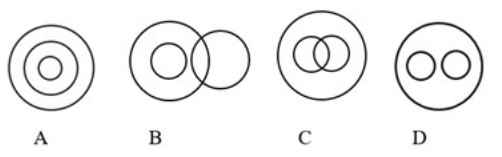
To determine the correct Venn diagram representing the relationship between the classes "Trousers," "Garments," and "Shirts," we need to understand how these categories relate to each other.
In the diagrams provided, Option B correctly illustrates this relationship, with two non-overlapping circles inside a larger circle.
Correct Option: B) The diagram shows two separate circles within a larger circle, representing "Trousers" and "Shirts" as distinct subsets of "Garments."
The problem presents a series of letters and asks us to find the next letter in the sequence. To solve this, we need to identify the pattern or rule governing the series. We can do this by assigning numerical positions to each letter in the alphabet and then looking for relationships between these numbers.
C) E is the correct answer because the series follows an alternating pattern where each sub-series increases by two alphabetical positions. The second sub-series is A (1), C (3), and the next term would be \(3+2=5\), which corresponds to the letter E.