
To find the minimum number of rows, we need to maximize the number of trees in each row. Since each row must contain the same number of trees of only one variety, the number of trees in each row must be a common divisor of the total number of mango, apple, and orange trees. To maximize this number, we need to find the Highest Common Factor (HCF) or Greatest Common Divisor (GCD) of the given numbers of trees.
Identify the given quantities:
Determine the number of trees per row: Since each row must have the same number of trees of one variety, and we want the minimum number of rows, we must maximize the number of trees in each row. This maximum number will be the HCF of 24, 56, and 72.
Calculate the HCF of 24, 56, and 72: First, find the prime factorization of each number:
The HCF is the product of the lowest powers of the common prime factors. The only common prime factor is 2, and its lowest power is \(2^3\).
\[ \text{HCF}(24, 56, 72) = 2^3 = 8 \]So, 8 trees will be planted in each row.
Calculate the number of rows for each type of tree:
Calculate the total minimum number of rows: Add the number of rows for each type of tree:
\[ \text{Total rows} = 3 + 7 + 9 = 19 \]A) 19 is the correct answer. By planting 8 trees of a single variety in each row, we achieve the minimum total number of rows, which is 19.
The question asks to identify the founder of the Muhammadan Anglo-Oriental College, which later evolved into Aligarh Muslim University. This requires knowledge of key figures in Indian educational history, particularly those associated with Muslim reform movements in the 19th century.
A) Syed Ahmed Khan founded the Muhammadan Anglo-Oriental College in 1875. His efforts were instrumental in promoting modern education among Muslims in British India, and the college eventually transformed into the prestigious Aligarh Muslim University.
We are given the sum of two numbers and their Highest Common Factor (HCF). We need to find the number of pairs of such numbers. We can represent the two numbers using their HCF and two co-prime factors. Then, we can use the given sum to find the relationship between these co-prime factors and count the possible pairs.
where \(x\) and \(y\) are co-prime integers (i.e., their HCF is 1).
Substitute the expressions for \(a\) and \(b\):
\[ 16x + 16y = 288 \]Factor out 16:
\[ 16(x + y) = 288 \]Divide by 16 to find the sum of \(x\) and \(y\):
\[ x + y = \frac{288}{16} \]\[ x + y = 18 \]We stop at \((9, 9)\) because the pairs would just be reversed afterwards (e.g., \((10, 8)\) is the same as \((8, 10)\) for forming the numbers).
A) 3 is the correct option because we found 3 pairs of co-prime integers \((x, y)\) whose sum is 18, which in turn correspond to 3 pairs of numbers whose sum is 288 and HCF is 16.
Observe the figure given and answer the question below. 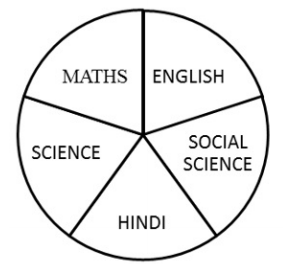
If the total number of students is 120, and the number of students is distributed equally across all the subjects, how many students study languages?
The question requires determining the number of students studying languages from a total student population distributed equally across different subjects.
Correct Option: D) 48
The question asks to identify the body responsible for recommending Minimum Support Price (MSP) for crops in India. This requires knowledge of various governmental and quasi-governmental organizations involved in agricultural policy.
Correct Option: D) CACP is the correct answer. The Commission for Agricultural Costs and Prices (CACP) is responsible for recommending Minimum Support Prices (MSPs) for various agricultural commodities to the Government of India.
The question asks about the term length for non-permanent members of the UN Security Council. This is a factual question related to the structure and functioning of the United Nations, a common topic in competitive exams.
Therefore, the correct term for non-permanent members is 2 years.
B) 2 years is the correct term for non-permanent members of the UN Security Council.
This is an analogy question where we need to find the relationship between the first pair of words and apply the same relationship to the second pair. The relationship is cause and effect.
D) Health — Exercise is an activity that promotes or leads to good health. Just as a virus causes disease, exercise causes or results in health.
The question asks for the formation date of the Gandhi Smriti and Darshan Samiti (GSDS). This requires knowledge of specific historical facts related to the organization's establishment.
C) September 1984 — The Gandhi Smriti and Darshan Samiti (GSDS) was indeed formed in September 1984 as an autonomous body by the Government of India.
The question asks for the southernmost tip of Indian territory. This requires distinguishing between the southernmost point of the Indian mainland and the southernmost point of the entire Indian territory, which includes its islands.
D) Indira Point is the southernmost tip of Indian territory, located in the Great Nicobar Island of the Andaman and Nicobar Islands.
The question asks about the year when Section 3 of the Official Languages Act came into force, which continued the use of English for official purposes of the Union. This requires knowledge of the specific date of implementation of this significant legislative act in India's official language policy.
Correct Option: B) 1965. Section 3 of the Official Languages Act, 1963, which allowed for the continued use of English for official purposes of the Union, came into force on January 26, 1965.