
This problem involves work and time, where the total work done is constant. We can set up equations based on the given information, representing the daily work done by a man and a boy as variables. By solving these simultaneous equations, we can find the ratio of their daily work rates.
Let \(M\) be the amount of work a man can do in one day, and \(B\) be the amount of work a boy can do in one day.
The total work done is constant. The formula for total work is: \(\text{Total Work} = \text{Number of people} \times \text{Daily work per person} \times \text{Number of days}\).
From the first statement: 20 men and 15 boys can do a piece of work in 10 days.
\[ (20M + 15B) \times 10 = \text{Total Work} \quad \text{(Equation 1)} \]From the second statement: 25 men and 10 boys can do it in 9 days.
\[ (25M + 10B) \times 9 = \text{Total Work} \quad \text{(Equation 2)} \]Since the total work is the same in both cases, we can equate Equation 1 and Equation 2:
\[ (20M + 15B) \times 10 = (25M + 10B) \times 9 \]Expand both sides of the equation:
\[ 200M + 150B = 225M + 90B \]Rearrange the terms to group \(M\) and \(B\) together:
\[ 150B - 90B = 225M - 200M \]\[ 60B = 25M \]Now, find the ratio of the daily work done by a man to that of a boy, which is \(M : B\) or \(\frac{M}{B}\):
\[ \frac{M}{B} = \frac{60}{25} \]Simplify the ratio by dividing both the numerator and the denominator by their greatest common divisor, which is 5:
\[ \frac{M}{B} = \frac{60 \div 5}{25 \div 5} = \frac{12}{5} \]So, the ratio of the daily work done by a man to that of a boy is \(12 : 5\).
Correct Option: C) 12 : 5
To find the youngest person, we need to establish the relative ages of all individuals based on the given statements. We will use inequalities to represent the age relationships and then combine them to determine the overall order.
Correct Option: A) A is the youngest person as per the derived age order \(E > D > C > B > A\).
Observe the table and answer the question below.
The table gives the pass percentage of class X students of five government schools in Delhi on the basis of gender.
| School | Pass Percentage |
Ratio of boys and girls |
| A | 35 | 5:6 |
| B | 32 | 3:5 |
| C | 24 | 1:2 |
| D | 19 | 3:2 |
| E | 15 | 5:3 |
What is the ratio of the pass percentage of boys of school B to the pass percentage of boys of school C?
The question states that David sells a car for ₹1,20,000 at a profit of 20%. We need to calculate the original cost price of the car and then determine its new selling price if the profit increases to 30%.
Identify the given information:
Recall the selling price formula:
When an article is sold at a profit:
\[ SP=CP\times\frac{100+R}{100} \]Where:
Rearranging to find the cost price:
\[ CP=\frac{SP\times100}{100+R} \]Calculate the cost price of the car:
The car was sold for ₹1,20,000 at a profit of 20%.
\[ CP=\frac{120000\times100}{100+20} \] \[ =\frac{120000\times100}{120} \] \[ =100000 \]Therefore, the cost price of the car is ₹1,00,000.
Calculate the selling price at 30% profit:
The new selling price must provide a profit of 30% on the cost price of ₹1,00,000.
\[ SP=CP\times\frac{100+30}{100} \]Substituting the cost price:
\[ SP=100000\times\frac{130}{100} \] \[ SP=130000 \]Therefore, the new selling price is ₹1,30,000.
Correct Option: D) ₹1,30,000 — The original selling price of ₹1,20,000 includes a profit of 20%, so the cost price is:
\[ CP=\frac{120000\times100}{120}=100000 \]
At a profit of 30%, the new selling price is:
\[ SP=100000\times\frac{130}{100}=130000 \]
Hence, Option D is the correct answer.
A) ₹1,35,000: This is incorrect because selling the car for ₹1,35,000 would result in a profit of 35% on the cost price of ₹1,00,000, not 30%.
B) ₹1,25,000: This is incorrect because selling the car for ₹1,25,000 would result in a profit of 25%, not 30%.
C) ₹1,40,000: This is incorrect because selling the car for ₹1,40,000 would result in a profit of 40%, not 30%.
The problem involves the concept of volume displacement. When lead spheres are dropped into a cylindrical beaker, the volume of water displaced is equal to the total volume of the spheres submerged. This displaced water causes the water level to rise. We can equate the volume of the raised water in the cylinder to the total volume of the lead spheres to find the number of spheres.
The formula for the volume of a sphere is \(V_s = \frac{4}{3}\pi r_s^3\).
\[ V_s = \frac{4}{3} \pi (3 \text{ cm})^3 = \frac{4}{3} \pi (27 \text{ cm}^3) = 36\pi \text{ cm}^3 \]The volume of water that has risen is in the shape of a cylinder. The formula for the volume of a cylinder is \(V_w = \pi r_b^2 h\).
\[ V_w = \pi (4.5 \text{ cm})^2 (32 \text{ cm}) = \pi (20.25 \text{ cm}^2) (32 \text{ cm}) = 648\pi \text{ cm}^3 \]Let \(N\) be the number of lead spheres dropped. The total volume of \(N\) spheres is \(N \times V_s\). This total volume is equal to the volume of the raised water, \(V_w\).
\[ N \times V_s = V_w \]\[ N \times 36\pi \text{ cm}^3 = 648\pi \text{ cm}^3 \]A) 18 is the correct number of lead spheres dropped into the beaker.
The question asks to identify the type of satellite GSAT-31. This requires knowledge of ISRO's satellite series and their primary functions.
GSAT (Geosynchronous Satellite) series satellites are primarily designed and launched by the Indian Space Research Organisation (ISRO) for communication purposes. These satellites are placed in geostationary or geosynchronous orbits, which allows them to remain over a fixed point on the Earth's surface, making them ideal for continuous communication services. GSAT-31, launched in February 2019, is a high-throughput communication satellite providing Ku-band transponders for various communication applications.
Correct Option: C) Telecommunication Satellite
The question asks for the location of India's newest High Court as of November 2020. This requires knowledge of recent judicial developments and the establishment of new High Courts in India.
Correct Option: A) Amaravati is the correct answer. The High Court of Andhra Pradesh, established in Amaravati, was inaugurated on January 1, 2019, making it India's newest High Court as of November 2020.
Study the given pattern carefully and select the number from among the given options that can replace the question mark (?).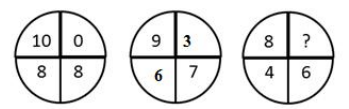
The problem involves identifying a pattern in a series of segmented circles, each divided into four quadrants with numbers. Our task is to determine the number that should replace the question mark in the third circle.
Correct Option: B) 6
The question asks for the full form of the acronym ISP in the context of the telecom field. This is a common acronym related to internet services.
An Internet Service Provider (ISP) is a company that provides internet access to customers. They offer various services like internet connectivity, email, web hosting, and other related services.
D) Internet Service Provider — This is the correct and universally accepted full form of ISP. An Internet Service Provider is an organization that provides services for accessing, using, or participating in the Internet.
To simplify the given expression, we must follow the order of operations, often remembered by the acronym PEMDAS/BODMAS. This stands for Parentheses/Brackets, Exponents/Orders, Multiplication and Division (from left to right), and Addition and Subtraction (from left to right).
The given expression is:
\[ 15 - 6.3 \div 7 + 3 \times 1.3 - 2 \]First, perform division:
\[ 6.3 \div 7 = 0.9 \]Substitute this value back into the expression:
\[ 15 - 0.9 + 3 \times 1.3 - 2 \]Next, perform multiplication:
\[ 3 \times 1.3 = 3.9 \]Substitute this value back into the expression:
\[ 15 - 0.9 + 3.9 - 2 \]Now, perform addition and subtraction from left to right:
First, \(15 - 0.9\):
\[ 15 - 0.9 = 14.1 \]Next, \(14.1 + 3.9\):
\[ 14.1 + 3.9 = 18 \]Finally, \(18 - 2\):
\[ 18 - 2 = 16 \]The simplified value of the expression is \(16\).
C) 16 — Following the order of operations (BODMAS/PEMDAS), division and multiplication are performed before addition and subtraction, leading to the result of 16.