
The problem asks us to find an original amount given a series of percentage reductions that result in a final value. We can set up an equation where the unknown amount is represented by a variable, and then solve for that variable by converting percentages to fractions or decimals.
So, the original amount is ₹5,625.
Correct Option: C) 5,625
This question tests knowledge of the Fundamental Rights enshrined in the Indian Constitution, specifically the articles related to the Right to Equality. We need to identify the article that deals with the abolition of titles.
Correct Option: B) Article 18 ensures the abolition of titles, prohibiting the State from conferring titles (except military and academic distinctions) and restricting citizens from accepting titles from foreign states.
Study the given pattern carefully and select the numbers from among the options that can replace the question marks (?).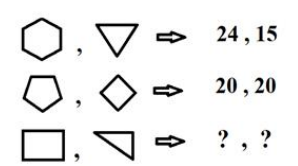
To solve this pattern-based question, we need to identify the relationship between the shapes and the numbers provided. Each pair of shapes corresponds to a pair of numbers, and we must determine the rule applied to find the missing numbers for the last pair of shapes.
Correct Option: A) 16, 15
The possible value of x in the equation\(\sqrt{\frac{x}{1-x}}+\sqrt{\frac{1-x}{x}}\)= \( \frac{25}{12} \) is:
\( \frac{8}{25} \) or \( \frac{17}{25} \)
\( \frac{9}{25} \) or \( \frac{16}{25} \)
\( \frac{19}{25} \) or \( \frac{6}{25} \)
\( \frac{12}{25} \) or \( \frac{13}{25} \)
To solve the given equation, we will use a substitution method to simplify the expression involving square roots. Let one of the square root terms be a variable, which will transform the equation into a quadratic form. We will then solve the quadratic equation for the substituted variable and back-substitute to find the values of \(x\).
The given equation is:
\[ \sqrt{\frac{x}{1-x}} + \sqrt{\frac{1-x}{x}} = \frac{25}{12} \]Let \(y = \sqrt{\frac{x}{1-x}}\). Then, \[\sqrt{\frac{1-x}{x}} = \frac{1}{y}\].
Substitute these into the equation:
\[ y + \frac{1}{y} = \frac{25}{12} \]Multiply the entire equation by \(12y\) to eliminate the denominators:
\[ 12y^2 + 12 = 25y \]Rearrange the terms to form a standard quadratic equation:
\[ 12y^2 - 25y + 12 = 0 \]Solve the quadratic equation using factorization or the quadratic formula. We will use factorization by splitting the middle term:
\[ 12y^2 - 16y - 9y + 12 = 0 \]\[ 4y(3y - 4) - 3(3y - 4) = 0 \]\[ (4y - 3)(3y - 4) = 0 \]This gives two possible values for \(y\):
\[ 4y - 3 = 0 \implies y = \frac{3}{4} \]\[ 3y - 4 = 0 \implies y = \frac{4}{3} \]Now, substitute back \(y = \sqrt{\frac{x}{1-x}}\) for each value of \(y\).
Case 1: \(y = \frac{3}{4}\)
\[ \sqrt{\frac{x}{1-x}} = \frac{3}{4} \]\[ \frac{x}{1-x} = \left(\frac{3}{4}\right)^2 \]\[ \frac{x}{1-x} = \frac{9}{16} \]\[ 16x = 9(1-x) \]\[ 16x = 9 - 9x \]\[ 16x + 9x = 9 \]\[ 25x = 9 \]\[ x = \frac{9}{25} \]Case 2: \(y = \frac{4}{3}\)
\[ \sqrt{\frac{x}{1-x}} = \frac{4}{3} \]\[ \frac{x}{1-x} = \left(\frac{4}{3}\right)^2 \]\[ \frac{x}{1-x} = \frac{16}{9} \]\[ 9x = 16(1-x) \]\[ 9x = 16 - 16x \]\[ 9x + 16x = 16 \]\[ 25x = 16 \]\[ x = \frac{16}{25} \]Thus, the possible values for \(x\) are \( \frac{9}{25} \) or \( \frac{16}{25} \).
B) \( \frac{9}{25} \) or \( \frac{16}{25} \)
The problem asks us to find an option where the relationship between the two terms is the same as the relationship between 'DMO' and 'WNL'. This is a letter analogy problem, which typically involves identifying a pattern based on alphabetical positions, reverse alphabetical order, or a specific shift in letters.
The question asks about the deficiency of which nutrient causes colour blindness and poor vision. We need to identify the vitamin or mineral directly associated with these eye conditions.
Vitamin A is crucial for good vision, especially in low light, and for maintaining the health of the cornea and retina. Retinal, a derivative of Vitamin A, combines with opsin to form rhodopsin, the light-sensitive pigment in rod cells responsible for vision in dim light. Deficiency of Vitamin A can lead to night blindness (poor vision in low light) and, in severe cases, xerophthalmia, which can cause permanent blindness. While true congenital colour blindness is genetic, Vitamin A deficiency can impair the function of cone cells (responsible for colour vision) to some extent, leading to altered colour perception or making existing colour vision deficiencies worse. Therefore, its deficiency directly impacts vision, including aspects of colour perception and overall visual acuity.
The question asks for the headquarters location of the International Monetary Fund (IMF) and the World Bank, both of which were established in 1944. This is a factual question related to international organizations and their geographical presence.
Correct Option: C) Washington DC
The headquarters of both the International Monetary Fund (IMF) and the World Bank Group are located in Washington D.C., USA. They were established at the Bretton Woods Conference in 1944.
The question asks about the representation of provinces in the Constituent Assembly of India as on December 31, 1947. This date is significant because it is after the partition of India, which occurred on August 15, 1947. Therefore, the composition of the Constituent Assembly changed after partition, with members from territories that became Pakistan no longer being part of the Indian Constituent Assembly. We need to recall the strength of each province in the Constituent Assembly post-partition.
Correct Option: C) United Provinces had 55 members in the Constituent Assembly as on December 31, 1947, which was the highest among the listed provinces.
The problem presents a series of alphanumeric terms. We need to identify the term that does not fit the pattern established by the others. This involves analyzing both the alphabetical and numerical components of each term to find a consistent rule.
Let's convert each letter to its corresponding position in the English alphabet (A=1, B=2, ..., Z=26).
Now, let's find the difference between consecutive letters:
The alphabetical difference is consistently 5, except for the step from P to T (difference 4) and T to Z (difference 6). This suggests that the letter 'T' might be the anomaly, or the pattern might be more complex.
Let's examine the numbers: 5, 11, 24, 51, 105, 217.
Let's try to find a relationship between consecutive numbers, often involving multiplication and addition/subtraction.
Let's re-evaluate the numerical pattern assuming the first few terms establish the rule: \(\times 2 + n\), where \(n\) increments by 1.
This shows that the number 105 in 'T105' is incorrect. It should be 106 to follow the pattern.
The alphabetical sequence has a consistent difference of +5 between letters, except for T. The numerical sequence follows the pattern \((N \times 2) + \text{increment}\), where the increment increases by 1 for each step. The number 105 in 'T105' breaks this numerical pattern.
Let's check if 'T' itself is also an anomaly in the alphabetical sequence if we assume the number 105 is the error. If the number was 106, the term would be T106. The letter 'T' is at position 20. P is at 16. \(20 - 16 = 4\). This is still not +5. So, both the letter and the number in 'T105' seem to be problematic if we assume a strict +5 for letters and the \(\times 2 + n\) for numbers.
However, in such series questions, usually, one component (either letter or number) is the primary pattern, and the other is secondary, or one term is entirely off. The numerical pattern \((N \times 2) + \text{increment}\) is very clear for the first four terms and then for the last term if the fifth term is corrected. The alphabetical pattern is also consistent for the first four terms.
Let's assume the numerical pattern is the primary one and identify the term that violates it. The term 'T105' has 105, but it should be 106 based on the rule. If it were T106, the next term Z217 would fit perfectly: \(106 \times 2 + 5 = 212 + 5 = 217\).
Therefore, the term 'T105' is the one that does NOT belong to the series due to its numerical component.
C) T105 — The numerical part of this term, 105, does not follow the established pattern. The pattern for the numbers is \((\text{previous number} \times 2) + \text{increment}\), where the increment starts at 1 and increases by 1 for each subsequent term. Following this, the number after 51 should be \(51 \times 2 + 4 = 102 + 4 = 106\), not 105. If it were 106, the next term 217 would follow the pattern \(106 \times 2 + 5 = 217\).
NITI Aayog was constituted on ______.
1st January 2015
1st April 2014
1st September 2015
1st April 2016
The question asks for the constitution date of NITI Aayog. This is a factual question related to Indian governance and policy-making bodies. Recalling the historical context of its formation will help identify the correct date.
Correct Option: A) 1st January 2015