
Study the given pattern carefully and select the number from among the given options that can replace the question mark (?).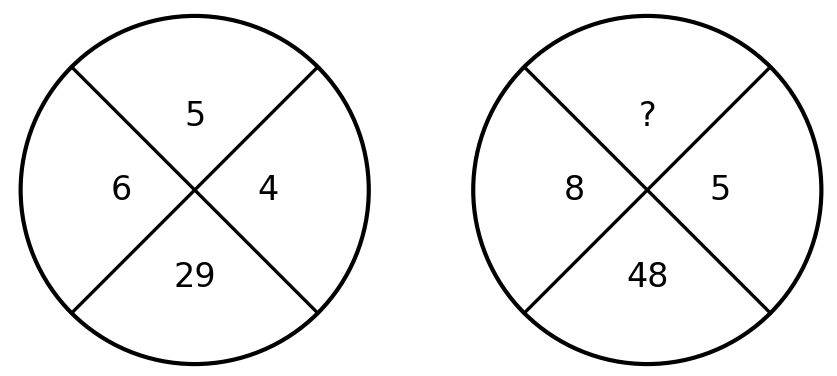
To solve this pattern-based problem, we need to identify the relationship between the numbers in the quadrants of the circles. The goal is to find the missing number that fits the same pattern.
Correct Option: B) 8
To find the cost of fencing a square plot, we first need to determine the length of its side from the given area. Once the side length is known, we can calculate the perimeter of the square, which represents the total length of fencing required. Finally, we multiply the perimeter by the cost per metre to get the total fencing cost.
Correct Option: D) ₹35,700 is the calculated total cost of fencing the square plot.
The question asks for the system that translates numerical IP addresses into human-readable, easy-to-remember names. This is a fundamental concept in networking and internet infrastructure.
C) Domain name system — This is the correct term for the distributed naming system that translates human-readable domain names into numerical IP addresses, making the internet easier to use.
From the given diagram, find which number represents the following:
Boys are good at sports but not dance.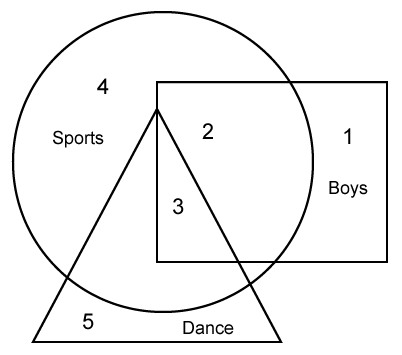
To solve this problem, we need to identify the section of the diagram that represents boys who are good at sports but not involved in dance. The diagram consists of a circle, a triangle, and a rectangle representing sports, dance, and boys, respectively.
Correct Option: D) 2
The question asks to identify which of the given 'ashrams' was NOT established by Mahatma Gandhi. To answer this, we need to recall the ashrams founded by Mahatma Gandhi and compare them with the options provided.
Correct Option: A) Paunar was established by Acharya Vinoba Bhave, not Mahatma Gandhi.
The question asks for the animal whose scientific name is Rana Tigrina. This requires knowledge of common scientific names of animals, particularly those that might be relevant to general knowledge or biology sections of competitive exams.
Correct Option: D) Asian Frog
Rana Tigrina is the scientific name for the Indian Bullfrog, which is a large species of frog found in mainland Asia. It is also sometimes referred to as the Asian Bullfrog. The genus Rana is a large genus of frogs, and Tigrina refers to its striped or spotted appearance.
The question asks for the chemical symbol of Lead. This requires knowledge of common chemical elements and their corresponding symbols, which are often derived from their Latin names.
The element Lead has the chemical symbol 'Pb'. This symbol comes from its Latin name, Plumbum.
A) Pb — 'Pb' is the correct chemical symbol for Lead, derived from its Latin name Plumbum.
This question tests basic knowledge about the properties of magnets and the Earth's magnetic field. A freely suspended magnet acts as a compass, aligning itself with the Earth's magnetic field lines.
Correct Option: C) north - south
To find the area of a rhombus, we need the lengths of both its diagonals. We are given the perimeter and one diagonal. We can use the perimeter to find the side length of the rhombus. Then, using the property that diagonals of a rhombus bisect each other at right angles, we can form a right-angled triangle and use the Pythagorean theorem to find half the length of the second diagonal.
Find the side length of the rhombus:
A rhombus has four equal sides. The perimeter of a rhombus is given by \(P = 4a\), where \(a\) is the side length.
\[ 116 \text{ cm} = 4a \]\[ a = \frac{116}{4} \text{ cm} \]\[ a = 29 \text{ cm} \]Find half the length of the given diagonal:
Let the given diagonal be \(d_1 = 42 \text{ cm}\). The diagonals of a rhombus bisect each other. So, half of this diagonal is:
\[ \frac{d_1}{2} = \frac{42}{2} \text{ cm} = 21 \text{ cm} \]Find half the length of the second diagonal:
The diagonals of a rhombus bisect each other at right angles. This means that half of each diagonal and one side of the rhombus form a right-angled triangle. Let the other diagonal be \(d_2\).
Using the Pythagorean theorem, where \(a\) is the hypotenuse:
\[ a^2 = \left(\frac{d_1}{2}\right)^2 + \left(\frac{d_2}{2}\right)^2 \]\[ (29)^2 = (21)^2 + \left(\frac{d_2}{2}\right)^2 \]\[ 841 = 441 + \left(\frac{d_2}{2}\right)^2 \]\[ \left(\frac{d_2}{2}\right)^2 = 841 - 441 \]\[ \left(\frac{d_2}{2}\right)^2 = 400 \]\[ \frac{d_2}{2} = \sqrt{400} \]\[ \frac{d_2}{2} = 20 \text{ cm} \]Find the length of the second diagonal:
Since half of the second diagonal is \(20 \text{ cm}\), the full length of the second diagonal is:
\[ d_2 = 2 \times 20 \text{ cm} = 40 \text{ cm} \]Calculate the area of the rhombus:
The area of a rhombus is given by the formula \(A = \frac{1}{2} d_1 d_2\).
\[ A = \frac{1}{2} \times 42 \text{ cm} \times 40 \text{ cm} \]\[ A = 21 \text{ cm} \times 40 \text{ cm} \]\[ A = 840 \text{ cm}^2 \]Correct Option: B) 840 cm²
Select the Venn diagram from among the given options that best represents the relationship between the following classes.
Human being, Father, Man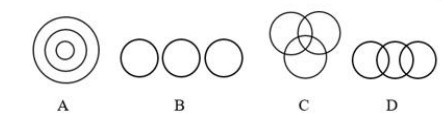
To determine the best Venn diagram representing the relationship between Human being, Father, and Man, we need to understand how these categories overlap. A father is a subset of man, and a man is a subset of human being.
Correct Option: B) Diagram A