
The question asks to identify the organization in Hyderabad responsible for specific remote sensing activities, including data acquisition, processing, dissemination, aerial remote sensing, and disaster management support. This requires knowledge of the functions and locations of key Indian space and IT organizations.
Correct Option: C) National Remote Sensing Centre (NRSC)
The National Remote Sensing Centre (NRSC), located in Hyderabad, is a vital center under the Indian Space Research Organisation (ISRO). Its mandate includes receiving, processing, and disseminating data from remote sensing satellites, conducting aerial remote sensing surveys, and providing geospatial solutions for various applications, including disaster management support.
The question asks to identify the plant group characterized by bearing "naked seeds". This refers to seeds that are not enclosed within an ovary or fruit. We need to recall the defining characteristics of each plant group listed in the options.
B) Gymnosperms are characterized by their naked seeds, meaning the seeds are not enclosed within an ovary or fruit. Examples include conifers like pines and spruces.
To calculate the percentage of profit, we first need to find the absolute profit by subtracting the cost price from the selling price. Then, we divide the profit by the cost price and multiply by 100 to express it as a percentage.
Identify the given values:
Calculate the Profit:
Profit is the difference between the Selling Price and the Cost Price.
\[ \text{Profit} = \text{SP} - \text{CP} \] \[ \text{Profit} = \text{₹}3,600 - \text{₹}3,000 \] \[ \text{Profit} = \text{₹}600 \]Calculate the Percentage of Profit:
The percentage of profit is calculated by dividing the profit by the cost price and multiplying by 100.
\[ \text{Percentage of Profit} = \left( \frac{\text{Profit}}{\text{CP}} \right) \times 100 \] \[ \text{Percentage of Profit} = \left( \frac{\text{₹}600}{\text{₹}3,000} \right) \times 100 \] \[ \text{Percentage of Profit} = \left( \frac{6}{30} \right) \times 100 \] \[ \text{Percentage of Profit} = \left( \frac{1}{5} \right) \times 100 \] \[ \text{Percentage of Profit} = 0.2 \times 100 \] \[ \text{Percentage of Profit} = 20\% \]Correct Option: C) 20 %
For a system of two linear equations in two variables to have infinite solutions, the lines represented by the equations must be coincident. This means that the ratios of the corresponding coefficients and the constant terms must be equal. We will apply this condition to the given system of equations to find the values of 'a' and 'b'.
Write down the given system of linear equations in the standard form \(A_1x + B_1y = C_1\) and \(A_2x + B_2y = C_2\).
Equation 1: \(2x - (a - 4)y = 2b + 1\)
Here, \(A_1 = 2\), \(B_1 = -(a - 4)\), \(C_1 = 2b + 1\)
Equation 2: \(4x - (a - 1)y = 5b - 1\)
Here, \(A_2 = 4\), \(B_2 = -(a - 1)\), \(C_2 = 5b - 1\)
For infinite solutions, the condition is:
\[ \frac{A_1}{A_2} = \frac{B_1}{B_2} = \frac{C_1}{C_2} \]Substitute the coefficients into the condition:
\[ \frac{2}{4} = \frac{-(a - 4)}{-(a - 1)} = \frac{2b + 1}{5b - 1} \]Simplify the first ratio:
\[ \frac{2}{4} = \frac{1}{2} \]Now, equate the first two ratios to find 'a':
\[ \frac{1}{2} = \frac{-(a - 4)}{-(a - 1)} \]\[ \frac{1}{2} = \frac{a - 4}{a - 1} \]\[ 1 \cdot (a - 1) = 2 \cdot (a - 4) \]\[ a - 1 = 2a - 8 \]\[ 2a - a = 8 - 1 \]\[ a = 7 \]Next, equate the first and third ratios to find 'b' using the value of 'a' (though 'a' is not in the third ratio, we just need to use the \(\frac{1}{2}\) ratio):
\[ \frac{1}{2} = \frac{2b + 1}{5b - 1} \]\[ 1 \cdot (5b - 1) = 2 \cdot (2b + 1) \]\[ 5b - 1 = 4b + 2 \]\[ 5b - 4b = 2 + 1 \]\[ b = 3 \]Thus, the values are \(a = 7\) and \(b = 3\).
Correct Option: A) a = 7 and b = 3
The question asks about the discovery location of a specific artifact, the 'Nataraja' stone male dancing figure, from the Indus Valley Civilization. To answer this, one needs to recall the major sites of the Indus Valley Civilization and the significant discoveries made at each site.
Correct Option: A) Harappa is the correct answer. A stone male dancing figure, often referred to as a proto-Nataraja, was discovered at Harappa. This figure, along with a red sandstone torso, represents early sculptural art from the Indus Valley Civilization.
A tree, 12 m in height, is broken by the wind in such a way that its top touches the ground and makes an angle of 60° with the ground. At what height from the bottom is the tree broken by the wind?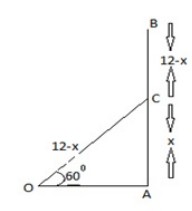
(24\(\sqrt{2}\) − 30) m
(24\(\sqrt{3}\) − 36) m
(2\(\sqrt{3}\) − 3) m
24\(\sqrt{3}\) m
To solve this problem, we use trigonometry to find the height at which the tree is broken. The diagram shows a right triangle formed by the tree, the ground, and the broken part.
Let the height at which the tree is broken be \(x\) meters. Therefore, the remaining part of the tree is \((12 - x)\) meters.
In the triangle \(OAC\), we know:
Using the sine function:
\[ \sin 60^\circ = \frac{\text{Opposite}}{\text{Hypotenuse}} = \frac{12 - x}{OA} \]
Since \(\sin 60^\circ = \frac{\sqrt{3}}{2}\), we have:
\[ \frac{\sqrt{3}}{2} = \frac{12 - x}{OA} \]
To find the length of the hypotenuse \(OA\), use the Pythagorean theorem:
\[ OA^2 = OC^2 + OA^2 \]
Since \(OC = 12 - x\), we have:
\[ OA = \frac{2(12 - x)}{\sqrt{3}} \]
Substitute back to find \(x\):
\[ \frac{\sqrt{3}}{2} = \frac{12 - x}{\frac{2(12 - x)}{\sqrt{3}}} \]
Solving for \(x\), we find:
\[ x = 24\sqrt{3} - 36 \]
Correct Option: B) \((24\sqrt{3} - 36)\) m
The question asks for the full form of the acronym ASCII. This is a common computer science abbreviation. We need to identify the correct expansion from the given options.
Correct Option: A) American Standard Code for Information Interchange. This is the universally recognized full form of ASCII. ASCII is a character encoding standard for electronic communication. ASCII codes represent text in computers, telecommunications equipment, and other devices. Most modern character-encoding schemes are based on ASCII, though they support many more characters.
In the given figure, DE ∥ BC. If AD = x, DB = x − 2, AE = x + 2 and EC = x − 1, then find the value of x.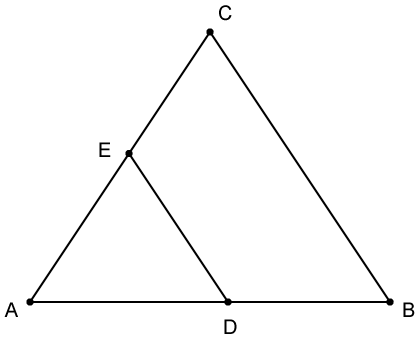
We are given that line segment DE is parallel to BC in a triangle, and we need to find the value of \(x\) using the properties of similar triangles.
Thus, the value of \(x\) is 4.
Correct Option: B) 4
This question asks us to evaluate the strength of two arguments regarding whether joint families are better than nuclear families. We need to determine if each argument provides a valid and generally accepted point in favor of its stance.
C) Both arguments 1 and 2 are strong.
The question asks to identify the largest bauxite-producing state in India as of 2021. This requires knowledge of the distribution of mineral resources in India and the leading states in their production.
A) Odisha is the largest bauxite-producing state in India, contributing a significant majority of the country's total production.