
The question asks to identify the first Soviet Republic to declare its independence. This requires knowledge of the historical timeline of the dissolution of the Soviet Union.
Correct Option: C) Lithuania was the first Soviet Republic to declare its independence on March 11, 1990.
In a row of girls, Vani is 6th from one extreme and 8th from the other. Find the total number of girls in the row.
To find the total number of girls in a row when the position of one person from both ends is given, we can use a simple formula. The key is to understand that the person whose position is given is counted twice (once from each end) in the sum of the ranks, so we need to subtract one to get the total count.
Correct Option: C) 13
The question asks about the number of banks nationalised in India in the year 1969. This is a factual question related to the history of banking in India, specifically the first phase of bank nationalisation.
Correct Option: C) 14. On July 19, 1969, the Indian government nationalised 14 major commercial banks. This was a significant step aimed at aligning the banking sector with the socialist objectives of the government, ensuring that credit reached priority sectors like agriculture and small industries.
This problem involves calculating the principal amount using the formula for simple interest. We are given the simple interest amount, the rate of interest, and the time period. We need to rearrange the simple interest formula to solve for the principal.
The formula for simple interest is:
\[ SI = \frac{P \times R \times T}{100} \]Where:
To find the principal amount, we can rearrange the formula as follows:
\[ P = \frac{SI \times 100}{R \times T} \]So, the principal amount borrowed by Ravi is ₹16,000.
The question asks about the essential element required for the synthesis of a specific hormone. We need to identify which hormone from the given options requires iodine for its production in the human body.
B) Thyroxine
Thyroxine, also known as tetraiodothyronine (\(T_4\)), is one of the two main hormones produced by the thyroid gland. The synthesis of thyroxine and triiodothyronine (\(T_3\)) critically depends on the availability of iodine. Iodine is incorporated into tyrosine residues on the thyroglobulin protein, which then undergoes further processing to form \(T_3\) and \(T_4\). A deficiency of iodine can lead to impaired thyroid hormone production, resulting in conditions like goiter and hypothyroidism.
When two objects move towards each other and meet, the time taken by both objects to meet is the same. The distance covered by each object is directly proportional to its speed during this common time. Therefore, the ratio of their speeds will be equal to the ratio of the distances covered by them until they meet.
Let the two stations be A and B, and the total distance between them be \(D = 250 \text{ km}\).
Let the two trains be Train 1 and Train 2. Train 1 starts from station A and Train 2 starts from station B.
The trains meet at a point C. Let the distance of point C from station A be \(d_1\). The problem states that they meet at a distance of 130 km from one of the stations. Let's assume this is from station A. So, \(d_1 = 130 \text{ km}\).
The distance covered by Train 2 from station B to the meeting point C will be \(d_2 = D - d_1\).
Substitute the given values:
\[ d_2 = 250 \text{ km} - 130 \text{ km} = 120 \text{ km} \]Let \(S_1\) be the speed of Train 1 and \(S_2\) be the speed of Train 2. Let \(T\) be the time taken for them to meet.
Since both trains start at the same time and meet at the same time, the time taken by both trains to reach the meeting point is identical. We know that \(\text{Distance} = \text{Speed} \times \text{Time}\), so \(\text{Time} = \frac{\text{Distance}}{\text{Speed}}\).
For Train 1: \(T = \frac{d_1}{S_1}\)
For Train 2: \(T = \frac{d_2}{S_2}\)
Equating the times:
\[ \frac{d_1}{S_1} = \frac{d_2}{S_2} \]Rearranging to find the ratio of speeds:
\[ \frac{S_1}{S_2} = \frac{d_1}{d_2} \]Substitute the distances \(d_1 = 130 \text{ km}\) and \(d_2 = 120 \text{ km}\):
\[ \frac{S_1}{S_2} = \frac{130}{120} = \frac{13}{12} \]The ratio of their speeds is 13 : 12.
A) 13 : 12 is the correct ratio of their speeds, as derived from the ratio of the distances covered by each train until they meet.
In the following diagram, A represents servicemen, B represents rich men and C represents honest men. Which number represents rich servicemen?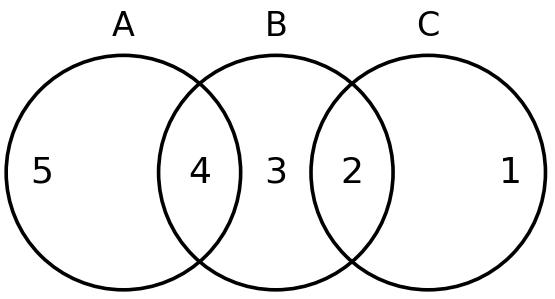
The problem involves identifying the number that represents rich servicemen using a Venn diagram. The diagram consists of three circles labeled A, B, and C, representing servicemen, rich men, and honest men, respectively.
Correct Option: D) 4
To find the percentage of gain, we need to determine the cost price (CP) and the selling price (SP) of the article. We will assume an original value for the article to simplify calculations, then calculate CP and SP based on the given percentages, and finally use the formula for percentage gain.
Let the original value of the article be \(P\).
For ease of calculation, let's assume the original value \(P = 100\).
Ramesh buys the article for 15% less than its original value.
\[ \text{CP} = P - (15\% \text{ of } P) \]\[ \text{CP} = P - \frac{15}{100} \times P \]\[ \text{CP} = P \left(1 - \frac{15}{100}\right) \]\[ \text{CP} = P \left(\frac{100 - 15}{100}\right) \]\[ \text{CP} = P \times \frac{85}{100} \]If \(P = 100\), then\( \text{CP} = 100 \times \frac{85}{100} = 85 \)
Ramesh sells the article for 10% more than its original value.
\[ \text{SP} = P + (10\% \text{ of } P) \]\[ \text{SP} = P + \frac{10}{100} \times P \]\[ \text{SP} = P \left(1 + \frac{10}{100}\right) \]\[ \text{SP} = P \left(\frac{100 + 10}{100}\right) \]\[ \text{SP} = P \times \frac{110}{100} \]If \(P = 100\), then\( \text{SP} = 100 \times \frac{110}{100} = 110 \)
Gain is the difference between the Selling Price and the Cost Price.
\[ \text{Gain} = \text{SP} - \text{CP} \]\[ \text{Gain} = 110 - 85 \]\[ \text{Gain} = 25 \]The percentage of gain is calculated with respect to the Cost Price.
\[ \text{Percentage of Gain} = \left(\frac{\text{Gain}}{\text{CP}}\right) \times 100\% \]\[ \text{Percentage of Gain} = \left(\frac{25}{85}\right) \times 100\% \]\[ \text{Percentage of Gain} = \frac{2500}{85}\% \]\[ \text{Percentage of Gain} \approx 29.4117...\% \]Approximately, the percentage of gain is 29.41%.
Correct Option: D) 29.41%
The question asks to identify the musical instrument associated with V Balsara. This requires knowledge of famous Indian musicians and their primary instruments.
Correct Option: C) V. Balsara was primarily associated with the Piano. He was a celebrated music director and composer who extensively used the piano in his compositions, particularly in Bengali cinema.
The problem asks for the direction of the minute hand after exactly 24 hours. The key to solving this is understanding how a clock works and the concept of time cycles. A clock's hands complete a full cycle and return to their original positions after a certain period. We need to determine if the direction of the minute hand changes after 24 hours.
D) South. After exactly 24 hours, the time will be the same (6:30). Since the minute hand was pointing South at 6:30 initially, it will point South again at 6:30, 24 hours later.