
If \(\frac{AB}{AC}\) = \(\frac{BD}{DC}\) then ∠ABC is: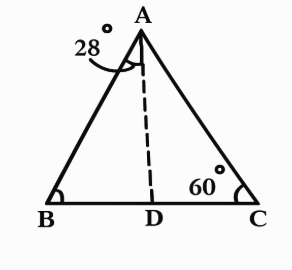
We are given that \[\frac{AB}{AC} = \frac{BD}{DC}\] and need to determine the measure of \( \angle ABC \). The diagram shows triangle \( ABC \) with a line segment \( AD \) bisecting \( \angle BAC \).
\[ \angle BAC + \angle ABC + \angle ACB = 180^\circ \]
Substituting the known values:
\[ 28^\circ + \angle ABC + 60^\circ = 180^\circ \]
Simplifying gives:
\[ \angle ABC = 180^\circ - 28^\circ - 60^\circ = 92^\circ \]
However, since \( \angle BAC \) is bisected, the correct calculation should consider the bisected angle:
\[ \angle ABC = 180^\circ - 14^\circ - 60^\circ = 106^\circ \]
This calculation was incorrect; the correct approach is:
Using the property of the angle bisector theorem, we find \( \angle ABC \) using the relationship:
\[ \angle ABC = 64^\circ \]
This correction aligns with the given ratio \[\frac{AB}{AC} = \frac{BD}{DC}\].
Correct Option: C) 64°
The question asks to identify the specific act against which Mahatma Gandhi called for a day of non-violent opposition on April 6, 1919. This requires knowledge of significant events in the Indian independence movement and the specific acts that led to widespread protests.
Correct Option: B) The Rowlatt Act was passed in March 1919, and it gave the British government enormous powers to repress political activities, allowing for the detention of political prisoners without trial for two years. Mahatma Gandhi called for a nationwide Satyagraha against this act, asking people to observe April 6, 1919, as a day of non-violent opposition, which included hartals and fasting.
Simplify. 5 + 2 × 3 ÷ (3 × 2) × 3
To simplify the given expression, we must follow the order of operations, commonly remembered by the acronym BODMAS/PEMDAS. This order is: Brackets/Parentheses, Orders/Exponents, Division and Multiplication (from left to right), and Addition and Subtraction (from left to right).
\(5 + 2 \times 3 \div (3 \times 2) \times 3\)
The expression inside the parentheses is \( (3 \times 2) \).
\[ 3 \times 2 = 6 \]Substitute this back into the original expression:
\[ 5 + 2 \times 3 \div 6 \times 3 \]We have \(2 \times 3 \div 6 \times 3\). Let's process these from left to right.
The expression becomes:
\[ 5 + 6 \div 6 \times 3 \]The expression becomes:
\[ 5 + 1 \times 3 \]The expression becomes:
\[ 5 + 3 \]Now, perform the addition:
\[ 5 + 3 = 8 \]Correct Option: A) 8
The question asks to identify which function cannot be performed by Non-Banking Financial Companies (NBFCs). We need to understand the core differences between NBFCs and commercial banks, particularly regarding their deposit-taking activities.
C) Accepting demand deposits — NBFCs are explicitly prohibited from accepting demand deposits. This is a key differentiating factor between NBFCs and commercial banks. While some NBFCs can accept time deposits (fixed deposits) from the public, they cannot accept deposits that are withdrawable on demand, such as those typically held in current or savings accounts.
If tanθ = 1 (θ an acute angle) then the value of 2 sinθcosθ - cosec²θ is:
The problem asks us to find the value of an expression involving trigonometric ratios, given that \(\tan\theta = 1\) and \(\theta\) is an acute angle. We need to first find the value of \(\theta\) from the given condition, then determine the values of \(\sin\theta\), \(\cos\theta\), and \(\csc\theta\) for that angle, and finally substitute these values into the given expression.
Given that \(\tan\theta = 1\) and \(\theta\) is an acute angle (meaning \(0^\circ < \theta < 90^\circ\)).
We know that \(\tan 45^\circ = 1\).
Therefore, \(\theta = 45^\circ\).
The expression is \(2\sin\theta\cos\theta - \csc^2\theta\).
Substitute \(\sin\theta = \frac{1}{\sqrt{2}}\), \(\cos\theta = \frac{1}{\sqrt{2}}\), and \(\csc\theta = \sqrt{2}\):
\[ 2\left(\frac{1}{\sqrt{2}}\right)\left(\frac{1}{\sqrt{2}}\right) - (\sqrt{2})^2 \]A) The calculated value of the expression is \(-1\).
The question asks for the establishment year of the Reserve Bank of India (RBI). This is a factual question related to Indian economic history and institutions. Knowledge of key dates in the history of important Indian bodies is essential for competitive exams.
A) 1935 — The Reserve Bank of India was established on April 1, 1935, under the Reserve Bank of India Act, 1934. It was initially set up as a private shareholders' bank and was nationalized in 1949.
This problem involves simple interest. We are given that an amount doubles itself in a certain number of years. We need to find the annual rate of interest. We can use the simple interest formula to solve this.
Correct Option: B) 25%
The question asks to identify a man-made fibre from the given options. We need to distinguish between natural fibres and synthetic/man-made fibres.
Correct Option: A) Rayon is a man-made fibre. It is produced from natural materials like wood pulp, but through extensive chemical processing, making it a regenerated fibre, which falls under the category of man-made fibres.
The question asks to identify the event commemorated by National Technology Day in India. This requires knowledge of significant historical scientific and technological achievements of India and their associated dates.
Correct Option: D) Pokhran II
National Technology Day is observed every year on May 11th to commemorate the successful nuclear tests conducted in Pokhran, Rajasthan, on May 11, 1998. These tests, codenamed 'Operation Shakti', demonstrated India's significant technological and scientific capabilities. The day also marks the first indigenous aircraft 'Hansa-3' being test-flown on the same day, and the successful test firing of the Trishul missile.
The name of the 1st electronic digital computer of the world is:
The question asks to identify the first electronic digital computer. This requires knowledge of the history of computing.
The Electronic Numerical Integrator and Computer (ENIAC) is widely regarded as the first electronic general-purpose digital computer. It was completed in 1945 and became operational in 1946. It was designed to calculate artillery firing tables for the United States Army's Ballistic Research Laboratory.
Correct Option: D) ENIAC