
The question asks to identify the hormone responsible for regulating blood sugar levels in the human body. This is a fundamental concept in human physiology, specifically endocrinology.
Correct Option: B) Insulin is a hormone produced by the pancreas. Its primary role is to regulate blood sugar (glucose) levels by facilitating the uptake of glucose into cells for energy or storage, thereby lowering blood glucose concentrations.
Two cars cover a certain distance by moving at speeds of 45 km/h and 50 km/h respectively. Find the distance travelled when one car takes 32 minutes more than the other to cover the distance.
\( \frac{240}{19} \) km
\( \frac{152}{3} \) km
\( \frac{8}{3} \)km
240 km
This problem involves calculating distance, speed, and time. We are given the speeds of two cars and the difference in their travel times for the same distance. We can use the fundamental formula \(\text{Distance} = \text{Speed} \times \text{Time}\) to set up equations and solve for the unknown distance.
Let the distance travelled be \(D\) km.
Let the speed of the first car be \(S_1 = 45 \text{ km/h}\).
Let the speed of the second car be \(S_2 = 50 \text{ km/h}\).
The time taken by the first car is \[T_1 = \frac{D}{S_1} = \frac{D}{45}\] hours.
The time taken by the second car is \[T_2 = \frac{D}{S_2} = \frac{D}{50}\] hours.
We are given that one car takes 32 minutes more than the other. Since the second car is faster, it will take less time. So, the first car takes 32 minutes more than the second car.
Convert the time difference to hours: \[32 \text{ minutes} = \frac{32}{60} \text{ hours} = \frac{8}{15} \text{ hours}\].
Set up the equation based on the time difference:
\[ T_1 - T_2 = \frac{8}{15} \]Substitute the expressions for \(T_1\) and \(T_2\):
\[ \frac{D}{45} - \frac{D}{50} = \frac{8}{15} \]Find a common denominator for 45 and 50, which is 450:
\[ \frac{10D - 9D}{450} = \frac{8}{15} \]Simplify the left side:
\[ \frac{D}{450} = \frac{8}{15} \]Solve for \(D\):
\[ D = \frac{8}{15} \times 450 \]Calculate the value:
\[ D = 8 \times \frac{450}{15} \]Since \(450 \div 15 = 30\):
\[ D = 8 \times 30 \]\[ D = 240 \text{ km} \]
Correct Option: D) 240 km
The question asks about the founder of the Tattwabodhini Sabha, an organization dedicated to promoting the ideas of Ram Mohan Roy. We need to identify the correct historical figure from the given options.
Correct Option: C) Debendranath Tagore founded the Tattwabodhini Sabha in 1839 to propagate the ideas of Ram Mohan Roy. He was a prominent leader of the Brahmo Samaj and father of Rabindranath Tagore.
This problem involves work and time. We need to find the individual work rates of A and B, and then combine them to find their combined work rate to determine the total time taken to complete the work together.
C) 15 days is the correct answer because A and B together complete the work in 15 days.
The question asks us to identify the sport associated with a 'stick' based on the relationship between 'Bat' and 'Cricket'. This is an analogy question where we need to find the common relationship between the first pair of words and apply it to the third word to find the fourth.
Correct Option: D) Hockey — A stick is a fundamental piece of equipment used in the sport of Hockey, just as a bat is used in Cricket.
Find the area of ΔABC. 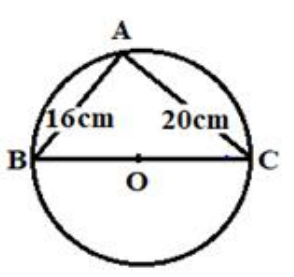
To find the area of triangle \( \triangle ABC \), we can use Heron's formula, which requires the lengths of all three sides. The diagram provides the lengths of two sides, \( AB = 16 \text{ cm} \) and \( AC = 20 \text{ cm} \), and \( BC \) is the diameter of the circle.
Correct Option: B) 160 cm2
If (4y - 1) and (y + 4) both are factors of \( py^{2} + 15y - q \) then:
If a polynomial \(f(y)\) has a factor \((ay - b)\), then \(f\left(\frac{b}{a}\right) = 0\). This is known as the Factor Theorem. We will use this theorem for both given factors to form two equations involving \(p\) and \(q\), and then solve them simultaneously.
Let the given polynomial be \(f(y) = py^2 + 15y - q\).
Given that \((4y - 1)\) is a factor of \(f(y)\). According to the Factor Theorem, if \((4y - 1)\) is a factor, then \(f\left(\frac{1}{4}\right) = 0\).
Substitute \(y = \frac{1}{4}\) into \(f(y)\):
\[ p\left(\frac{1}{4}\right)^2 + 15\left(\frac{1}{4}\right) - q = 0 \] \[ p\left(\frac{1}{16}\right) + \frac{15}{4} - q = 0 \]Multiply the entire equation by 16 to clear denominators:
\[ p + 15(4) - 16q = 0 \] \[ p + 60 - 16q = 0 \quad \text{(Equation 1)} \]Given that \((y + 4)\) is also a factor of \(f(y)\). According to the Factor Theorem, if \((y + 4)\) is a factor, then \(f(-4) = 0\).
Substitute \(y = -4\) into \(f(y)\):
\[ p(-4)^2 + 15(-4) - q = 0 \] \[ p(16) - 60 - q = 0 \] \[ 16p - 60 - q = 0 \quad \text{(Equation 2)} \]Now we have a system of two linear equations:
Equation 1: \(p + 60 - 16q = 0 \Rightarrow p = 16q - 60\)
Equation 2: \(16p - 60 - q = 0 \Rightarrow q = 16p - 60\)
Substitute the expression for \(p\) from Equation 1 into Equation 2:
\[ q = 16(16q - 60) - 60 \] \[ q = 256q - 960 - 60 \] \[ q = 256q - 1020 \] \[ 1020 = 256q - q \] \[ 1020 = 255q \] \[ q = \frac{1020}{255} \] \[ q = 4 \]Now substitute the value of \(q = 4\) back into Equation 1 to find \(p\):
\[ p = 16q - 60 \] \[ p = 16(4) - 60 \] \[ p = 64 - 60 \] \[ p = 4 \]Since \(p = 4\) and \(q = 4\), we can conclude that \(p = q\).
Correct Option: B) p = q
Simplify.
\(4\sqrt{0.000081}\)
To simplify the expression \(4\sqrt{0.000081}\), we first need to find the square root of \(0.000081\). This can be done by converting the decimal to a fraction or by directly finding the square root of the number and then placing the decimal point correctly.
D) 0.036 is the correct simplification of the given expression.
The question asks to identify the author who described 'Adhyakshas' as superintendents of various departments in the Mauryan administration. This requires knowledge of ancient Indian historical sources and their authors.
B) Kautilya (also known as Chanakya or Vishnugupta) is the author of the Arthashastra, a comprehensive treatise that meticulously describes the Mauryan administration. In the Arthashastra, Kautilya details the roles of numerous 'Adhyakshas' (superintendents) who were in charge of various departments such as mining, agriculture, trade, weights and measures, customs, and more. This work is the primary source for understanding the intricate administrative structure of the Mauryan Empire, including the functions of these superintendents.
This problem requires us to use the formulas for the circumference and area of a circle. We are given that these two quantities are numerically equal. By setting their formulas equal to each other, we can solve for the radius of the circle.
The circumference of a circle (\(C\)) with radius \(r\) is given by:
\[ C = 2 \pi r \]The area of a circle (\(A\)) with radius \(r\) is given by:
\[ A = \pi r^2 \]According to the problem statement, the circumference and area are numerically equal. So, we can write:
\[ 2 \pi r = \pi r^2 \]To solve for \(r\), we can rearrange the equation:
\[ \pi r^2 - 2 \pi r = 0 \]Factor out common terms (\(\pi r\)):
\[ \pi r (r - 2) = 0 \]This equation gives two possible solutions for \(r\):
First solution:
\[ \pi r = 0 \implies r = 0 \]A radius of 0 would mean there is no circle, so this solution is not valid in this context.
Second solution:
\[ r - 2 = 0 \implies r = 2 \]Thus, the radius of the circle is 2 units.
B) 2 units is the correct answer because when the radius is 2 units, the circumference is \(2\pi(2) = 4\pi\) and the area is \(\pi(2^2) = 4\pi\), making them numerically equal.