
The question asks about the angle of inclination between the Earth's equatorial plane and its orbital plane (ecliptic plane). This is a fundamental concept in Earth sciences and astronomy, explaining phenomena like seasons.
Correct Option: A) 23.5° is the correct angle of inclination between the Earth's equatorial plane and its orbital plane (ecliptic plane).
The question asks to identify the Leader of Opposition in Rajya Sabha as of February 2021. This is a factual question related to current political appointments in India. Recalling the key political appointments around that period is essential.
C) Mallikarjun Kharge — He was appointed as the Leader of Opposition in Rajya Sabha in February 2021, succeeding Ghulam Nabi Azad.
The question asks to identify the district in Haryana where a nuclear power plant is located. This requires knowledge of major infrastructure projects and their geographical locations within the state of Haryana.
A) Fatehabad — The Gorakhpur Haryana Anu Vidyut Pariyojana (GHAVP), a nuclear power plant, is being constructed in Gorakhpur village, Fatehabad district, Haryana. This makes Fatehabad the correct answer.
In what time will ₹3,200 invested at 10% per annum compounded quarterly become ₹3,362?
2 years
\( \frac{1}{2} \) year
2 \( \frac{1}{2} \) years
\( \frac{1}{4} \) year
This problem involves compound interest where the interest is compounded quarterly. We need to find the time it takes for a given principal amount to grow to a specific future value at a given annual interest rate. We will use the compound interest formula, adjusting the rate and time for quarterly compounding.
Since the interest is compounded quarterly, the number of compounding periods per year (\(n\)) is 4.
The formula for compound interest is \(A = P \left(1 + \frac{R}{n}\right)^{nT}\).
Substitute the known values into the formula:
\[ 3362 = 3200 \left(1 + 0.025\right)^{4T} \]First, divide both sides by 3200:
\[ \frac{3362}{3200} = \left(1.025\right)^{4T} \]\[ 1.050625 = \left(1.025\right)^{4T} \]We need to find what power of 1.025 equals 1.050625. Let's try squaring 1.025:
\[ (1.025)^2 = 1.025 \times 1.025 = 1.050625 \]Since \(1.050625 = (1.025)^2\), we can write:
\[ (1.025)^{4T} = (1.025)^2 \]\[ 4T = 2 \]B) \( \frac{1}{2} \) year — The calculation shows that the time required is \( \frac{1}{2} \) year.
The question asks to identify the type of nutrition where an organism obtains nutrients in solution form from dead and decaying matter. We need to recall the definitions of different modes of nutrition.
D) Saprophytic nutrition is the type of nutrition where organisms obtain nutrients in solution form from dead and decaying organic matter. Organisms such as fungi and certain bacteria exhibit this mode of nutrition.
This problem can be solved by using the concept of work rates. If a person or a group of people can complete a work in 'n' days, then their one day's work is \(1/n\) of the total work. We will calculate the combined one day's work of A, B, and C, and C's one day's work. Then, we can find the one day's work of A and B together by subtracting C's work rate from the combined work rate of A, B, and C.
Calculate the combined one day's work of A, B, and C:
A, B, and C together can do a piece of work in 14 days.
So, their combined one day's work is:
Calculate C's one day's work:
C alone can do the same work in 42 days.
So, C's one day's work is:
Calculate the combined one day's work of A and B:
The one day's work of A and B together can be found by subtracting C's one day's work from the combined one day's work of A, B, and C.
Perform the subtraction:
To subtract the fractions, find a common denominator, which is 42.
Determine the time taken by A and B together:
If A and B together can do \(1/21\) of the work in one day, then they will take 21 days to complete the entire work.
C) 21 days is the correct answer. A and B together will take 21 days to finish the work.
To solve this number series problem, we need to identify the pattern or the rule that governs the sequence of numbers. We will look for differences between consecutive terms, or a multiplication/division pattern, or a pattern involving squares/cubes, or a combination of these.
D) 37 — The pattern of differences between consecutive terms is \(2, 4, 8, \dots\), which implies that each difference is double the previous one. The next difference should be \(8 \times 2 = 16\). Adding this to the last term \(21 + 16 = 37\).
The question asks to identify the incorrect pair of an abbreviation and its full form from the given options. This requires knowledge of common computer and communication technology abbreviations.
Correct Option: B) URL- Uniform Reserve Locator is an incorrect pair. The correct full form of URL is Uniform Resource Locator.
The problem asks us to evaluate the expression \( a^2 - b^2 \) given the values of \( a \) and \( b \). We will substitute the given values into the expression and perform the arithmetic operations.
Identify the given values:
Identify the expression to be evaluated:
\[ a^2 - b^2 \]Substitute the values of \( a \) and \( b \) into the expression:
\[ (-5)^2 - (5)^2 \]Calculate \( (-5)^2 \):
\[ (-5)^2 = (-5) \times (-5) = 25 \]Remember that the square of a negative number is positive.
Calculate \( (5)^2 \):
\[ (5)^2 = 5 \times 5 = 25 \]Substitute these squared values back into the expression:
\[ 25 - 25 \]Perform the subtraction:
\[ 25 - 25 = 0 \]B) 0 — By substituting \( a = -5 \) and \( b = 5 \) into the expression \( a^2 - b^2 \), we get \( (-5)^2 - (5)^2 = 25 - 25 = 0 \).
In the given figure, AB is the diameter of the circle. AP is a tangent to circle at A. Extended BC meets the tangent at P. ∠AOC = 36°. Find ∠BPQ.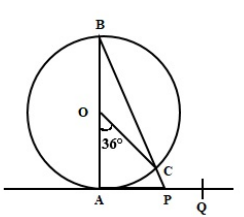
To find the measure of \(\angle BPQ\), we will use properties of circles and angles formed by tangents and chords.
Therefore, the correct answer is \(\angle BPQ = 108^\circ\).
Correct Option: C) 108°