
This problem involves work and time, specifically comparing the work rates of men and boys. We need to establish a relationship between the work done by men and boys, then calculate the total equivalent work units for the combined group, and finally determine the time taken.
Establish the equivalence between men and boys:
Given that 3 men or 6 boys can complete a task in 20 days, it means that the work done by 3 men is equivalent to the work done by 6 boys.
From this, we can find the equivalent number of boys for 1 man:
\[ 1 \text{ man} = \frac{6}{3} \text{ boys} = 2 \text{ boys} \]Convert the combined group into an equivalent number of boys:
We need to find out how many days 6 men and 8 boys will take. First, convert the 6 men into an equivalent number of boys:
Now, add this to the existing 8 boys:
\[ \text{Total equivalent boys} = 12 \text{ boys} + 8 \text{ boys} = 20 \text{ boys} \]Calculate the time taken by the combined group:
We know that 6 boys can complete the task in 20 days. We need to find out how many days 20 boys will take. This is an inverse proportion problem: if more workers are involved, less time will be taken.
Let \(D_1\) be the days taken by \(B_1\) boys, and \(D_2\) be the days taken by \(B_2\) boys.
\[ B_1 \times D_1 = B_2 \times D_2 \]Given:
\[ B_1 = 6 \text{ boys} \] \[ D_1 = 20 \text{ days} \] \[ B_2 = 20 \text{ boys} \] \[ D_2 = ? \]Substitute the values into the formula:
\[ 6 \times 20 = 20 \times D_2 \] \[ 120 = 20 \times D_2 \] \[ D_2 = \frac{120}{20} \] \[ D_2 = 6 \text{ days} \]Thus, 6 men and 8 boys will take 6 days to complete the same task.
A) 6 days is the correct answer, as calculated by converting men to an equivalent number of boys and then applying the inverse proportionality of workers and time.
The question asks to identify India's first nuclear reactor. This requires knowledge of the history of India's nuclear program and the names and timelines of its early reactors.
India's nuclear program began under the leadership of Homi J. Bhabha. The first nuclear reactor to be established in India was Apsara, which became operational on August 4, 1956, at the Bhabha Atomic Research Centre (BARC) in Trombay, Mumbai. It was a pool-type reactor and used enriched uranium as fuel.
Correct Option: A) Apsara was India's first nuclear reactor, commissioned in 1956.
To find the height of an isosceles triangle, we can divide it into two right-angled triangles. The height bisects the base and forms a right angle with it. Then, we can use the Pythagorean theorem to calculate the height.
Let the isosceles triangle be ABC, where AB = AC = 5 cm (equal sides) and BC = 8 cm (base).
Draw a perpendicular from vertex A to the base BC, and let the point of intersection be D. AD is the height (h) we need to find.
In an isosceles triangle, the altitude from the vertex to the base bisects the base. So, BD = DC = \(\frac{\text{BC}}{2}\).
Calculate BD:
\[ \text{BD} = \frac{8 \text{ cm}}{2} = 4 \text{ cm} \]Now, consider the right-angled triangle ADB. We have:
Apply the Pythagorean theorem to triangle ADB:
\[ \text{AB}^2 = \text{AD}^2 + \text{BD}^2 \]Substitute the known values:
\[ 5^2 = h^2 + 4^2 \]\[ 25 = h^2 + 16 \]Solve for \(h^2\):
\[ h^2 = 25 - 16 \]\[ h^2 = 9 \]Solve for h:
\[ h = \sqrt{9} \]\[ h = 3 \text{ cm} \]B) 3 cm — The height of the vertex opposite to the base from the base is 3 cm, calculated using the Pythagorean theorem.
Number 0.232323 can be written in rational form as:
\(\frac{23}{99}\)
\(\frac{23}{990}\)
\(\frac{23}{999}\)
\(\frac{23}{9}\)
To convert a repeating decimal into a rational fraction (p/q form), we use an algebraic method. We set the given decimal equal to a variable, multiply it by a power of 10 to shift the repeating part, and then subtract the original equation to eliminate the repeating decimal part.
A) \(\frac{23}{99}\) is the correct rational form for the repeating decimal \(0.232323...\).
The question asks to identify which of the given options is NOT an invertebrate. To answer this, we need to understand the definition of an invertebrate and classify each option accordingly.
Correct Option: C) reptiles — Reptiles are vertebrates, meaning they possess a vertebral column or backbone. Therefore, they are not invertebrates.
The question asks to identify the component of the nervous system responsible for mediating reflex actions and transmitting impulses to and from the brain. We need to recall the primary functions of the central nervous system components.
Correct Option: C) Spinal cord is composed of nerve fibres that mediate reflex actions and transmit impulses to and from the brain. This perfectly matches the description provided in the question.
The question asks to identify the category of device that a tracker ball belongs to in the context of computers. We need to understand the function of a tracker ball and relate it to the basic categories of computer hardware: input, output, storage, and processing.
Correct Option: C) input
This is an analogy question where we need to find the relationship between the first pair of words and apply the same relationship to the second pair to find the missing word.
B) Curator: A 'Curator' is a person responsible for managing, preserving, and interpreting a collection of artifacts or exhibits in a museum or gallery. This directly aligns with the role of a 'Gardener' for a 'Garden'.
In the given diagram, if ∠BAC = 30°, ∠ABC = 50° and ∠CDE = 25°, then ∠AED is equal to: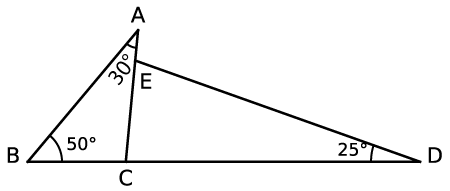
To find the value of \( \angle AED \), we need to use the properties of angles in triangles and straight lines. The diagram shows two triangles, \( \triangle ABC \) and \( \triangle CDE \), with given angles.
Correct Option: A) 105°
The question asks about the location of the Nipah virus outbreak in 2018. This is a factual question related to current events and public health, often covered in general knowledge sections of competitive exams.
Correct Option: D) The Nipah virus outbreak in 2018 occurred in Kerala. The state faced a significant health challenge with multiple fatalities, leading to extensive public health measures to contain the spread.