
The question asks to identify which of the given options is NOT an abiotic component. To answer this, we need to understand the definitions of abiotic and biotic components in an ecosystem.
Correct Option: C) Green plant is a living organism (a producer) and therefore a biotic component, not an abiotic one.
The question asks to identify an ancient Buddhist text from the given options. We need to evaluate each option to determine its origin and religious affiliation.
Correct Option: B) Abhidharma Kosha — This is a foundational text of Buddhist philosophy, written by Vasubandhu, belonging to the Sarvastivada school of Buddhism. It systematically explains the Abhidharma teachings.
To find the length of the longest pole that can be placed in a room, we need to calculate the length of the main diagonal of the room. A room is a cuboid, and the formula for the length of the main diagonal of a cuboid with dimensions length (L), width (W), and height (H) is given by \( \sqrt{L^2 + W^2 + H^2} \).
The dimensions of the room are given as:
The length of the longest pole (main diagonal, D) can be found using the formula:
\[ D = \sqrt{L^2 + W^2 + H^2} \]Substitute the given dimensions into the formula:
\[ D = \sqrt{(30 \text{ m})^2 + (15 \text{ m})^2 + (10 \text{ m})^2} \]The square root of 1225 is 35.
\[ D = 35 \text{ m} \]D) 35 m — The calculation shows that the length of the longest pole that can be placed in the room is 35 m, which corresponds to the main diagonal of the cuboid.
A cuboid having the surface area of 3 adjacent faces as a, b, c has the volume:
\( a^{3}b^{3}c^{3} \)
\( (abc)^{\frac{1}{3}} \)
abc
\( (abc)^{\frac{1}{2}} \)
To find the volume of a cuboid given the areas of three adjacent faces, we first define the dimensions of the cuboid. Then, we express the given face areas in terms of these dimensions and use these relationships to find the volume.
Let the dimensions (length, breadth, and height) of the cuboid be \(l\), \(b\), and \(h\) respectively.
The areas of three adjacent faces of the cuboid are given as \(a\), \(b\), and \(c\). We can express these areas in terms of \(l\), \(b\), and \(h\):
To find the volume \(V\) of the cuboid, which is \(V = lbh\), we need to combine these equations. Multiply the three area equations together:
\[ (lb)(bh)(hl) = abc \]\[ l^2 b^2 h^2 = abc \]We can rewrite the left side of the equation as \((lbh)^2\):
\[ (lbh)^2 = abc \]Since \(V = lbh\), substitute \(V\) into the equation:
\[ V^2 = abc \]To find \(V\), take the square root of both sides:
\[ V = \sqrt{abc} \]\[ V = (abc)^{\frac{1}{2}} \]D) The volume of the cuboid is \( (abc)^{\frac{1}{2}} \).
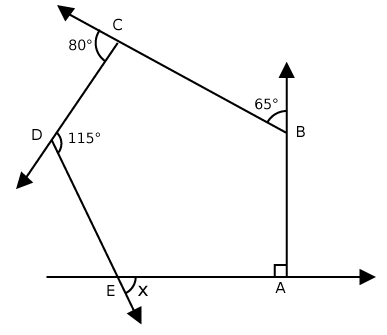
In the given figure, value of x is:
The problem involves finding the value of angle x in a geometric figure. We will use the properties of angles formed by intersecting lines and the sum of angles in a triangle to find the solution.
Correct Option: B) 60°
The question asks about the initiation year of the disinvestment process in Public Sector Enterprises (PSEs) in India. This is a factual question related to India's economic history, specifically the period of economic reforms.
Correct Option: B) 1991
To solve this problem, we need to add a series of decimal numbers. The most straightforward way to do this accurately is to align the decimal points of all numbers and then perform column-wise addition, starting from the rightmost digit.
It's crucial to align the decimal points vertically to ensure that digits of the same place value are added together correctly. We can also add trailing zeros to make all numbers have the same number of decimal places for easier addition.
\[ \begin{array}{r} 6202.50000 \\ 620.25000 \\ 62.02500 \\ 6.20250 \\ + \quad 0.62025 \\ \hline \end{array} \]Start adding from the rightmost column (the hundred-thousandths place).
So, the sum is:
\[ \begin{array}{r} 6202.50000 \\ 620.25000 \\ 62.02500 \\ 6.20250 \\ + \quad 0.62025 \\ \hline 6891.59775 \end{array} \]The calculated sum is \(6891.59775\).
Correct Option: B) 6891.59775 is the correct sum obtained by adding all the given numbers.
The question asks about the primary objective of the 'Operation Greens' scheme. To answer this, one needs to recall the specific commodities and goals associated with this government initiative.
Correct Option: B) Supply stabilisation of TOP crops (Tomato Onion Potato)
This option accurately describes the initial and primary focus of the 'Operation Greens' scheme, which aims to enhance value realization for farmers and reduce post-harvest losses of Tomato, Onion, and Potato by stabilizing their supply and prices.
Solve the following.
\( \left(1+4-\frac{42}{14}+65\right)+\left(\frac{2+7\times9}{13}\right)\times(65+7-19)+(19-25\times15) = \) ?
To solve this problem, we need to follow the order of operations (BODMAS/PEMDAS) carefully. This means performing operations in parentheses first, then division/multiplication, and finally addition/subtraction from left to right.
Let the given expression be \(E\). We will evaluate each part of the expression separately.
The expression is: \[\left(1+4-\frac{42}{14}+65\right)+\left(\frac{2+7\times9}{13}\right)\times(65+7-19)+(19-25\times15)\]
Evaluate the first parenthesis: \( \left(1+4-\frac{42}{14}+65\right) \)
So, the first part is \( 67 \).
Evaluate the second part, which involves three sub-expressions: \[\left(\frac{2+7\times9}{13}\right)\times(65+7-19)\]
Evaluate the first fraction: \( \left(\frac{2+7\times9}{13}\right) \)
So, the first sub-expression is \( 5 \).
Evaluate the second parenthesis: \( (65+7-19) \)
So, the second sub-expression is \( 53 \).
Multiply the results of these two sub-expressions: \( 5 \times 53 = 265 \)
So, the second part of the main expression is \( 265 \).
Evaluate the third parenthesis: \( (19-25\times15) \)
So, the third part is \( -356 \).
Combine the results from steps 1, 2, and 3:
\( E = 67 + 265 + (-356) \)
\( E = 332 - 356 \)
\( E = -24 \)
Thus, the final answer is \( -24 \).
Correct Option: C) -24
The question asks to identify the commission/committee that is NOT related to Centre-State relations in India. We need to recall the primary focus of each listed body.
Based on this analysis, the Kothari Commission is the one not related to Centre-State relations.
Correct Option: D) Kothari Commission