
Express 0.037̄ in the form of \( \frac{p}{q} \), where p is a whole number and q is a natural number.
\( \frac{37}{1000} \)
\( \frac{34}{99} \)
\( \frac{17}{45} \)
\( \frac{17}{450} \)
To express a non-terminating repeating decimal in the form of \( \frac{p}{q} \), we use an algebraic method. We set the given decimal equal to a variable, multiply by powers of 10 to align the repeating parts, and then subtract the equations to eliminate the repeating decimal, solving for the variable.
Thus, \( 0.037\bar{7} \) expressed in the form \( \frac{p}{q} \) is \( \frac{17}{450} \).
Correct Option: D) \( \frac{17}{450} \)
The question asks to identify the person who successfully deciphered the ancient Brahmi and Kharosthi scripts, which were crucial for understanding early Indian inscriptions, particularly those of Emperor Ashoka.
The decipherment of Brahmi and Kharosthi scripts was a monumental achievement that unlocked a vast amount of historical information from ancient India. These scripts were used in many early inscriptions, most notably the edicts of Emperor Ashoka. James Prinsep, an English scholar, orientalist, and antiquary, is widely credited with this breakthrough in the 1830s. His work allowed historians to read and understand the contents of these inscriptions, providing invaluable insights into ancient Indian administration, religion, and society.
Correct Option: A) James Prinsep — He was an English scholar and antiquary who successfully deciphered the Brahmi and Kharosthi scripts in the 1830s. This achievement was pivotal for the study of ancient Indian history, especially the Mauryan period, as it enabled the reading of Ashokan edicts.
To solve this problem, we need to represent the four consecutive multiples of 3 algebraically. Then, we will set up an equation based on their sum and solve for the unknown variable. Finally, we will identify the largest of these numbers.
Correct Option: D) 24
In the figure, O is the centre of the circle. If ∠ARS = 125°, then find the measure of ∠PAB.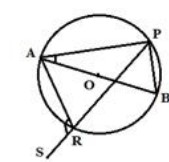
To find the measure of \( \angle PAB \), we use the properties of angles in a circle, particularly the relationship between angles subtended by the same arc.
Correct Option: B) 35°
To solve this problem, we need to follow the order of operations, commonly remembered by the acronym BODMAS/PEMDAS. This rule dictates the sequence in which mathematical operations should be performed: Brackets/Parentheses, Orders/Exponents, Division and Multiplication (from left to right), and Addition and Subtraction (from left to right).
Thus, the value of the expression is \(2\).
B) 2 — Following the BODMAS/PEMDAS rule, the correct sequence of operations leads to the result of 2.
The question asks to identify the sixth-largest country in the world by area. This requires knowledge of the geographical areas of major countries.
B) Australia is the sixth-largest country in the world by total area, with an area of approximately 7.69 million square kilometers.
The given series alternates between numbers and letters. We need to find the pattern for both the numerical and alphabetical sequences separately and then combine them to find the missing element.
The question asks about the form of energy produced when complex organic compounds like glucose are broken down during respiration. This is a fundamental concept in biology, specifically in cellular respiration.
Correct Option: C) ATP
To find the percentage profit or loss, we need to determine the cost price (CP) and the selling price (SP) of the article. We can assume a marked price (MP) for the article to simplify calculations. Then, we will calculate the CP based on the off-season discount and the SP based on the selling discount, both applied to the assumed MP.
Thus, Zamir makes a profit of 25%.
D) 25% profit — As calculated, the selling price is Rs. 75 and the cost price is Rs. 60, resulting in a profit of Rs. 15, which is 25% of the cost price.
The question asks for the state where the Ayushman Bharat Scheme was launched in 2018. This is a factual question related to a significant government welfare program.
B) Jharkhand — The Ayushman Bharat Scheme (PMJAY) was launched from Ranchi, Jharkhand, on September 23, 2018, by Prime Minister Narendra Modi.