
Select the Venn diagram that best represents the relationship between the given set of classes.
Year, Month, Day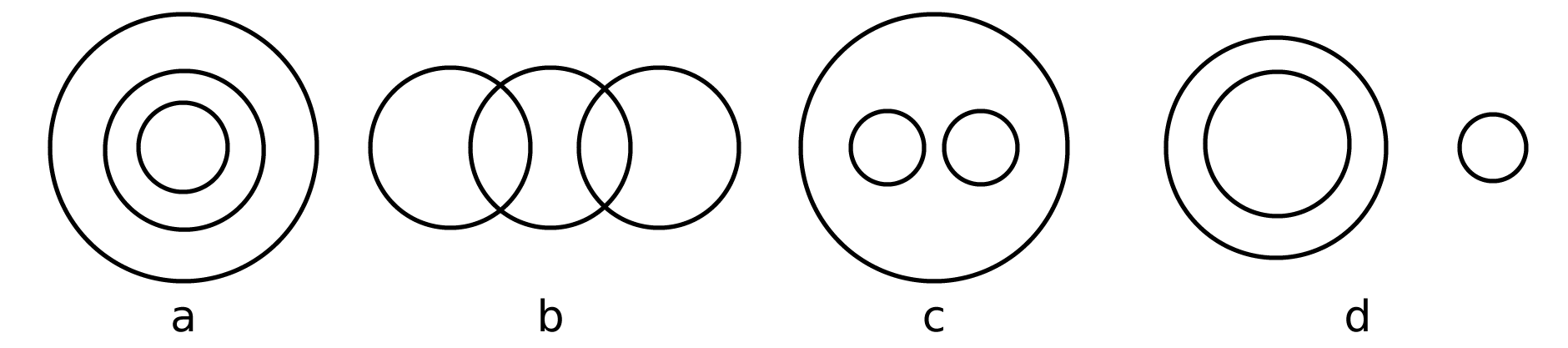
To determine the correct Venn diagram representing the relationship between the classes "Year," "Month," and "Day," we need to understand the hierarchical relationship among them.
Correct Option: B) The diagram with three concentric circles.
The question asks to identify the component that functions as the "brain" of a computer system. This requires knowledge of the basic components of a computer and their primary roles.
Correct Option: C) CPU — The Central Processing Unit (CPU) is responsible for executing instructions, performing arithmetic and logical operations, and managing the overall flow of data and control within the computer system. It is the primary component that carries out the instructions of a computer program, hence earning it the title "brain" of the computer.
This problem involves work and time, where the efficiency of men and women needs to be determined first. We will calculate the total work units, the individual efficiencies, the work done by the initial group, and then the remaining work to be completed by the new group of men.
Calculate total work units:
Let the total work be \(W\). The work can be expressed in terms of men-days or women-days.
Determine the relationship between men's and women's efficiency:
Since the total work is the same:
Calculate the work done by 8 men and 8 women in 12 days:
Convert women to men for consistency, or vice-versa. Let's convert women to men:
Calculate the remaining work:
Total work \( = 192 \text{ man-days}\).
Work done \( = 144 \text{ man-days}\).
Remaining work \( = 192 - 144 = 48 \text{ man-days}\).
Calculate the number of days for the remaining work:
After 12 days, the women dropped and 8 men joined. The initial 8 men were already there, so now there are \(8 \text{ men} + 8 \text{ men} = 16 \text{ men}\).
A) 3 days is the correct answer. The remaining task will be completed by 16 men in 3 days.
The question asks to identify a movement similar to the Chipko Movement, specifically one that aims to protect forests in the Uttara Kannada district. We need to recall major environmental movements in India and their objectives and locations.
Based on this analysis, the Appiko Movement is the correct answer as it directly mirrors the Chipko Movement's objectives and is located in the specified region.
Correct Option: A) Appiko Movement — The Appiko Movement, which began in 1983 in the Uttara Kannada district of Karnataka, was a forest conservation movement inspired by the Chipko Movement. Its primary goal was to protect the Western Ghats forests from commercial felling, and it involved people embracing trees to prevent their destruction.
The problem asks us to find a number that relates to 27 in the same way that 529 relates to 23. This is a number analogy problem. We need to identify the mathematical operation or pattern connecting the first pair of numbers (23 and 529) and then apply the same pattern to the third number (27) to find the missing fourth number.
Correct Option: A) 729
The relationship between the first and second number is that the second number is the square of the first number. Applying the same rule to the third number, \(27^2 = 729\).
The difference between 82% and 73% of the same number is 72. What is 48% of that number?
The problem states that the difference between 82% and 73% of the same number is 72. We need to find 48% of that number. We can first find the number by setting up an equation based on the given percentage difference, and then calculate 48% of that number.
Let the number be \(X\).
82% of \(X\) can be written as \(0.82X\).
73% of \(X\) can be written as \(0.73X\).
The difference between 82% and 73% of \(X\) is 72. So, we have:
\[ 0.82X - 0.73X = 72 \]Subtract the percentages:
\[ (0.82 - 0.73)X = 72 \]\[ 0.09X = 72 \]Divide both sides by 0.09:
\[ X = \frac{72}{0.09} \]\[ X = \frac{72}{\frac{9}{100}} \]\[ X = \frac{72 \times 100}{9} \]\[ X = 8 \times 100 \]\[ X = 800 \]Now that we have \(X = 800\), we need to find 48% of 800:
\[ 48\% \text{ of } 800 = \frac{48}{100} \times 800 \]\[ = 48 \times 8 \]\[ = 384 \]D) 384 is the correct answer. This matches our calculated value for 48% of the number.
This problem can be solved using the concept of work and time. We first determine the individual work rates of a man and a woman. Then, we calculate the combined work rate of 2 men and 3 women and use it to find the total time required to complete the task.
Calculate the work rate of one man:
A man can complete the task in 8 days. So, in one day, a man completes \(\frac{1}{8}\) of the task.
Calculate the work rate of one woman:
A woman can complete the task in 12 days. So, in one day, a woman completes \(\frac{1}{12}\) of the task.
Calculate the combined work rate of 2 men:
If one man completes \(\frac{1}{8}\) of the work in a day, then 2 men will complete:
Calculate the combined work rate of 3 women:
If one woman completes \(\frac{1}{12}\) of the work in a day, then 3 women will complete:
Calculate the total combined work rate of 2 men and 3 women:
Add the work rates from step 3 and step 4:
Calculate the number of days to complete the task:
If 2 men and 3 women complete \(\frac{1}{2}\) of the task in one day, then they will complete the full task (1 unit of work) in:
D) 2 days is the correct answer. The combined team of 2 men and 3 women can complete the task in 2 days.
The question asks to identify the recipient of the Nobel Peace Prize in 2019. This requires knowledge of recent Nobel Prize winners, which is a common topic in general knowledge sections of competitive exams.
The Nobel Peace Prize in 2019 was awarded to Abiy Ahmed Ali, the Prime Minister of Ethiopia, for his efforts to achieve peace and international cooperation, and in particular for his decisive initiative to resolve the border conflict with neighbouring Eritrea.
Correct Option: D) Abiy Ahmed
In the given figure, BC ∥ DE. Find the value of x.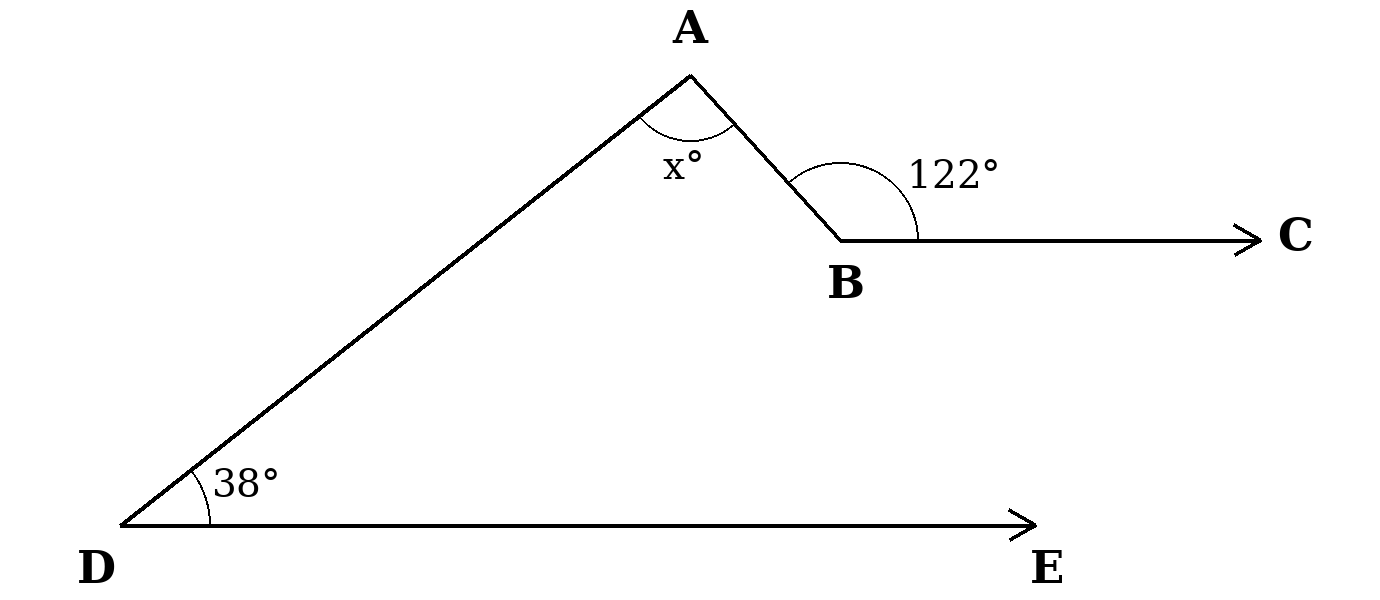
To find the value of \(x\), we use the properties of parallel lines and angles. Since \(BC \parallel DE\), the corresponding angles are equal.
\[ x = 122^\circ - 38^\circ = 84^\circ \]
Thus, the value of \(x\) is \(84^\circ\).
Correct Option: A) 84
Solve the following.
\(\sqrt{37+\sqrt{130+2\sqrt{56-\sqrt{16}-\sqrt{9}}}}\) = ?
To solve this problem, we need to simplify the expression by working from the innermost square root outwards. We will evaluate each square root step by step until the entire expression is simplified to a single numerical value.
The innermost part of the expression is \(\sqrt{16}\) and \(\sqrt{9}\).
\[ \sqrt{16} = 4 \]\[ \sqrt{9} = 3 \]The expression becomes:
\[ \sqrt{37+\sqrt{130+2\sqrt{56-4-3}}} \]The expression now is:
\[ \sqrt{37+\sqrt{130+2\sqrt{49}}} \]\[ \sqrt{49} = 7 \]The expression becomes:
\[ \sqrt{37+\sqrt{130+2 \times 7}} \]\[ \sqrt{37+\sqrt{130+14}} \]\[ \sqrt{37+\sqrt{144}} \]The expression is now:
\[ \sqrt{37+12} \]\[ \sqrt{49} \]A) 7 is the correct answer because, after step-by-step simplification of the nested square roots, the final value obtained is 7.