
A train is travelling at the rate of 45 km/h. How many seconds will it take to cover a distance of \( \frac{4}{5} \) km?
To find the time taken to cover a certain distance, we use the fundamental formula relating speed, distance, and time. Since the speed is given in km/h and the distance in km, we first need to convert the speed to meters per second (m/s) or convert the distance to meters and then calculate the time in seconds. Converting speed to m/s is generally more straightforward.
To convert km/h to m/s, we multiply by a factor of \(\frac{5}{18}\).
\[ S = 45 \times \frac{5}{18} \text{ m/s} = \frac{5 \times 5}{2} \text{ m/s} = \frac{25}{2} \text{ m/s} = 12.5 \text{ m/s} \]Since \(1 \text{ km} = 1000 \text{ m}\),
\[ D = \frac{4}{5} \times 1000 \text{ m} = 4 \times 200 \text{ m} = 800 \text{ m} \]The formula for time is \(T = \frac{D}{S}\).
\[ T = \frac{800 \text{ m}}{12.5 \text{ m/s}} \] \[ T = \frac{800}{\frac{25}{2}} \text{ s} = \frac{800 \times 2}{25} \text{ s} \] \[ T = \frac{1600}{25} \text{ s} = 64 \text{ s} \]Correct Option: A) 64 seconds
Study the given pattern carefully and select the number that can replace the question mark (?) in it.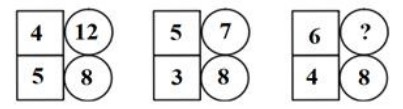
To solve this problem, we need to identify the pattern used in the given diagram to determine the number that replaces the question mark.
\[ 10 - x + 8 = 6 \]
\[ 18 - x = 6 \]
\[ x = 18 - 6 \]
\[ x = 12 \]
Therefore, the number that replaces the question mark is 12.
Correct Option: C) 12
To find the compound interest, we can calculate the amount after 2 years using the compound interest formula and then subtract the principal. Alternatively, we can calculate the interest for each year separately, adding the previous year's interest to the principal for the next year's calculation.
The formula for the amount (\(A\)) compounded annually is:
\[ A = P \left(1 + \frac{R}{100}\right)^T \]Substitute the given values:
\[ A = 7500 \left(1 + \frac{4}{100}\right)^2 \] \[ A = 7500 \left(1 + 0.04\right)^2 \] \[ A = 7500 \left(1.04\right)^2 \] \[ A = 7500 \times 1.0816 \] \[ A = 8112 \]The compound interest (\(CI\)) is the Amount minus the Principal:
\[ CI = A - P \] \[ CI = 8112 - 7500 \] \[ CI = 612 \]For the first year:
\[ \text{Interest for 1st year} = \frac{P \times R \times T}{100} \] \[ \text{Interest for 1st year} = \frac{7500 \times 4 \times 1}{100} \] \[ \text{Interest for 1st year} = 75 \times 4 = 300 \]Amount at the end of the 1st year = Principal + Interest for 1st year
\[ \text{Amount after 1st year} = 7500 + 300 = 7800 \]For the second year:
The principal for the second year will be the amount at the end of the first year.
\[ \text{Interest for 2nd year} = \frac{7800 \times 4 \times 1}{100} \] \[ \text{Interest for 2nd year} = 78 \times 4 = 312 \]Total Compound Interest = Interest for 1st year + Interest for 2nd year
\[ \text{Total CI} = 300 + 312 = 612 \]Both methods yield the same result.
Correct Option: B) ₹612
The question asks for the definition of a parliamentary executive. We need to understand the fundamental characteristics of a parliamentary system of government, particularly the relationship between the executive and the legislature.
Correct Option: A) an executive who is dependent on the support of the majority in the parliament. This accurately describes a parliamentary executive, where the executive is accountable to and draws its legitimacy from the legislature (parliament).
To find the largest of four consecutive even integers given their average, we can represent the integers algebraically. Since they are consecutive even integers, they differ by 2. The average is the sum of the numbers divided by the count of numbers.
C) 30 — By representing the four consecutive even integers as \(x, x+2, x+4, x+6\) and using the given average, we found that the first integer \(x\) is 24. The largest integer is \(x+6\), which is \(24+6=30\).
To find the percentage increase, we need to calculate the absolute increase in the premium and then express this increase as a percentage of the original premium.
The percentage increase in the health insurance premium is 5%.
A) 5 % — This is the correct calculation for the percentage increase.
The question asks for the theme of the 2019 Human Development Report (HDR). To answer this, one needs to recall the specific focus of the HDR for that particular year, which is often highlighted in its title or introductory remarks.
D) focusing on inequality. The 2019 Human Development Report explicitly focused on "Inequalities in human development in the 21st century," making this the correct theme.
The question asks about the number of fundamental rights originally enshrined in the Indian Constitution in 1950. This requires knowledge of the historical evolution of fundamental rights in India.
Correct Option: A) Seven
The question asks for the year when the British achieved political power in India. This refers to a pivotal moment when their influence transitioned from mere trade to direct political control and territorial acquisition. We need to identify the historical event that marked this shift.
Correct Option: C) 1757 — The Battle of Plassey, fought in 1757, is widely regarded as the event that marked the beginning of British political dominance and territorial rule in India. After this battle, the British East India Company gained significant political power and control over Bengal, which was one of the wealthiest provinces in India at the time.
To find the total time required, we need to divide the total number of words by the typing rate. The result will be in minutes, which then needs to be converted into minutes and seconds.
The formula to calculate time is:
\[ \text{Time} = \frac{\text{Total words}}{\text{Typing rate}} \]Substitute the given values:
\[ \text{Time} = \frac{987 \text{ words}}{35 \text{ words/minute}} \]Perform the division:
\[ \text{Time} = 28.2 \text{ minutes} \]The total time is 28 minutes and 0.2 minutes.
To convert 0.2 minutes to seconds, multiply by 60 (since 1 minute = 60 seconds):
\[ \text{Seconds} = 0.2 \text{ minutes} \times 60 \text{ seconds/minute} \]Perform the multiplication:
\[ \text{Seconds} = 12 \text{ seconds} \]So, the total time taken is 28 minutes and 12 seconds.
B) 28 mins 12 secs is the correct answer, as calculated by dividing the total words by the typing rate and converting the decimal part of minutes to seconds.