The question asks about the primary application of the SONAR technique. SONAR stands for Sound Navigation and Ranging. It uses sound waves to detect objects and measure distances, particularly underwater.
Correct Option: B) depth of the sea. SONAR is extensively used to measure the depth of the sea (bathymetry) by sending sound waves to the seabed and calculating the distance based on the time taken for the echo to return.
Find the correct expression for 5.46̄ (with 46 recurring) in the fractional form.
\( \frac{541}{99} \)
\( \frac{541}{900} \)
\( \frac{546}{99} \)
\( \frac{541}{100} \)
To convert a recurring decimal into a fractional form, we use an algebraic method. We assign the decimal to a variable, multiply it by powers of 10 to align the recurring part, and then subtract the equations to eliminate the recurring digits.
Let the given recurring decimal be \(x\):
\[ x = 5.4666... \]Identify the non-recurring part and the recurring part. Here, '4' is the non-recurring part after the decimal, and '6' is the recurring part.
Multiply \(x\) by a power of 10 such that the non-recurring digits after the decimal point move to the left of the decimal point. In this case, we need to move '4' to the left, so we multiply by \(10^1 = 10\):
\[ 10x = 54.666... \quad \text{(Equation 1)} \]Now, multiply \(x\) by a power of 10 such that the recurring block starts immediately after the decimal point. In this case, the recurring block '6' starts immediately after '4'. So, we need to move '46' to the left of the decimal point. We multiply by \(10^2 = 100\):
\[ 100x = 546.666... \quad \text{(Equation 2)} \]Subtract Equation 1 from Equation 2 to eliminate the recurring part:
\[ 100x - 10x = 546.666... - 54.666... \]\[ 90x = 492 \]Solve for \(x\):
\[ x = \frac{492}{90} \]Simplify the fraction by dividing both the numerator and the denominator by their greatest common divisor. Both are divisible by 6:
\[ x = \frac{492 \div 6}{90 \div 6} \]\[ x = \frac{82}{15} \]Re-evaluating the question: The question states "5.46̄ (with 46 recurring)". This notation means that both 4 and 6 are recurring, i.e., \(5.464646...\). Let's re-solve with this interpretation.
Let \(x = 5.464646...\) (Equation 1)
Since two digits (46) are recurring, multiply \(x\) by \(10^2 = 100\):
\[ 100x = 546.464646... \quad \text{(Equation 2)} \]Subtract Equation 1 from Equation 2:
\[ 100x - x = 546.464646... - 5.464646... \]\[ 99x = 541 \]Solve for \(x\):
\[ x = \frac{541}{99} \]The notation "5.46̄ (with 46 recurring)" typically means that the bar is over both '4' and '6', indicating that '46' is the repeating block. If the bar was only over '6', it would be written as \(5.4\bar{6}\). Given the options, the interpretation that '46' is the repeating block is consistent with option A.
A) \( \frac{541}{99} \) is the correct fractional form for \(5.464646...\).
The question asks for the year when the first elections for provincial legislatures were held in British India. This refers to the elections conducted under the provisions of the Government of India Act, 1935.
Correct Option: D) 1937
The first elections for the provincial legislatures in British India, based on the Government of India Act, 1935, were held in 1936-1937, with the results and formation of ministries occurring in 1937. This marked a significant step towards greater Indian participation in governance at the provincial level.
To find the mean (average) of a set of data, we need to sum all the values in the dataset and then divide this sum by the total number of values in the dataset. This is a fundamental concept in statistics.
Correct Option: B) 4.6
To find the number of integers divisible by 11 between 500 and 700, we need to identify the first multiple of 11 greater than or equal to 500 and the last multiple of 11 less than or equal to 700. Then, we can use the formula for the number of terms in an arithmetic progression.
B) 18 is the correct count of numbers divisible by 11 between 500 and 700.
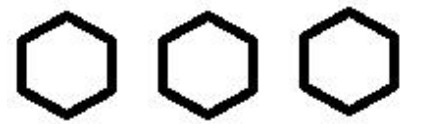
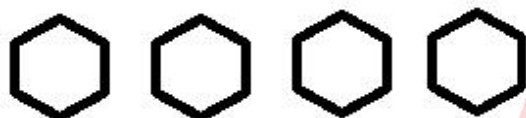
Study the given pattern carefully and select the option that can replace the question mark (?) in it.
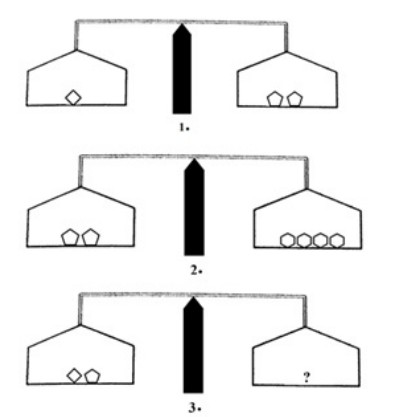
The problem involves identifying a pattern in a sequence of diagrams and selecting the option that logically completes the sequence.
Correct Option: A) The diagram with 4 hexagons in the right house.
This is a problem involving ages, which can be solved by setting up a system of linear equations based on the given conditions. We will define variables for the present ages of the father and son and then translate the given statements into algebraic equations.
Define variables:
Let the present age of the son be \(S\) years.
Let the present age of the father be \(F\) years.
Formulate the first equation:
The problem states, "A father is 3 times as old as his son today."
So, we can write:
Formulate the second equation:
The problem states, "After 13 years the father will be twice as old as his son."
After 13 years:
According to the condition:
\[ F + 13 = 2(S + 13) \quad \text{(Equation 2)} \]Solve the system of equations:
Substitute Equation 1 into Equation 2:
Simplify and solve for \(S\):
\[ 3S + 13 = 2S + 26 \]Isolate \(S\) terms on one side and constants on the other:
\[ 3S - 2S = 26 - 13 \]\[ S = 13 \]State the present age of the son:
The present age of the son is 13 years.
Correct Option: B) 13 years
The question asks to identify the author of the Sanskrit drama 'Ratnavali'. This is a factual question related to ancient Indian literature and history.
Correct Option: D) Harsha
Harsha, also known as Harshavardhana, was an Indian emperor who ruled northern India from 606 to 647 CE. He was not only a powerful ruler but also a patron of art and literature, and a skilled writer himself. He is credited with writing three Sanskrit plays: Ratnavali, Priyadarshika, and Nagananda. Ratnavali is a popular romantic comedy (Natika) in four acts.
A man purchased an item for ₹1,200, spent ₹300 on its repairs and sold it for ₹2,000. What is the profit percentage?
To calculate the profit percentage, we first need to determine the total cost price of the item and the profit made. The total cost price includes the purchase price and any expenses incurred for repairs. The profit is the difference between the selling price and the total cost price. Finally, the profit percentage is calculated by dividing the profit by the total cost price and multiplying by 100.
Calculate the Total Cost Price (CP):
The man purchased the item for ₹1,200 and spent ₹300 on its repairs. The total cost price is the sum of these two amounts.
\[ \text{Total CP} = \text{Purchase Price} + \text{Repair Cost} \] \[ \text{Total CP} = \text{₹}1,200 + \text{₹}300 = \text{₹}1,500 \]Calculate the Profit:
The item was sold for ₹2,000. The profit is the difference between the Selling Price (SP) and the Total Cost Price (CP).
\[ \text{Profit} = \text{Selling Price} - \text{Total Cost Price} \] \[ \text{Profit} = \text{₹}2,000 - \text{₹}1,500 = \text{₹}500 \]Calculate the Profit Percentage:
The profit percentage is calculated using the formula:
\[ \text{Profit Percentage} = \left( \frac{\text{Profit}}{\text{Total Cost Price}} \right) \times 100\% \] \[ \text{Profit Percentage} = \left( \frac{\text{₹}500}{\text{₹}1,500} \right) \times 100\% \] \[ \text{Profit Percentage} = \left( \frac{1}{3} \right) \times 100\% \] \[ \text{Profit Percentage} = 33\frac{1}{3}\% \]Correct Option: A) \(33\frac{1}{3}\)\%
The area of the triangle formed by the line 2x - 4y - 7 = 0 with the coordinate axis is:
\( \frac{49}{8} \) unit\( ^{2} \)
\( \frac{49}{4} \) unit\( ^{2} \)
\( \frac{49}{2} \) unit\( ^{2} \)
\( \frac{49}{16} \) unit\( ^{2} \)
To find the area of the triangle formed by a line with the coordinate axes, we first need to find the points where the line intersects the x-axis and the y-axis. These points, along with the origin \((0,0)\), will form the vertices of the triangle. The area of such a right-angled triangle can then be calculated using the formula: Area \( = \frac{1}{2} \times \text{base} \times \text{height} \), where the base and height are the absolute values of the x-intercept and y-intercept, respectively.
Identify the equation of the line:
The given equation of the line is \(2x - 4y - 7 = 0\).
Find the x-intercept:
To find the x-intercept, set \(y = 0\) in the equation of the line:
\[ 2x - 4(0) - 7 = 0 \]\[ 2x - 7 = 0 \]\[ 2x = 7 \]\[ x = \frac{7}{2} \]The x-intercept is \( \left( \frac{7}{2}, 0 \right) \). So, the base of the triangle is \[\left| \frac{7}{2} \right| = \frac{7}{2}\] units.Find the y-intercept:
To find the y-intercept, set \(x = 0\) in the equation of the line:
\[ 2(0) - 4y - 7 = 0 \]\[ -4y - 7 = 0 \]\[ -4y = 7 \]\[ y = -\frac{7}{4} \]The y-intercept is \( \left( 0, -\frac{7}{4} \right) \). So, the height of the triangle is \[\left| -\frac{7}{4} \right| = \frac{7}{4}\] units.Calculate the area of the triangle:
The triangle formed has vertices at the origin \((0,0)\), the x-intercept \( \left( \frac{7}{2}, 0 \right) \), and the y-intercept \( \left( 0, -\frac{7}{4} \right) \). This is a right-angled triangle with base \( \frac{7}{2} \) and height \( \frac{7}{4} \).
The area of the triangle is given by:
\[ \text{Area} = \frac{1}{2} \times \text{base} \times \text{height} \]\[ \text{Area} = \frac{1}{2} \times \frac{7}{2} \times \frac{7}{4} \]\[ \text{Area} = \frac{49}{16} \]The area is \( \frac{49}{16} \) square units.Correct Option: D) \( \frac{49}{16} \) unit\( ^{2} \)