
The question asks to identify the successor of Chandragupta I on the Gupta throne. This requires knowledge of the succession order of prominent rulers in the Gupta Empire.
C) Samudragupta — Samudragupta was the son and immediate successor of Chandragupta I. His reign marked a period of significant expansion and consolidation of the Gupta Empire, earning him the title "Napoleon of India" from historian V.A. Smith.
The question asks to identify the instrument used for measuring wind speed. We need to recall the functions of the given instruments.
Correct Option: B) Anemometer is the correct instrument for measuring wind speed.
The question asks to identify a volatile memory from the given options. Volatile memory is a type of computer memory that requires power to maintain the stored information. Most modern RAM (Random Access Memory) is volatile memory. We need to evaluate each option based on this definition.
Correct Option: A) RAM is a volatile memory. Its contents are lost when the power is turned off.
The question asks about the organ responsible for providing nutrition to a baby in the mother's womb. This is a fundamental concept in human reproduction and developmental biology.
C) placenta — The placenta is a temporary organ that develops in the uterus during pregnancy. It provides oxygen and nutrients to the growing baby and removes waste products from the baby's blood. It acts as a vital interface between the mother and the fetus, ensuring proper development.
The question asks to identify the Buddhist monument built by Emperor Ashoka in Madhya Pradesh to honor Lord Buddha. This requires knowledge of major Buddhist sites associated with Ashoka and their locations.
Correct Option: A) Sanchi Stupa — The Great Stupa at Sanchi, located in Madhya Pradesh, was originally commissioned by Emperor Ashoka in the 3rd century BCE. It is one of the oldest and most significant Buddhist monuments in India, built to house relics of the Buddha.
A person sells his table at a profit of 12\( \frac{1}{2} \)% and chair at a loss of 8\( \frac{1}{3} \)% but on the whole he gains ₹25. On the other hand, if he sells the table at a loss of 8\( \frac{1}{3} \)% and the chair at a profit of 12\( \frac{1}{2} \)% then he neither gains nor loses. Find the cost price of the table.
This problem involves two scenarios of selling a table and a chair with different profit/loss percentages, leading to two linear equations. We need to set up these equations based on the given profit/loss percentages and the overall gain/loss, and then solve them simultaneously to find the cost price of the table.
Define variables:
Convert percentages to fractions:
Formulate the first scenario equation:
In the first scenario, the person sells the table at a profit of \(12\frac{1}{2}\)% and the chair at a loss of \(8\frac{1}{3}\)%. The overall gain is ₹25.
Formulate the second scenario equation:
In the second scenario, the person sells the table at a loss of \(8\frac{1}{3}\)% and the chair at a profit of \(12\frac{1}{2}\)%. There is neither gain nor loss (overall gain/loss is 0).
Solve the system of equations:
From Equation 2, we can express \(C_C\) in terms of \(C_T\):
Find the cost price of the chair (optional, but good for verification):
\[ C_C = \frac{2}{3} C_T = \frac{2}{3} \times 360 = 2 \times 120 = 240 \]The cost price of the table is ₹360.
C) ₹360 is the correct cost price of the table as calculated by solving the system of linear equations derived from the problem statements.
Select the Venn diagram that best represents the relationship between the given classes.
Mammals, Tigers, Cows.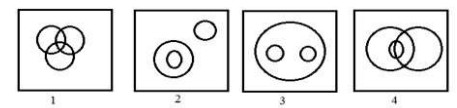
To determine the correct Venn diagram that represents the relationship between the classes "Mammals," "Tigers," and "Cows," we need to understand the hierarchical relationship among these categories.
Correct Option: B) Option 3, where two smaller circles are inside a larger circle, correctly represents this relationship.
The problem asks us to find the value of an algebraic expression given the values of variables \(a\), \(b\), and \(c\). We can substitute the given values of \(a\), \(b\), and \(c\) into the expression and simplify. Alternatively, we can recognize the given expression as a standard algebraic identity.
The given expression is \( a^{2} + b^{2} + c^{2} - 2ab + 2ac - 2bc \).
Recall the algebraic identity for the square of a trinomial: \( (x + y + z)^{2} = x^{2} + y^{2} + z^{2} + 2xy + 2yz + 2zx \).
The given expression has negative terms: \(-2ab\), \(-2bc\), and a positive term: \(+2ac\). This suggests that one or more of the terms \(a\), \(b\), or \(c\) in the identity might be negative.
Let's compare \( a^{2} + b^{2} + c^{2} - 2ab + 2ac - 2bc \) with \( (X + Y + Z)^{2} = X^{2} + Y^{2} + Z^{2} + 2XY + 2YZ + 2ZX \).
We can see that the \(a^2\), \(b^2\), \(c^2\) terms are positive. The \(2ac\) term is positive, while \(2ab\) and \(2bc\) are negative. This pattern suggests that \(b\) might be negative when multiplied by \(a\) and \(c\), but \(a\) and \(c\) are positive when multiplied together. So, we can consider the form \( (a - b + c)^2 \).
Let's expand \( (a - b + c)^{2} \):
\[ (a - b + c)^{2} = a^{2} + (-b)^{2} + c^{2} + 2(a)(-b) + 2(-b)(c) + 2(c)(a) \]
\[ = a^{2} + b^{2} + c^{2} - 2ab - 2bc + 2ac \]
This matches the given expression exactly.
Now, substitute the given values of \(a\), \(b\), and \(c\) into \( (a - b + c)^{2} \):
Given: \( a = x + y \), \( b = x - y \), and \( c = 2x - 1 \).
Substitute these into \( (a - b + c) \):
\[ a - b + c = (x + y) - (x - y) + (2x - 1) \]
\[ = x + y - x + y + 2x - 1 \]
\[ = (x - x + 2x) + (y + y) - 1 \]
\[ = 2x + 2y - 1 \]
Therefore, the value of the expression is \( (2x + 2y - 1)^{2} \).
Correct Option: B) \( (2x + 2y - 1)^{2} \)
The Khilafat Movement was a political campaign launched by Indian Muslims to pressure the British government to protect the integrity of the Ottoman Caliphate. Understanding the historical context of the Ottoman Empire and its role as the seat of the Caliphate is key to identifying the origin of the movement's concerns.
C) Turkey is the correct answer because the Khilafat Movement was primarily concerned with the fate of the Ottoman Empire, whose capital and spiritual center (the Caliphate) were located in Turkey. The movement aimed to protect the Caliph and the Ottoman territories from dismemberment by the Allied powers after World War I.
The question asks for the full form of IPAB, which was constituted in 2003 under the Ministry of Commerce and Industry. This is a factual recall question related to Indian administrative bodies and intellectual property.
Correct Option: B) The full form of IPAB is the Intellectual Property Appellate Board. It was constituted by the Indian government in 2003 to hear appeals against the decisions of the Registrar under the various Intellectual Property Acts, such as the Patents Act, the Trademarks Act, the Geographical Indications of Goods (Registration and Protection) Act, and the Copyright Act.