
The question asks about the fundamental structure of governance established by the Indian Constitution, specifically in the context of Parliamentary Democracy at both the Centre and State levels. We need to identify the term that best describes this governmental framework.
D) federal. The Constitution of India provides for a federal structure of governance. This means there is a division of powers between the Union (Central) government and the State governments, each sovereign in its own sphere, as delineated by the Constitution. Both operate under a parliamentary democratic system.
The question asks to identify a program that translates and executes high-level language instructions one by one. We need to understand the functions of different types of language processors.
Correct Option: C) An Interpreter is a program that translates each instruction of a high-level language and executes it before passing on to the next instruction. This method allows for immediate execution and easier debugging but can be slower than compiled programs.
The question asks to identify the city that hosted the India International Cherry Blossom Festival in 2019. This is a factual question related to current events and general knowledge, specifically concerning festivals in India's North-Eastern states.
Correct Option: C) Shillong
The question asks about the form in which plants store internal energy reserves. This relates to the process of photosynthesis and how plants manage the energy they produce.
D) carbohydrates — Starch is a complex carbohydrate. Plants synthesize glucose (a simple carbohydrate) during photosynthesis and then convert it into starch for storage. This starch serves as the internal energy reserve.
To find the area of paper needed, we need to calculate the sum of the areas of the base, the two side faces, and the back face of the cuboid aquarium. We are given the external dimensions of the cuboid: length, breadth, and height.
The base is a rectangle with dimensions length \(\times\) breadth.
\[ \text{Area of base} = L \times B = 80 \text{ cm} \times 30 \text{ cm} = 2400 \text{ cm}^2 \]There are two side faces. Each side face is a rectangle with dimensions breadth \(\times\) height.
\[ \text{Area of one side face} = B \times H = 30 \text{ cm} \times 40 \text{ cm} = 1200 \text{ cm}^2 \] \[ \text{Area of two side faces} = 2 \times (B \times H) = 2 \times 1200 \text{ cm}^2 = 2400 \text{ cm}^2 \]The back face is a rectangle with dimensions length \(\times\) height.
\[ \text{Area of back face} = L \times H = 80 \text{ cm} \times 40 \text{ cm} = 3200 \text{ cm}^2 \]Sum the areas of the base, two side faces, and the back face.
\[ \text{Total area} = \text{Area of base} + \text{Area of two side faces} + \text{Area of back face} \] \[ \text{Total area} = 2400 \text{ cm}^2 + 2400 \text{ cm}^2 + 3200 \text{ cm}^2 \] \[ \text{Total area} = 8000 \text{ cm}^2 \]Correct Option: B) 8000 cm²
This problem involves trigonometry, specifically the concept of the angle of elevation. We can model the situation as a right-angled triangle where the lamp post is the perpendicular side, the distance from the point to the foot of the lamp post is the base, and the line of sight to the top of the lamp post is the hypotenuse. We will use the tangent function to relate the angle of elevation to the height of the lamp post and the given distance.
In a right-angled triangle, the tangent of an angle is defined as the ratio of the length of the opposite side (perpendicular) to the length of the adjacent side (base).
\[ \tan(\theta) = \frac{\text{Perpendicular}}{\text{Base}} \]Let the height of the lamp post be \(h\).
\[ \tan(45°) = \frac{h}{80 \text{ m}} \]The value of \(\tan(45°)\) is 1.
B) 80 m. Based on the trigonometric calculation, the height of the lamp post is 80 m.
How much does one need to add to \( \frac{1}{2} \) to get 2?
\( \frac{3}{2} \)
\( \frac{1}{-1} \)
\( \frac{1}{2} \)
\( \frac{5}{3} \)
The problem asks us to find a number that, when added to \( \frac{1}{2} \), results in 2. This can be set up as a simple algebraic equation.
Correct Option: A) \( \frac{3}{2} \)
In the following diagram, if the triangle represents the people who drink green tea, the circle represents the people who drink coffee and the rectangle represents the people who drink milk, then how many people like both green tea and coffee?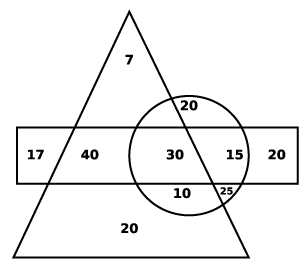
We need to determine how many people like both green tea and coffee by analyzing the given diagram, where the triangle represents green tea drinkers, the circle represents coffee drinkers, and the rectangle represents milk drinkers.
Correct Option: C) 40
This is a work and time problem. The key idea is to calculate the 'one day's work' for each individual or group. If a person completes a task in \(N\) days, their one day's work is \(1/N\) of the task. We will use this concept to find Chitra's one day's work and then determine the number of days she needs to complete the task alone.
Calculate Ameesha's one day's work:
Ameesha completes the task in 14 days. So, Ameesha's one day's work is:
\[ \text{Ameesha's work per day} = \frac{1}{14} \text{ of the task} \]Calculate Bhavya's one day's work:
Bhavya completes the task in 35 days. So, Bhavya's one day's work is:
\[ \text{Bhavya's work per day} = \frac{1}{35} \text{ of the task} \]Calculate the combined one day's work of Ameesha, Bhavya, and Chitra:
Together, Ameesha, Bhavya, and Chitra complete the task in 6 days. So, their combined one day's work is:
\[ \text{(Ameesha + Bhavya + Chitra)'s work per day} = \frac{1}{6} \text{ of the task} \]Calculate Chitra's one day's work:
To find Chitra's one day's work, we subtract Ameesha's and Bhavya's individual one day's work from their combined one day's work:
\[ \text{Chitra's work per day} = \text{(Ameesha + Bhavya + Chitra)'s work per day} - \text{Ameesha's work per day} - \text{Bhavya's work per day} \] \[ \text{Chitra's work per day} = \frac{1}{6} - \frac{1}{14} - \frac{1}{35} \]To subtract these fractions, find a common denominator. The least common multiple (LCM) of 6, 14, and 35 is 210.
\[ \text{Chitra's work per day} = \frac{35}{210} - \frac{15}{210} - \frac{6}{210} \] \[ \text{Chitra's work per day} = \frac{35 - 15 - 6}{210} \] \[ \text{Chitra's work per day} = \frac{20 - 6}{210} \] \[ \text{Chitra's work per day} = \frac{14}{210} \]Simplify the fraction:
\[ \text{Chitra's work per day} = \frac{1}{15} \text{ of the task} \]Calculate the number of days Chitra needs to complete the task alone:
If Chitra completes \(1/15\) of the task in one day, she will take 15 days to complete the entire task alone.
\[ \text{Days for Chitra alone} = \frac{1}{\text{Chitra's work per day}} = \frac{1}{1/15} = 15 \text{ days} \]To find the combined ratio A : B : C : D, we need to make the common terms in the given individual ratios equal. We will start by combining two ratios at a time, ensuring the common variable has the same value in both, and then extend this to the next ratio.
Combine A : B and B : C:
Given:
To combine these, we need to make the value of B the same in both ratios. The least common multiple (LCM) of 3 and 5 is 15.
Now, we have \(A : B : C = 5 : 15 : 12\).
Combine A : B : C and C : D:
Given:
To combine these, we need to make the value of C the same in both ratios. The LCM of 12 (from A:B:C) and 2 (from C:D) is 12.
Now, we can combine them to get \(A : B : C : D = 5 : 15 : 12 : 18\).
Correct Option: D) 5 : 15 : 12 : 18