The question asks to identify the gas that constitutes 78% of the Earth's atmosphere and is crucial for life. This requires knowledge of atmospheric composition and the role of different elements in biological processes.
C) Nitrogen — Nitrogen gas (\(N_2\)) constitutes approximately 78% of the Earth's atmosphere. It is also a fundamental component of many biological molecules essential for life, such as proteins, DNA, and RNA. Although atmospheric nitrogen is relatively inert, it is converted into usable forms by nitrogen-fixing bacteria, making it accessible to plants and, subsequently, to other organisms.
The problem involves dividing an amount of money among three individuals (A, B, and C) in a given ratio. We are provided with the difference between the shares of two individuals (A and C) and need to find the total amount. We will use the concept of ratios to represent the shares and then use the given difference to find the value of one ratio unit, which will allow us to calculate the total amount.
Understand the given ratio: The money is divided among A, B, and C in the ratio of 5 : 2 : 8. This means:
where \(x\) is a common multiplier or a unit of the ratio.
Use the given difference: The difference between the shares of A and C is ₹7,740.
Difference \(= \text{Share of C} - \text{Share of A}\)
Since C's share (8x) is greater than A's share (5x), the difference is:
\[ 8x - 5x = 7,740 \]Calculate the value of \(x\): Simplify the equation:
\[ 3x = 7,740 \]Now, solve for \(x\):
\[ x = \frac{7,740}{3} \] \[ x = 2,580 \]Calculate the total amount: The total amount is the sum of the shares of A, B, and C:
\[ \text{Total Amount} = \text{Share of A} + \text{Share of B} + \text{Share of C} \] \[ \text{Total Amount} = 5x + 2x + 8x \] \[ \text{Total Amount} = (5 + 2 + 8)x \] \[ \text{Total Amount} = 15x \]Substitute the value of \(x\) we found:
\[ \text{Total Amount} = 15 \times 2,580 \] \[ \text{Total Amount} = 38,700 \]So, the total amount is ₹38,700.
B) ₹38,700 is the correct total amount calculated based on the given ratio and the difference in shares.
The problem involves calculating the total volume of milk required to fill a vessel and then determining how many smaller glasses are needed to hold that same total volume. We will first find the total volume of the vessel and then divide this total volume by the capacity of the new glass to find the number of glasses required.
Therefore, 45 glasses, each with a capacity of 0.5 L, are required to fill the same vessel.
Correct Option: B) 45
This problem involves understanding the relationship between profit percentage calculated on cost price and profit percentage calculated on selling price. We will use the basic definitions of profit, cost price (CP), and selling price (SP) to establish an equation and solve for the unknown percentage.
Let the Cost Price be \(CP\) and the Selling Price be \(SP\).
Profit (\(P\)) is defined as \(P = SP - CP\).
The problem states that the profit on selling price is 20%. This can be written as:
\[ \text{Profit} = 20\% \text{ of } SP \]
So, \(P = 0.20 \times SP\).
Substitute this value of profit into the profit formula:
\[ 0.20 \times SP = SP - CP \]
Rearrange the equation to find the relationship between \(SP\) and \(CP\):
\[ CP = SP - 0.20 \times SP \]
\[ CP = (1 - 0.20) \times SP \]
\[ CP = 0.80 \times SP \]
This means \[SP = \frac{CP}{0.80} = \frac{100}{80} CP = \frac{5}{4} CP\].
Now, we need to find the profit percentage on the cost price. The formula for profit percentage on cost price is:
\[ \text{Profit \% on CP} = \frac{\text{Profit}}{CP} \times 100 \% \]
We know \(P = 0.20 \times SP\) and \(SP = \frac{1}{0.80} CP\). Substitute \(SP\) in the profit equation:
\[ P = 0.20 \times \left(\frac{1}{0.80} CP\right) \]
\[ P = \frac{0.20}{0.80} CP \]
\[ P = \frac{1}{4} CP \]
Now, substitute this into the profit percentage on CP formula:
\[ \text{Profit \% on CP} = \frac{\frac{1}{4} CP}{CP} \times 100 \% \]
\[ \text{Profit \% on CP} = \frac{1}{4} \times 100 \% \]
\[ \text{Profit \% on CP} = 25 \% \]
Correct Option: C) 25%
Which of the following was introduced as the 101st Amendment of the Constitution of India on July 1, 2017?
Goods and Service Tax
Land boundary agreement between India and Bangladesh
Replacing Orissa with Odisha
Constitutional status of cooperatives
The question asks to identify the constitutional amendment that was introduced as the 101st Amendment on July 1, 2017. This requires knowledge of significant constitutional amendments and their effective dates.
Correct Option: A) Goods and Service Tax. The 101st Constitutional Amendment Act, 2016, paved the way for the introduction of the Goods and Services Tax (GST) in India. The GST was implemented nationwide on July 1, 2017, making it the correct answer.
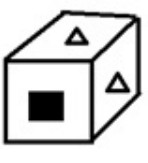
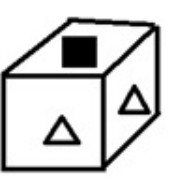
Which cube given in the options CANNOT be made using the following sheet?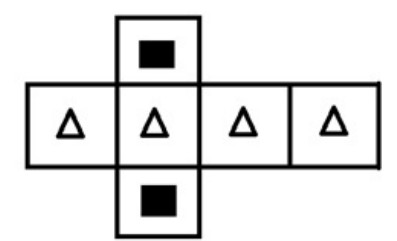
To determine which cube cannot be formed from the given net, we need to analyze the arrangement of the faces in the net and compare it with each option.
Correct Option: B) The cube in option B shows two black square faces adjacent to each other, which is impossible as they must be opposite.
The question asks for the specific period approved by the Union Cabinet for the continuation of the GSLV phase-4 programmes, consisting of five GSLV flights. This is a factual question related to current affairs and government decisions concerning India's space program.
D) 2021-2024 is the correct period approved by the Union Cabinet for the continuation of the GSLV phase-4 programmes, comprising five GSLV flights.
What is the value of the following expression?
\(\frac{\cos3x+\cos x}{\sin3x-\sin x}\)
To simplify the given trigonometric expression, we will use the sum-to-product trigonometric identities. Specifically, we will apply the formulas for \(\cos A + \cos B\) and \(\sin A - \sin B\).
Let \(A = 3x\) and \(B = x\). For the numerator \(\cos 3x + \cos x\):
\[ \cos 3x + \cos x = 2 \cos\left(\frac{3x+x}{2}\right) \cos\left(\frac{3x-x}{2}\right) \] \[ = 2 \cos\left(\frac{4x}{2}\right) \cos\left(\frac{2x}{2}\right) \] \[ = 2 \cos(2x) \cos(x) \]Let \(A = 3x\) and \(B = x\). For the denominator \(\sin 3x - \sin x\):
\[ \sin 3x - \sin x = 2 \cos\left(\frac{3x+x}{2}\right) \sin\left(\frac{3x-x}{2}\right) \] \[ = 2 \cos\left(\frac{4x}{2}\right) \sin\left(\frac{2x}{2}\right) \] \[ = 2 \cos(2x) \sin(x) \]Cancel out the common terms \(2 \cos(2x)\) from the numerator and denominator (assuming \(\cos(2x) \neq 0\)):
\[ = \frac{\cos(x)}{\sin(x)} \]We know that \(\frac{\cos(x)}{\sin(x)} = \cot(x)\).
\[ = \cot(x) \]Correct Option: D) cot x
The question asks to identify a folk dance form specific to the state of Maharashtra from the given options. This requires knowledge of Indian folk dances and their regional origins.
B) Lavani
Lavani is a traditional folk dance of Maharashtra, India. It is performed to the beats of a Dholki (a percussion instrument) and is known for its powerful rhythm and expressive movements. It is often performed by women in nine-yard sarees.
The question asks to identify the specific location on the east coast of India where the English established their first 'factory' (trading post) in 1611. This requires knowledge of early British colonial history in India.
A) Masulipatnam — The English East India Company established its first factory on the east coast of India at Masulipatnam in 1611. This port town in Andhra Pradesh was a prominent trading center at that time.