The question asks to identify the Delhi Sultanate ruler whose reign marked the largest territorial expansion. To answer this, we need to recall the territorial achievements of each ruler mentioned in the options.
Comparing the territorial extents, Muhammad bin Tughluq's empire was the largest.
Correct Option: A) Muhammad bin Tughluq's reign saw the largest extension of the Delhi Sultanate. His campaigns and administrative control stretched across almost the entire Indian subcontinent, reaching its peak during his rule.
The question asks to identify the statement that is NOT a property of colloids. We need to evaluate each given option against the known characteristics of colloidal solutions.
Based on the analysis, Option A is the only statement that is NOT a property of colloids.
A) Colloid cannot scatter a beam of light passing through it. This statement is incorrect. Colloids exhibit the Tyndall effect, which means they can scatter a beam of light passing through them. This phenomenon is used to distinguish colloidal solutions from true solutions.
We need to find a number that satisfies two conditions: it is a multiple of 7, and when divided by 6, 8, and 12, it leaves a remainder of 1. We will first find the general form of numbers that leave a remainder of 1 when divided by 6, 8, and 12. Then, we will use the condition that the number must be a multiple of 7 to find the least such number.
Find the Least Common Multiple (LCM) of 6, 8, and 12:
First, list the prime factors of each number:
The LCM is the product of the highest powers of all prime factors involved:
\[ \text{LCM}(6, 8, 12) = 2^3 \times 3 = 8 \times 3 = 24 \]Determine the general form of numbers that leave a remainder of 1:
Any number that leaves a remainder of 1 when divided by 6, 8, and 12 must be of the form \((\text{LCM} \times k) + 1\), where \(k\) is a positive integer.
So, the numbers are of the form \(24k + 1\).
Find the least multiple of 7 among these numbers:
We need to find the smallest value of \(k\) such that \(24k + 1\) is a multiple of 7. We can test values for \(k\):
Since we are looking for the least multiple of 7, \(49\) is our answer.
B) 49 is the least multiple of 7 which, when divided by 6, 8, and 12, leaves a remainder of 1. We verified that \(49 \div 6 = 8\) with remainder \(1\), \(49 \div 8 = 6\) with remainder \(1\), and \(49 \div 12 = 4\) with remainder \(1\).
This problem involves a series of profit calculations. We are given the final price C paid and need to work backward to find the initial cost price for A. We will use the formula for selling price with profit percentage.
Let the cost price for A be \(CP_A\).
A sells the article to B at a profit of 20%. So, the selling price for A (which is the cost price for B, \(CP_B\)) is:
\[ CP_B = CP_A + 20\% \text{ of } CP_A = CP_A \left(1 + \frac{20}{100}\right) = CP_A \left(\frac{120}{100}\right) = 1.2 \times CP_A \]B sells the article to C at a profit of 20%. So, the selling price for B (which is the cost price for C, \(CP_C\)) is:
\[ CP_C = CP_B + 20\% \text{ of } CP_B = CP_B \left(1 + \frac{20}{100}\right) = CP_B \left(\frac{120}{100}\right) = 1.2 \times CP_B \]We are given that C pays ₹360 for it, so \(CP_C = \text{₹}360\).
Substitute the expression for \(CP_B\) from step 2 into the equation from step 3:
\[ CP_C = 1.2 \times (1.2 \times CP_A) = 1.44 \times CP_A \]Now, substitute the value of \(CP_C\):
\[ 360 = 1.44 \times CP_A \]Solve for \(CP_A\):
\[ CP_A = \frac{360}{1.44} = \frac{360}{\frac{144}{100}} = \frac{360 \times 100}{144} \] \[ CP_A = \frac{36000}{144} \]To simplify, divide both numerator and denominator by common factors:
\[ CP_A = \frac{18000}{72} = \frac{9000}{36} = \frac{4500}{18} = \frac{2250}{9} = 250 \]So, the cost price for A was ₹250.
Correct Option: C) ₹250
The question asks about the specific type of currency for which BuyUcoin introduced India's first wholesale trading platform. This requires knowledge of recent developments in the financial technology and cryptocurrency sectors in India.
Correct Option: A) cryptocurrency — BuyUcoin is a prominent Indian cryptocurrency exchange. In 2021, they launched India's first wholesale trading platform specifically for cryptocurrencies, catering to bulk transactions and institutional investors.
Find the value of
\(\frac{\cos^2 22^\circ+\cos^2 68^\circ}{2(\sin^2 22^\circ+\sin^2 68^\circ)}\) - sin²16° - cos16°sin74°
The problem requires simplifying a trigonometric expression. We will use complementary angle identities such as \(\cos(90^\circ - \theta) = \sin \theta\) and \(\sin(90^\circ - \theta) = \cos \theta\), along with the Pythagorean identity \(\sin^2 \theta + \cos^2 \theta = 1\).
The first term is \[\frac{\cos^2 22^\circ+\cos^2 68^\circ}{2(\sin^2 22^\circ+\sin^2 68^\circ)}\].
We know that \(\cos 68^\circ = \cos(90^\circ - 22^\circ) = \sin 22^\circ\).
And \(\sin 68^\circ = \sin(90^\circ - 22^\circ) = \cos 22^\circ\).
Substitute these into the numerator and denominator:
\[ \text{Numerator} = \cos^2 22^\circ + \sin^2 22^\circ = 1 \]\[ \text{Denominator} = 2(\sin^2 22^\circ + \cos^2 22^\circ) = 2(1) = 2 \]\[ \text{So, the first term} = \frac{1}{2} \]The remaining terms are \(-\sin^2 16^\circ - \cos 16^\circ \sin 74^\circ\).
We know that \(\sin 74^\circ = \sin(90^\circ - 16^\circ) = \cos 16^\circ\).
Substitute this into the expression:
\[ -\sin^2 16^\circ - \cos 16^\circ (\cos 16^\circ) \]\[ = -\sin^2 16^\circ - \cos^2 16^\circ \]\[ = -(\sin^2 16^\circ + \cos^2 16^\circ) \]\[ = -(1) = -1 \]Now, add the results from step 1 and step 2:
\[ \frac{1}{2} + (-1) = \frac{1}{2} - 1 = -\frac{1}{2} \]A) \(-\frac{1}{2}\) is the correct answer, as derived from the step-by-step simplification of the given trigonometric expression.
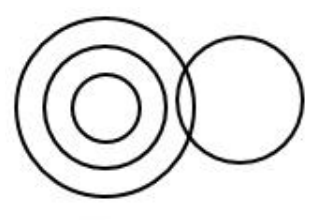
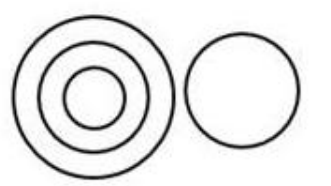
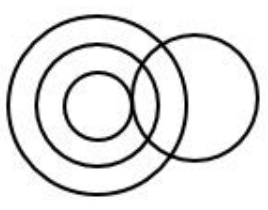
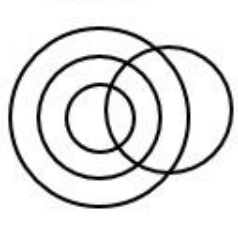
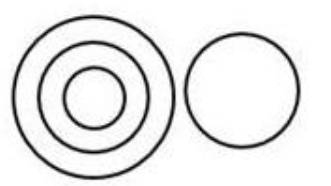
Select the Venn diagram that best represents the relationship between the following classes. Parallelogram, Rhombus, Square, Trapezoid
To determine the correct Venn diagram representation, we need to understand the hierarchical and overlapping relationships between the geometric figures: parallelogram, rhombus, square, and trapezoid.
Option B correctly represents this hierarchy with three nested circles (square inside rhombus inside parallelogram) and a separate circle for trapezoid.
Correct Option: B) The diagram shows nested circles for parallelogram, rhombus, and square, with trapezoid separate.
A bag contains cards numbered from 33 to 92 (both inclusive). If one card is drawn from the bag, the probability that the number on the drawn card is a perfect square is:
\( \frac{5}{59} \)
\( \frac{4}{59} \)
\( \frac{1}{15} \)
-\( \frac{1}{12} \)
To find the probability, we need to determine the total number of possible outcomes (total cards) and the number of favorable outcomes (cards with perfect squares). The probability is then calculated as the ratio of favorable outcomes to total outcomes.
Calculate the total number of cards: The cards are numbered from 33 to 92, both inclusive. The total number of cards can be found using the formula: \(\text{Last Number} - \text{First Number} + 1\).
\[ \text{Total cards} = 92 - 33 + 1 = 59 + 1 = 60 \]Identify perfect squares within the given range: We need to find the perfect squares between 33 and 92 (inclusive).
The perfect squares in the given range are 36, 49, 64, and 81.
Count the number of favorable outcomes: There are 4 perfect squares between 33 and 92.
\[ \text{Number of favorable outcomes} = 4 \]Calculate the probability: The probability of drawing a card with a perfect square is the ratio of the number of favorable outcomes to the total number of outcomes.
\[ \text{Probability} = \frac{\text{Number of favorable outcomes}}{\text{Total number of cards}} = \frac{4}{60} \]Simplify the probability:
\[ \text{Probability} = \frac{4}{60} = \frac{1}{15} \]C) \( \frac{1}{15} \) is the correct probability, as calculated by dividing the 4 perfect squares by the total of 60 cards.
To find the Least Common Multiple (LCM) of a set of numbers, we can use the prime factorization method. This involves finding the prime factors of each number and then taking the highest power of each prime factor present in any of the numbers.
Alternatively, we can use the division method:
\[ \begin{array}{c|ccc} 2 & 30 & 40 & 45 \\ \hline 2 & 15 & 20 & 45 \\ \hline 2 & 15 & 10 & 45 \\ \hline 3 & 15 & 5 & 45 \\ \hline 3 & 5 & 5 & 15 \\ \hline 5 & 5 & 5 & 5 \\ \hline & 1 & 1 & 1 \end{array} \]
\[ \text{LCM} = 2 \times 2 \times 2 \times 3 \times 3 \times 5 = 2^3 \times 3^2 \times 5 = 8 \times 9 \times 5 = 360 \]
D) 360 is the correct LCM of 30, 40, and 45.
The question asks to identify the device that uses ultrasonic waves to measure distance, direction, and speed of underwater objects. We need to evaluate each option based on its working principle and application.
A) SONAR (Sound Navigation And Ranging) is the device that uses ultrasonic waves to measure the distance, direction, and speed of underwater objects. It works by emitting sound pulses and detecting their echoes.