
To identify which device is NOT an output device, we need to understand the basic definitions of input and output devices in the context of computer systems. An input device sends data to a computer, while an output device receives data from a computer and displays or presents it to the user.
Correct Option: C) Scanner
The question asks about the gas present in soda water. Soda water, also known as carbonated water, gets its fizziness from a dissolved gas. We need to identify which of the given options is commonly used for this purpose.
C) Carbon dioxide is the gas dissolved in water under pressure to produce soda water, giving it its characteristic fizziness and slightly acidic taste.
Four persons A, B, C and D completed a task in \( \frac{2}{3} \) h, \( \frac{3}{4} \) h, \( \frac{4}{5} \)h and \( \frac{1}{5} \) h respectively. Who among the following took the highest amount of time to complete the task?
To find out who took the highest amount of time, we need to compare the given fractions representing the time taken by each person. The easiest way to compare fractions is to convert them to a common denominator or to their decimal equivalents.
Comparing the decimal values: \( 0.666... \), \( 0.75 \), \( 0.80 \), \( 0.20 \).
The largest value among these is \( 0.80 \).
The time \( 0.80 \) h corresponds to Person C.
Therefore, Person C took the highest amount of time to complete the task.
Correct Option: C) C
The question asks to identify the Mughal ruler who granted permission to the British to establish their first factory in Surat. This requires knowledge of the early interactions between the British East India Company and the Mughal Empire.
B) Jahangir - Emperor Jahangir granted the British permission to establish their first factory in Surat in 1613 after the British victory over the Portuguese in the Battle of Swally.
To find the numbers exactly divisible by 21, 35, and 63, we first need to find the Least Common Multiple (LCM) of these three numbers. Any number divisible by 21, 35, and 63 must also be divisible by their LCM. Once we have the LCM, we can find how many multiples of this LCM are less than 10000.
Find the prime factorization of each number:
Calculate the LCM of 21, 35, and 63:
The LCM is found by taking the highest power of all prime factors present in the numbers.
So, the LCM is:
\[ \text{LCM}(21, 35, 63) = 3^2 \times 5 \times 7 = 9 \times 5 \times 7 = 45 \times 7 = 315 \]Find the number of multiples of 315 that are less than 10000:
We need to find how many numbers \(N\) satisfy \(N < 10000\) and \(N\) is a multiple of 315. This means \(N = 315k\) for some integer \(k\).
So, we need to find the largest integer \(k\) such that:
\[ 315k < 10000 \]\[ k < \frac{10000}{315} \]\[ k < 31.746... \]Determine the number of such integers:
Since \(k\) must be an integer, the largest possible integer value for \(k\) is 31. The possible values for \(k\) are \(1, 2, 3, \ldots, 31\). Each value of \(k\) corresponds to a unique number divisible by 21, 35, and 63.
Therefore, there are 31 such numbers less than 10000.
D) 31
The question asks for the correct decreasing order of crop production in India for the year 2019-20. To answer this, one needs to recall or refer to the agricultural production statistics for major crops in India for the specified period.
Correct Option: A) Rice-wheat-coarse cereals-pulses
Identify the letter-pair that does NOT belong to the following group.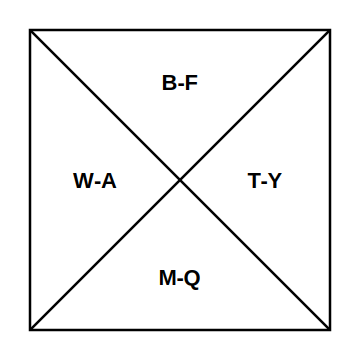
The problem involves identifying the letter-pair that does not fit the pattern shared by the others. The pattern is based on the alphabetical positions of the letters.
Correct Option: B) T-Y
What is the value of the following expression?
\(\left(\frac{\sqrt{225}}{14}\right)\times\left(\frac{\sqrt{196}}{22}\right)\times\left(\frac{\sqrt{484}}{15}\right)\)
To evaluate the given expression, we need to simplify each square root term first and then perform the multiplication of the resulting fractions. We will find the square root of each number (225, 196, and 484) and substitute these values back into the expression.
The given expression is: \[ \left(\frac{\sqrt{225}}{14}\right) \times \left(\frac{\sqrt{196}}{22}\right) \times \left(\frac{\sqrt{484}}{15}\right) \]
Step 1: Calculate the square roots
Step 2: Substitute the square root values into the expression
Substitute these values back into the original expression:
\[ \left(\frac{15}{14}\right) \times \left(\frac{14}{22}\right) \times \left(\frac{22}{15}\right) \]Step 3: Perform the multiplication and simplify
Now, multiply the fractions:
\[ \frac{15}{14} \times \frac{14}{22} \times \frac{22}{15} \]We can cancel out common terms from the numerator and denominator:
After cancellation, we are left with:
\[ \frac{\cancel{15}}{\cancel{14}} \times \frac{\cancel{14}}{\cancel{22}} \times \frac{\cancel{22}}{\cancel{15}} = 1 \]Thus, the value of the expression is 1.
Correct Option: B) 1
The question asks to identify the least urbanized state in India based on the 2011 Census data. This requires knowledge of urbanization statistics for Indian states.
As per the Census of 2011:
Comparing these figures, Himachal Pradesh clearly stands out as the least urbanized among the given options.
B) Himachal Pradesh had the lowest urban population percentage (10.03%) among the options, making it the least urbanized state as per the 2011 Census.