
The question asks to identify the correct statement regarding GPS. We need to evaluate each option based on general knowledge about GPS.
Correct Option: C) Mountains and building blocks can act as obstacles to GPS signals.
The question asks for the location of the famous Lion Capital pillar. This is a direct factual question related to ancient Indian history and art, specifically the Mauryan period.
Correct Option: A) Sarnath is the correct location for the Lion Capital pillar. The Ashoka Pillar at Sarnath is renowned for its Lion Capital, which features four Asiatic lions standing back to back, symbolizing power, courage, pride, and confidence. This capital was adopted as the National Emblem of India in 1950.
The question asks about the origin of Cyclone Amphan, which affected West Bengal in May 2020. To answer this, one needs to recall general knowledge about tropical cyclones affecting India, specifically those impacting the eastern coast, and the specific details of Cyclone Amphan's formation.
Correct Option: C) Bay of Bengal — Cyclone Amphan originated as a tropical depression in the southeastern Bay of Bengal and intensified as it moved northwards, eventually making landfall in West Bengal.
The question asks for the location of the Kanha Tiger Reserve. This is a factual question related to Indian geography and wildlife conservation. To answer this, one needs to recall the states where major tiger reserves are located.
Correct Option: A) Madhya Pradesh
Kanha Tiger Reserve is indeed located in Madhya Pradesh. It is one of the most prominent national parks in India and a major conservation area for tigers and other wildlife.
To identify the term that does not belong to the series, we need to analyze the pattern in each component of the given terms: the first number, the letter, and the second number.
D) 16Q12 — The first number in this term, 16, is not a prime number, while the first numbers in all other terms (2, 5, 11, 23) are prime numbers. The sequence of letters (T, S, R, Q, P) is a consistent reverse alphabetical order. The sequence of second numbers (3, 6, 9, 12, 15) is a consistent arithmetic progression with a common difference of 3. Therefore, 16Q12 is the term that does not follow the pattern of the first number being a prime number.
\The problem defines a new binary operation denoted by '∇'. We need to apply this operation sequentially following the order of operations (parentheses first) to find the final value.
Correct Option: B) The value of \((4 \nabla 5) \nabla 6\) is \(37\).
Study the given pattern carefully and select the number from among the given option that can replace the question mark (?).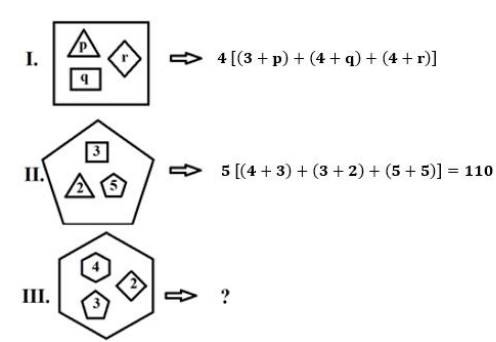
To solve this pattern-based question, we need to identify the relationship between the numbers inside the shapes and the operations applied to them. The key is to observe how the numbers are combined and multiplied to achieve the given results.
Correct Option: D) 144
The question asks to identify the Indian city or region that is in close proximity to the Karakoram Pass. This requires knowledge of the geographical location of the Karakoram Pass and the relative locations of the given options.
Correct Option: D) Kargil is a town in the Ladakh region, which is geographically closest to the Karakoram Pass among the given options. The Karakoram Pass is situated in the eastern part of the Karakoram Range, which is part of the larger Ladakh region.
The problem asks us to find the rate of interest given the principal amount, the time period, and the difference between compound interest (CI) and simple interest (SI) for that period. We can use the direct formula for the difference between CI and SI for 2 years or calculate CI and SI separately and then find the rate.
Identify the given values:
Recall the formula for the difference between CI and SI for 2 years:
For 2 years, the difference between compound interest and simple interest is given by:
Substitute the given values into the formula:
\[ 1000 = 16000 \left( \frac{R}{100} \right)^2 \]Solve for \(R\):
So, the rate of interest is 25% per annum.
B) 25% — The calculation shows that the rate of interest is 25% per annum.
The problem asks for the value of \(\tan(A+B)\) given the equation \((1 + \tan A)(1 + \tan B) = 2\). We will expand the given equation and then use the tangent addition formula, \(\tan(A+B) = \frac{\tan A + \tan B}{1 - \tan A \tan B}\), to find the required value.
Expand the given equation:
We are given \((1 + \tan A)(1 + \tan B) = 2\).
Expand the left side:
\[ 1 \cdot 1 + 1 \cdot \tan B + \tan A \cdot 1 + \tan A \cdot \tan B = 2 \] \[ 1 + \tan B + \tan A + \tan A \tan B = 2 \]Rearrange the expanded equation:
Subtract 1 from both sides:
\[ \tan A + \tan B + \tan A \tan B = 2 - 1 \] \[ \tan A + \tan B + \tan A \tan B = 1 \]Relate to the tangent addition formula:
The formula for \(\tan(A+B)\) is:
\[ \tan(A+B) = \frac{\tan A + \tan B}{1 - \tan A \tan B} \]From step 2, we have \(\tan A + \tan B + \tan A \tan B = 1\). We can rearrange this to find a relationship between \(\tan A + \tan B\) and \(1 - \tan A \tan B\).
Subtract \(\tan A \tan B\) from both sides of the equation from step 2:
\[ \tan A + \tan B = 1 - \tan A \tan B \]Substitute into the tangent addition formula:
Now, substitute \(1 - \tan A \tan B\) with \(\tan A + \tan B\) in the denominator of the \(\tan(A+B)\) formula:
\[ \tan(A+B) = \frac{\tan A + \tan B}{\tan A + \tan B} \]Assuming \(\tan A + \tan B \neq 0\), we can cancel the terms:
\[ \tan(A+B) = 1 \]If \(\tan A + \tan B = 0\), then from \(\tan A + \tan B = 1 - \tan A \tan B\), we would have \(0 = 1 - \tan A \tan B\), which means \(\tan A \tan B = 1\). In this case, \(\tan(A+B)\) would be \[\frac{0}{1-1} = \frac{0}{0}\], which is undefined. However, the problem implies a definite value exists. The condition \(\tan A + \tan B = 1 - \tan A \tan B\) generally holds, and if \(\tan A + \tan B \neq 0\), then the result is 1.
Correct Option: D) 1