
The question asks to identify the current owner of KUKA Robotics. This requires knowledge of major acquisitions and corporate structures in the industrial robotics sector. We need to recall which global conglomerate acquired KUKA.
Correct Option: D) Midea Group, China
Midea Group, a Chinese appliance manufacturer, acquired KUKA Robotics in 2017. This acquisition was a significant event in the industrial robotics industry, giving Midea Group a strong foothold in advanced automation technology.
Study the given pattern carefully and select the number that can replace the question mark (?) in it. 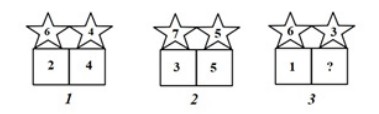
The given diagram consists of three sets of stars and boxes. Each set has two stars on top with numbers and two boxes below with numbers. Our task is to identify the pattern that relates the numbers in the stars to the numbers in the boxes and find the missing number.
Correct Option: A) 8
To find the number of sides of a regular polygon, we need to determine its interior or exterior angle. We are given the difference between the exterior and interior angles and the fact that the interior angle is greater. We will use the properties that the sum of an interior and exterior angle is 180° and the formulas for interior and exterior angles of a regular polygon.
Let \(I\) be the interior angle and \(E\) be the exterior angle of the regular polygon. For any polygon, the sum of an interior angle and its corresponding exterior angle is 180°.
\[ I + E = 180^\circ \quad \text{(Equation 1)} \]We are given that the difference between the exterior and interior angles is 60°, and the interior angle is greater than the exterior angle. So, we can write:
\[ I - E = 60^\circ \quad \text{(Equation 2)} \]Now we have a system of two linear equations. We can solve for \(I\) and \(E\). Add Equation 1 and Equation 2:
\[ (I + E) + (I - E) = 180^\circ + 60^\circ \] \[ 2I = 240^\circ \] \[ I = \frac{240^\circ}{2} \] \[ I = 120^\circ \]Substitute the value of \(I\) back into Equation 1 to find \(E\):
\[ 120^\circ + E = 180^\circ \] \[ E = 180^\circ - 120^\circ \] \[ E = 60^\circ \]For a regular polygon with \(n\) sides, the formula for the exterior angle is:
\[ E = \frac{360^\circ}{n} \]Substitute the calculated value of \(E\) into this formula:
\[ 60^\circ = \frac{360^\circ}{n} \]Solve for \(n\):
\[ n = \frac{360^\circ}{60^\circ} \] \[ n = 6 \]Thus, the polygon has 6 sides.
The question asks to identify the category to which services like Google Drive, SkyDrive (now OneDrive), and Dropbox belong. These services are widely known for storing files online.
D) cloud storage services — These services allow users to store their data on remote servers, which are maintained by a third party and accessed over the internet. This is the defining characteristic of Google Drive, SkyDrive (now OneDrive), and Dropbox.
If \( x^{2} - 3x + 1 = 0 \), then the value of \( x^{2} + x + ( \frac{1}{x} \)) + (\( \frac{1}{x^2} \)) is:
The problem asks us to find the value of an expression given a quadratic equation. We can manipulate the given equation to find the value of \(x + \frac{1}{x}\) and \(x^2 + \frac{1}{x^2}\), and then substitute these into the target expression.
Manipulate the given equation:
We are given the equation:
\[ x^2 - 3x + 1 = 0 \]Since \(x \neq 0\) (if \(x=0\), then \(1=0\), which is false), we can divide the entire equation by \(x\):
\[ \frac{x^2}{x} - \frac{3x}{x} + \frac{1}{x} = \frac{0}{x} \]\[ x - 3 + \frac{1}{x} = 0 \]Rearrange the terms to find \(x + \frac{1}{x}\):
\[ x + \frac{1}{x} = 3 \]Find the value of \(x^2 + \frac{1}{x^2}\):
We know the identity \( (a+b)^2 = a^2 + b^2 + 2ab \). Let \(a=x\) and \(b=\frac{1}{x}\). Then:
\[ \left(x + \frac{1}{x}\right)^2 = x^2 + \left(\frac{1}{x}\right)^2 + 2 \cdot x \cdot \frac{1}{x} \]\[ \left(x + \frac{1}{x}\right)^2 = x^2 + \frac{1}{x^2} + 2 \]Substitute the value of \(x + \frac{1}{x} = 3\) into this equation:
\[ (3)^2 = x^2 + \frac{1}{x^2} + 2 \]\[ 9 = x^2 + \frac{1}{x^2} + 2 \]Solve for \(x^2 + \frac{1}{x^2}\):
\[ x^2 + \frac{1}{x^2} = 9 - 2 \]\[ x^2 + \frac{1}{x^2} = 7 \]Evaluate the target expression:
The expression we need to evaluate is \[x^2 + x + \frac{1}{x} + \frac{1}{x^2}\]. We can rearrange it as:
\[ \left(x^2 + \frac{1}{x^2}\right) + \left(x + \frac{1}{x}\right) \]Substitute the values we found:
\[ 7 + 3 = 10 \]Thus, the value of the expression is \(10\).
B) 10 is the correct answer, as derived from the step-by-step calculation.
To solve this problem, we will use the property that if the HCF of two numbers is \(H\), then the numbers can be expressed as \(Hx\) and \(Hy\), where \(x\) and \(y\) are coprime integers. We will then use the given sum of the numbers to find possible pairs of \((x, y)\) and count the number of such coprime pairs.
Let the two numbers be \(A\) and \(B\).
Given that their HCF (Highest Common Factor) is 14. This means we can write the numbers as:
\[ A = 14x \ B = 14y \]where \(x\) and \(y\) are positive integers and are coprime (i.e., their HCF is 1). This condition is crucial because if \(x\) and \(y\) had a common factor greater than 1, then the HCF of \(A\) and \(B\) would be greater than 14.
Given that the sum of the two numbers is 98:
\[ A + B = 98 \]Substitute the expressions for \(A\) and \(B\) from step 2 into the sum equation:
\[ 14x + 14y = 98 \]Factor out 14 from the left side:
\[ 14(x + y) = 98 \]Divide both sides by 14 to find the sum of \(x\) and \(y\):
\[ x + y = \frac{98}{14} \ x + y = 7 \]Now, we need to find pairs of positive integers \((x, y)\) such that their sum is 7 and they are coprime. We list all possible pairs of positive integers \((x, y)\) that sum to 7, assuming \(x < y\) to avoid duplicates and ensure distinct pairs:
If \(x = 1\), then \(y = 7 - 1 = 6\). The pair is \((1, 6)\). HCF(1, 6) = 1. This pair is coprime.
If \(x = 2\), then \(y = 7 - 2 = 5\). The pair is \((2, 5)\). HCF(2, 5) = 1. This pair is coprime.
If \(x = 3\), then \(y = 7 - 3 = 4\). The pair is \((3, 4)\). HCF(3, 4) = 1. This pair is coprime.
If \(x = 4\), then \(y = 7 - 4 = 3\). This is the same pair as \((3, 4)\) so we stop here as we assumed \(x < y\).
The coprime pairs \((x, y)\) are \((1, 6)\), \((2, 5)\), and \((3, 4)\).
Each of these pairs corresponds to a unique pair of numbers \((A, B)\):
For \((1, 6)\): \(A = 14 \times 1 = 14\), \(B = 14 \times 6 = 84\). Sum = \(14 + 84 = 98\). HCF(14, 84) = 14.
For \((2, 5)\): \(A = 14 \times 2 = 28\), \(B = 14 \times 5 = 70\). Sum = \(28 + 70 = 98\). HCF(28, 70) = 14.
For \((3, 4)\): \(A = 14 \times 3 = 42\), \(B = 14 \times 4 = 56\). Sum = \(42 + 56 = 98\). HCF(42, 56) = 14.
There are 3 such pairs of numbers.
Correct Option: C) 3
The question asks to identify the galaxy nearest to our Milky Way galaxy. This requires knowledge of the major galaxies in our Local Group and their relative distances.
Correct Option: B) The Andromeda Galaxy is the closest large spiral galaxy to the Milky Way, at a distance of about \(2.5\) million light-years. It is on a collision course with the Milky Way, expected to merge in about \(4.5\) billion years.
To convert a decimal number of hours into hours, minutes, and seconds, we need to separate the whole number part (hours) from the decimal part. The decimal part then needs to be converted into minutes by multiplying by 60, and any remaining decimal part of the minutes is converted into seconds by multiplying by 60 again.
Identify the whole hours:
The given time is 3.33 hours. The whole number part is 3, so we have 3 hours.
Convert the decimal part of hours to minutes:
The decimal part is 0.33 hours. To convert this to minutes, multiply by 60 (since 1 hour = 60 minutes).
\[ \text{Minutes} = 0.33 \times 60 \] \[ \text{Minutes} = 19.8 \text{ minutes} \]Identify the whole minutes and convert the decimal part of minutes to seconds:
From 19.8 minutes, the whole number part is 19, so we have 19 minutes.
The decimal part of the minutes is 0.8 minutes. To convert this to seconds, multiply by 60 (since 1 minute = 60 seconds).
\[ \text{Seconds} = 0.8 \times 60 \] \[ \text{Seconds} = 48 \text{ seconds} \]Combine the results:
So, 3.33 hours is equal to 3 hours, 19 minutes, and 48 seconds.
A) 3 hours, 19 minutes, 48 seconds. This matches our calculated values.
This question asks us to evaluate the strength of two arguments regarding whether assigning class monitors fosters jealousy among students. We need to determine which argument provides a logical and universally applicable reason to support or refute the given statement.
A) Only argument (ii) is strong. Argument (ii) provides a valid and positive educational perspective on assigning class monitors, suggesting that it can teach equity and team spirit, which counters the idea of jealousy. This argument is well-reasoned and avoids generalizations.
Which nation hosted the 14th Conference of Parties (COP) of the United Nations Convention to Combat Desertification (UNCCD)?
The question asks to identify the host nation for the 14th Conference of Parties (COP) of the United Nations Convention to Combat Desertification (UNCCD). This requires knowledge of recent international environmental conferences and their host countries.
Correct Option: D) India hosted the 14th Conference of Parties (COP14) of the UNCCD in September 2019.