
The question asks to identify which option was NOT a feature of the Non-cooperation Movement. To answer this, we need to recall the key characteristics and events associated with the Non-cooperation Movement (1920-1922) and distinguish them from other significant movements in India's freedom struggle.
A) Salt March: The Salt March, also known as the Dandi March, was a significant act of civil disobedience led by Mahatma Gandhi in 1930. It was a protest against the British salt monopoly and tax, marking the beginning of the Civil Disobedience Movement, not the Non-cooperation Movement. Therefore, the Salt March was NOT a feature of the Non-cooperation Movement.
Solve the following.
Subtract \(\frac{9}{2}+\frac{x}{2}+\frac{3}{5}x^2+\frac{7}{4}x^3\) from \(\frac{7}{2}-\frac{x}{3}-\frac{1}{5}x^2\).
\(1-\frac{5}{6}x+\frac{4}{5}x^2+\frac{7}{4}x^3\)
\(-1-\frac{5}{6}x-\frac{4}{5}x^2-\frac{7}{4}x^3\)
\(1-\frac{5}{6}x-\frac{4}{5}x^2+\frac{7}{4}x^3\)
\(1-\frac{5}{6}x+\frac{4}{5}x^2-\frac{7}{4}x^3\)
To solve this problem, we need to subtract the first polynomial expression from the second polynomial expression. This involves distributing the negative sign to all terms of the first expression and then combining like terms.
Identify the two expressions:
Expression 1: \[\frac{9}{2}+\frac{x}{2}+\frac{3}{5}x^2+\frac{7}{4}x^3\]
Expression 2: \[\frac{7}{2}-\frac{x}{3}-\frac{1}{5}x^2\]
Set up the subtraction: Subtract Expression 1 from Expression 2. This means we write Expression 2 first, followed by a minus sign, and then Expression 1 in parentheses.
\[ \left(\frac{7}{2}-\frac{x}{3}-\frac{1}{5}x^2\right) - \left(\frac{9}{2}+\frac{x}{2}+\frac{3}{5}x^2+\frac{7}{4}x^3\right) \]Distribute the negative sign to every term in the second parenthesis:
\[ \frac{7}{2}-\frac{x}{3}-\frac{1}{5}x^2 - \frac{9}{2}-\frac{x}{2}-\frac{3}{5}x^2-\frac{7}{4}x^3 \]Group like terms together:
Constant terms: \[\frac{7}{2} - \frac{9}{2}\]
Terms with \(x\): \[-\frac{x}{3} - \frac{x}{2}\]
Terms with \(x^2\): \[-\frac{1}{5}x^2 - \frac{3}{5}x^2\]
Terms with \(x^3\): \(-\frac{7}{4}x^3\)
Combine the constant terms:
\[ \frac{7}{2} - \frac{9}{2} = \frac{7-9}{2} = \frac{-2}{2} = -1 \]Combine the terms with \(x\):
\[ -\frac{x}{3} - \frac{x}{2} = -\frac{1}{3}x - \frac{1}{2}x \]Find a common denominator, which is 6:
\[ -\frac{2}{6}x - \frac{3}{6}x = \frac{-2-3}{6}x = -\frac{5}{6}x \]Combine the terms with \(x^2\):
\[ -\frac{1}{5}x^2 - \frac{3}{5}x^2 = \frac{-1-3}{5}x^2 = -\frac{4}{5}x^2 \]The term with \(x^3\) remains as it is:
\[ -\frac{7}{4}x^3 \]Combine all the simplified terms to get the final expression:
\[ -1 - \frac{5}{6}x - \frac{4}{5}x^2 - \frac{7}{4}x^3 \]B) \[-1-\frac{5}{6}x-\frac{4}{5}x^2-\frac{7}{4}x^3\] is the correct result obtained by subtracting the first polynomial from the second and combining like terms.
The question asks to identify the Article of the Constitution of India that falls under Part XX and deals with the Parliament's power to amend the Constitution and its procedures. This requires knowledge of the structure and specific articles of the Indian Constitution.
D) Article 368
Article 368 of the Constitution of India is indeed located in Part XX and exclusively deals with the power of the Parliament to amend the Constitution and the procedure for doing so. It outlines the different methods of amendment, requiring a special majority in Parliament and, in some cases, ratification by half of the state legislatures.
Which of the following group of states falls in the category of 'aspirants' as per the 'Sustainable Development Goals India Index' released by NITI Aayog in 2018 (baseline report)?
Uttar Pradesh, Bihar, Assam
Sikkim, Punjab, Haryana
Telangana, Karnataka, Goa
Kerala, Himachal Pradesh, Tamil Nadu
The question asks to identify the group of states categorized as 'aspirants' in the 2018 NITI Aayog Sustainable Development Goals (SDG) India Index. Understanding the categories used in the SDG India Index is crucial to answer this question.
A) Uttar Pradesh, Bihar, Assam: In the 2018 SDG India Index baseline report, Uttar Pradesh, Bihar, and Assam were indeed categorized as 'aspirants' due to their low scores (below 50) across various SDG indicators. Bihar, in particular, had the lowest score among all states.
The question asks to identify the state that became India's prime producer of vanadium. This requires knowledge of recent developments in mineral exploration and production in India.
Correct Option: C) Arunachal Pradesh became India's prime producer of vanadium following the discovery of significant reserves by the Geological Survey of India (GSI) in 2021.
The question asks to identify the first Indian fencer to qualify for the women's individual event at the 2021 Tokyo Olympics. This is a factual recall question related to sports achievements.
CA Bhavani Devi is widely recognized for this historic achievement.
A) CA Bhavani Devi — She became the first Indian fencer to qualify for the Olympic Games after securing a spot in the women's individual sabre event at the 2021 Tokyo Olympics. She achieved this milestone through the Adjusted Official Ranking (AOR) method at the Fencing Asia-Oceania Olympic Qualification Tournament in Budapest in March 2021.
In the given figure, if PB = 20 cm and OA = 15 cm, then find the shortest distance between the circle and P.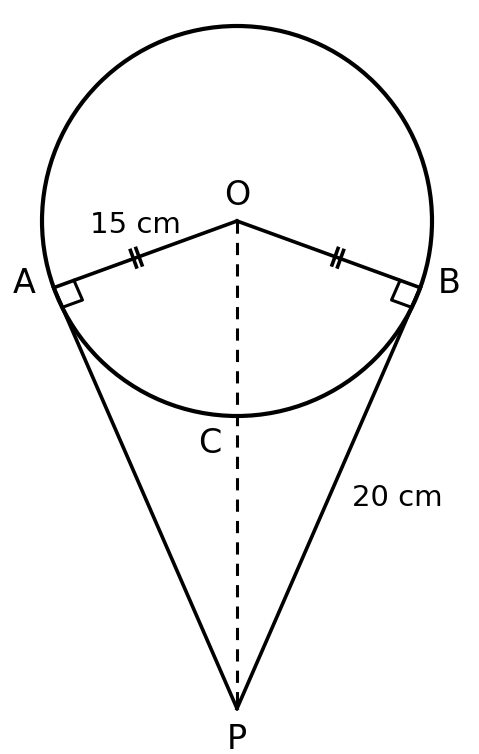
To find the shortest distance between point P and the circle, we need to determine the perpendicular distance from P to the line segment AB, which is the diameter of the circle.
Correct Option: D) 10 cm
The problem states that triangle ABC is right-angled at A. This means that the vectors \(\vec{AB}\) and \(\vec{AC}\) are perpendicular. The dot product of two perpendicular vectors is zero. We will use the coordinates of the vertices to find the vectors and then apply the dot product condition to solve for 'a'.
B) 5 — By using the property that the dot product of two perpendicular vectors is zero, we found that \(a = 5\).
To find Vanita's share of the profit, we need to determine the ratio of the effective capital invested by Ramani and Vanita. The effective capital is calculated by multiplying the amount invested by the duration for which it was invested. Profits are distributed in this ratio.
Correct Option: C) ₹1,200
In a class of 46 students, 18 play carom; 17 play chess, including 6 who play carom; 16 play cards, including 4 who play chess, but not carom; and 5 play only tennis. Which of the following figures represents these facts?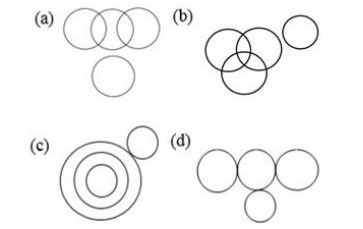
To solve this problem, we need to analyze the relationships between students playing different games using set theory and Venn diagrams. The goal is to identify which diagram correctly represents these relationships.
Correct Option: A) Diagram (a) correctly represents the overlapping sets.