
To determine the final position of house B relative to house A, we need to track the person's movements in the North-South and East-West directions separately. We will assign positive values for movement towards North and East, and negative values for movement towards South and West.
B) 27 m, East is the correct answer because the final displacement is 27 m towards the East from the starting point (house A).
This question asks about the characteristics of male and female germ cells (gametes) in sexually reproducing animals with complex body designs. The key is to recall the typical specializations of sperm and egg cells in such organisms.
Correct Option: B) Male germ cell – small and motile, Female – large with food store
In sexually reproducing animals with complex body designs, the male germ cell (sperm) is typically small and motile, equipped with a flagellum for movement to reach the female germ cell. The female germ cell (egg or ovum) is generally much larger, non-motile, and contains significant food reserves (yolk) to nourish the early embryo after fertilization. This specialization ensures efficient fertilization and initial embryonic development.
The problem asks us to identify the sequence of letters that completes a given letter series. We need to find a pattern in the provided letters and then apply that pattern to fill in the blanks.
A) JPAD — This option provides the letters J, P, A, D. When these are inserted into the blanks, the series becomes I J L O P R U V X A B D G. The differences between consecutive letters are +1, +2, +3, +1, +2, +3, and so on. This establishes a clear and consistent pattern.
This is a linear seating arrangement puzzle. We need to deduce the positions of eight classmates (D, E, F, G, H, I, J, K) sitting in a straight row, facing north, based on the given clues. We will build the arrangement step-by-step.
Clue 1: J is at the extreme right end of the row.
Since there are 8 people, the arrangement starts with:
_ _ _ _ _ _ _ J
Clue 2: K sits to the immediate left of D.
This means K and D are together in the order KD. Let's keep this block in mind.
Clue 3: D and I are immediate neighbours.
Given K is to the immediate left of D, and D and I are immediate neighbours, I must be to the immediate right of D. So the sequence is KDI.
Clue 4: There are only two classmates sitting between H and D.
From KDI, if D is at position _ _ _ D I, then H must be at H _ _ D I. This means H is 3 positions to the left of D. So the sequence becomes H _ _ D I.
Clue 5: Only E sits between I and G.
This means the sequence is IEG.
Now let's combine these sequences and fit them into the 8-person row:
_ _ _ _ _ _ _ JLet's place these blocks. The sequence H _ _ K D I E G has 7 positions. The full row has 8 positions. J is at the extreme right.
So, the arrangement must be: H _ _ K D I E G J
Let's count the positions: H (1), _ (2), _ (3), K (4), D (5), I (6), E (7), G (8). This doesn't fit with J at the end. Let's re-evaluate the placement.
Let's start from the right end, as J's position is fixed.
_ _ _ _ _ _ _ J
We have the block KDI. We also know D and I are immediate neighbours, and K is to the immediate left of D. So, KDI is a fixed block.
We also know 'Only E sits between I and G'. This means I E G is a fixed block.
Combining KDI and IEG: K D I E G.
Now, 'There are only two classmates sitting between H and D'. If we have K D I E G, and D is in it, then H must be placed such that there are two people between H and D. This means H _ _ D. So, H _ _ K D I E G.
This block H _ _ K D I E G has 7 people. Let's place it in the 8-person row with J at the end.
The only way for H _ _ K D I E G to fit and leave one spot for F is if J is immediately to the right of G. So, the sequence becomes H _ _ K D I E G J.
Now, let's fill the remaining empty spots. We have 8 people: D, E, F, G, H, I, J, K. The people placed are H, K, D, I, E, G, J. The only person left is F.
The arrangement is: H F K D I E G J
Let's verify all conditions:
The arrangement is: H F K D I E G J
The question asks: Who sits at the second position from the left end of the row?
From the arrangement H F K D I E G J, the second person from the left is F.
B) F — As derived from the step-by-step arrangement, F is at the second position from the left end.
The question asks to identify the discipline that attempts to explain the concept of 'temporal synthesis'. Temporal synthesis refers to the process of understanding and constructing a coherent narrative or meaning from events that occur over time. We need to evaluate each option based on its core focus and methodology.
B) History — History is fundamentally concerned with understanding and explaining the past. The process of historical inquiry involves gathering evidence from different periods, arranging it chronologically, establishing causal links, and constructing a coherent narrative. This act of integrating past events into a meaningful whole is precisely what 'temporal synthesis' entails. Historians synthesize disparate data points across time to create an understandable account of human experience.
The question asks about the committee that recommended the inclusion of Fundamental Duties in the Indian Constitution. This is a direct factual question related to Indian Polity and the historical development of the Constitution.
Correct Option: A) The Swaran Singh Committee recommended the inclusion of Fundamental Duties in the Constitution of India. These recommendations were subsequently incorporated into the Constitution through the 42nd Amendment Act of 1976, adding Part IV-A and Article 51-A.
The question asks about the properties of the metal used for a bulb filament. To answer this, we need to consider the function of a bulb filament and the conditions it operates under.
Correct Option: A) strong, high. The metal used for a bulb filament (typically tungsten) is strong and has a very high melting point, allowing it to glow brightly without melting.
Study the given diagram carefully and answer the question. The numbers in different sections indicate the number of different types of juices containing different fruit flavours which are manufactured by a juice company.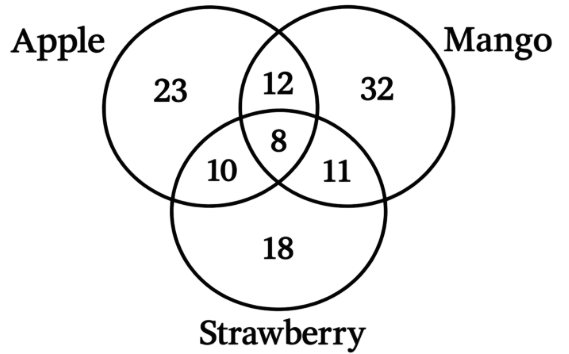
How many types of juices does the company make that contain both Apple and Strawberry flavours?
To determine how many types of juices contain both Apple and Strawberry flavours, we need to analyze the Venn diagram provided. The diagram shows the distribution of different types of juices containing combinations of Apple, Strawberry, and Mango flavours.
Correct Option: D) 18
Simplify: 3(9x3−6x2+30)−9(3x3+2x+30).
18(x2+ x +10)
18(x2+ x - 18)
18(x2+ x - 10)
-18 (x2+ x + 10)
To simplify the given algebraic expression, we will first distribute the constants into their respective parentheses. Then, we will combine like terms by adding or subtracting their coefficients. Finally, we will factor out any common terms to arrive at the simplified form.
The given expression is:
\[ 3(9x^3 - 6x^2 + 30) - 9(3x^3 + 2x + 30) \]First, multiply \(3\) into the first parenthesis:
\[ 3 \times 9x^3 = 27x^3 \]\[ 3 \times (-6x^2) = -18x^2 \]\[ 3 \times 30 = 90 \]So, the first part becomes: \(27x^3 - 18x^2 + 90\)
Next, multiply \(-9\) into the second parenthesis:
\[ -9 \times 3x^3 = -27x^3 \]\[ -9 \times 2x = -18x \]\[ -9 \times 30 = -270 \]So, the second part becomes: \(-27x^3 - 18x - 270\)
Now, combine the results from step 1:
\[ (27x^3 - 18x^2 + 90) + (-27x^3 - 18x - 270) \]Group terms with the same power of \(x\):
So, the expression simplifies to:
\[ 0 - 18x^2 - 18x - 180 \]\[ = -18x^2 - 18x - 180 \]Notice that \(-18\) is a common factor in all terms:
\[ -18(x^2 + x + 10) \]D) \(-18 (x^2 + x + 10)\) is the simplified form of the given expression, as derived in the step-by-step solution.
In the adjoining figure AB || CD and CD || EF. Also, EA is perpendicular to AB. If ∠BGD = 62°, then the value of w is: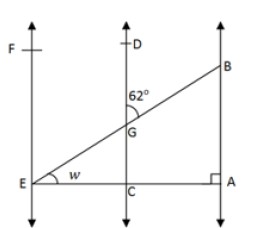
To find the value of angle \( w \), we need to use the properties of parallel lines and angles formed by a transversal. Given that \( AB \parallel CD \) and \( CD \parallel EF \), the angles formed by the transversal lines can be calculated using alternate interior angles and corresponding angles.
Correct Option: A) 28°