
The question asks about the specific aim of the 'Stree Manoraksha' Project. To answer this, one needs to recall the primary focus of this government initiative launched in March 2022.
A) mental — The 'Stree Manoraksha' Project is specifically designed to improve the mental health of women, especially those who have experienced violence and distress, by strengthening the psycho-social support mechanisms at One Stop Centres.
The question asks for the formula used to calculate Ex Ante Aggregate Demand. Ex Ante Aggregate Demand refers to the planned or desired aggregate expenditure in an economy. It is the sum of planned consumption expenditure and planned investment expenditure.
A) \(C̄ + Ī + cY\) is the correct formula for Ex Ante Aggregate Demand, as derived from the sum of autonomous consumption, induced consumption, and autonomous investment.
Study the given diagram carefully and answer the question. The numbers in different sections indicate the number of persons who eat a particular food for dinner every day.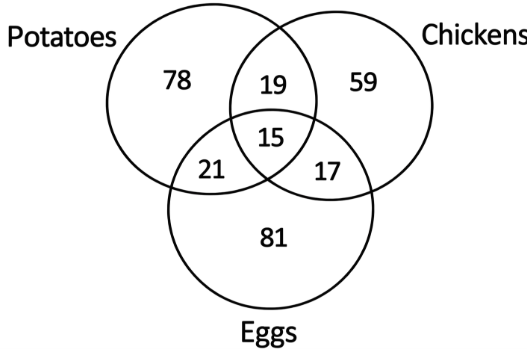
How many people eat potatoes and eggs for dinner but NOT chickens?
To solve this problem, we need to identify the number of people who eat both potatoes and eggs but do not eat chickens. This requires analyzing the Venn diagram provided and focusing on the relevant sections.
Thus, the number of people who eat potatoes and eggs but not chickens is 21.
Correct Option: B) 21
To balance a chemical reaction, we must ensure that the number of atoms of each element is the same on both the reactant side (left side) and the product side (right side) of the equation. This adheres to the Law of Conservation of Mass.
Identify Reactants and Products:
Write the Unbalanced Equation:
Hydrogen gas exists as a diatomic molecule (\(H_2\)), and Bromine exists as a diatomic molecule (\(Br_2\)). Hydrogen bromide is \(HBr\).
\(H_2 + Br_2 \rightarrow HBr\)
Count Atoms on Each Side:
Balance the Atoms:
To balance the Hydrogen and Bromine atoms, we need 2 molecules of Hydrogen bromide on the product side.
\(H_2 + Br_2 \rightarrow 2HBr\)
Verify the Balance:
The equation is now balanced.
Correct Option: A) \(H_2 + Br_2 \rightarrow 2 HBr\)
This option correctly represents hydrogen and bromine as diatomic molecules and balances the number of atoms of each element on both sides of the reaction, adhering to the Law of Conservation of Mass.
The question asks about the properties of the magnetic field produced by a current-carrying solenoid. We need to evaluate two statements regarding the nature of the magnetic field inside a solenoid and its application.
C) Both (a) and (b) are correct because the magnetic field inside a solenoid is uniform and parallel to its axis, and this strong field can be used for magnetization.
To find the average speed when an object travels a certain distance and returns, we need to calculate the total distance traveled and the total time taken. The average speed is then the total distance divided by the total time.
Given distance \(D = 90 \text{ km}\) and speed \(S_1 = 30 \text{ km/h}\).
\[ T_1 = \frac{D}{S_1} = \frac{90 \text{ km}}{30 \text{ km/h}} = 3 \text{ hours} \]The distance for the return journey is also \(D = 90 \text{ km}\). The speed for the return journey is \(S_2 = 60 \text{ km/h}\).
\[ T_2 = \frac{D}{S_2} = \frac{90 \text{ km}}{60 \text{ km/h}} = 1.5 \text{ hours} \]John travels 90 km to the destination and 90 km back.
\[ \text{Total Distance} = D + D = 90 \text{ km} + 90 \text{ km} = 180 \text{ km} \]Average speed is total distance divided by total time.
\[ \text{Average Speed} = \frac{\text{Total Distance}}{\text{Total Time}} = \frac{180 \text{ km}}{4.5 \text{ hours}} \] \[ \text{Average Speed} = \frac{1800}{45} \text{ km/h} = 40 \text{ km/h} \]Correct Option: A) 40 km/h
This problem involves determining distances and directions between houses. We need to establish a coordinate system or relative positions for each house based on the given information and then calculate the straight-line distance between O and N using the Pythagorean theorem.
C) 700 m is the straight distance between O and N, as calculated by finding their respective coordinates and then the distance between them.
This is a linear arrangement puzzle. We need to deduce the seating arrangement of the people in a row based on the given clues and then count the total number of people. We will start by identifying fixed positions or relationships and then build the arrangement step-by-step.
Clue 1: "Only one person sits to the right of S."
This means S is the second person from the right end of the row. Let's denote the extreme right end as 'R'.
_ _ _ _ _ _ _ _ _ _ S R
Clue 2: "Only one person sits between Q and S."
Since S is fixed, Q must be to the left of S with one person in between.
_ _ _ _ _ _ _ Q _ S R
Clue 3: "P sits to the immediate left of Q."
Placing P immediately to the left of Q:
_ _ _ _ _ _ P Q _ S R
Clue 4: "P sits second to the right of L."
This means L is to the left of P with one person in between.
_ _ _ _ L _ P Q _ S R
Clue 5: "L sits second to the right of D."
This means D is to the left of L with one person in between.
_ _ D _ L _ P Q _ S R
Clue 6: "K sits to the immediate right of D."
Placing K immediately to the right of D:
_ _ D K L _ P Q _ S R
Clue 7: "Only two people sit between D and Z."
From our current arrangement, D is at position 3 from the left. There are two possibilities for Z:
Let's check Case B first: D _ _ Z. This would mean Z is to the right of L. However, we already have K and L between D and P. So, Z cannot be to the right of D with only two people between them without disturbing the existing arrangement.
Therefore, Z must be to the left of D. If two people sit between D and Z, and Z is at an extreme end, then Z must be at the extreme left end.
Z _ _ D K L _ P Q _ S R
Clue 8: "Z sits at one of the extreme ends of the row."
This confirms Z is at the extreme left end. Combining with the previous point, we have:
Z _ _ D K L _ P Q _ S R
Now, let's fill in the blanks and count. The arrangement is:
Z (person 1) (person 2) D K L (person 3) P Q (person 4) S R
Let's re-verify the positions based on the clues:
So the arrangement is:
Z _ _ D K L _ P Q _ S _
Let's count the positions:
Total number of persons = 12.
A) 12. Based on the step-by-step deduction, the final arrangement has 12 people.