
Two wires A and B are made of the same material, but the length of A is 3 times that of B, and the cross-section of A is \( \frac{1}{4} \) that of B. The resistance of A is:
6 times that of B
9 times that of B
12 times that of B
3 times that of B
To solve this problem, we need to use the formula for electrical resistance, which relates resistance to the material's resistivity, length, and cross-sectional area. We will set up ratios for the resistances of wires A and B based on the given relationships between their lengths and cross-sectional areas.
Recall the formula for resistance: The resistance \(R\) of a wire is given by the formula:
\[ R = \rho \frac{L}{A} \]where \(\rho\) is the resistivity of the material, \(L\) is the length of the wire, and \(A\) is its cross-sectional area.
Define parameters for wire B: Let the length of wire B be \(L_B\) and its cross-sectional area be \(A_B\). Since both wires are made of the same material, their resistivity \(\rho\) will be the same.
So, the resistance of wire B is:
\[ R_B = \rho \frac{L_B}{A_B} \quad \text{(Equation 1)} \]Define parameters for wire A: We are given that the length of A is 3 times that of B, so \(L_A = 3L_B\). We are also given that the cross-section of A is \( \frac{1}{4} \) that of B, so \(A_A = \frac{1}{4} A_B\).
Now, substitute these into the resistance formula for wire A:
\[ R_A = \rho \frac{L_A}{A_A} = \rho \frac{3L_B}{\frac{1}{4} A_B} \]Simplify the expression for \(R_A\):
\[ R_A = \rho \frac{3L_B}{\frac{1}{4} A_B} = \rho \frac{3 \times 4 L_B}{A_B} = 12 \rho \frac{L_B}{A_B} \]Compare \(R_A\) with \(R_B\): From Equation 1, we know that \(R_B = \rho \frac{L_B}{A_B}\). Substitute this into the expression for \(R_A\):
\[ R_A = 12 \left( \rho \frac{L_B}{A_B} \right) = 12 R_B \]Thus, the resistance of A is 12 times that of B.
Correct Option: C) 12 times that of B
This problem involves tracking changes in direction based on a series of turns. We need to visualize Taruni's movement and her facing direction after each turn. Since all turns are 90°, we can simply rotate the current facing direction.
Correct Option: B) East is the direction Taruni is facing after all her turns.
This is a syllogism problem. We need to evaluate the given conclusions based on the provided statements. We can use Venn diagrams to visualize the relationships between the categories and determine which conclusions logically follow.
D) Both conclusions I and II follow. Both conclusions are logically derived from the given statements.
Study the given diagram carefully and answer the question. The numbers in different sections indicate the number of persons. The circle represents ‘professors’, the square represents ‘poets’, and the triangle represents ‘women’. How many professors are there who are women and also poets?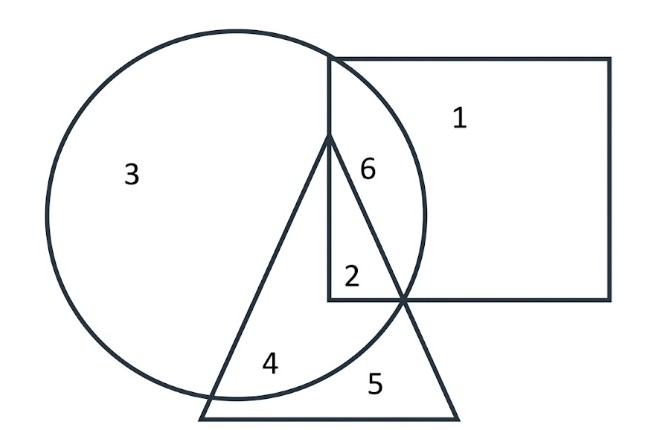
We need to find the number of people who are professors, women, and poets. This corresponds to the intersection of the circle, triangle, and square in the diagram.
Thus, the number of professors who are women and also poets is 2.
Correct Option: B) 2
The tenure of the Village Panchayat is for how many years?
This question tests knowledge about the tenure of local self-government bodies in India, specifically the Village Panchayat. The duration of these bodies is a fundamental aspect of their functioning and is enshrined in the Constitution.
Correct Option: D) The tenure of the Village Panchayat, as stipulated by Article 243E of the Indian Constitution, is five years from the date of its first meeting.
The question asks to identify India's first indigenous aircraft carrier. This requires knowledge of the Indian Navy's fleet and its shipbuilding initiatives, specifically focusing on vessels designed and built domestically.
India's first indigenously designed and built aircraft carrier is INS Vikrant. It was commissioned into the Indian Navy in September 2022, marking a significant milestone in India's 'Atmanirbhar Bharat' (self-reliant India) initiative in defence.
Correct Option: C) INS Vikrant is India's first indigenously designed and built aircraft carrier. It was built by Cochin Shipyard Limited (CSL) in Kochi, Kerala, and commissioned into the Indian Navy on September 2, 2022.
Convert 0.2\(\overline{6}\) into a proper fraction.
\( \frac{5}{17} \)
\( \frac{7}{33} \)
\( \frac{8}{21} \)
\( \frac{4}{15} \)
To convert a repeating decimal into a proper fraction, we use an algebraic method. We set the given decimal equal to a variable, multiply by powers of 10 to align the repeating part, and then subtract the equations to eliminate the repeating decimal, solving for the variable.
D) The calculated fraction is \( \frac{4}{15} \), which matches option D.
The question asks to identify the Indian state where Nuakhai, an agricultural or harvesting festival, is primarily observed. This requires knowledge of major festivals and their associated regions in India.
Correct Option: C) Nuakhai is a prominent agricultural festival celebrated mainly in the state of Odisha, particularly in its western parts, and also in some parts of Chhattisgarh. It marks the celebration of the new rice crop.
The following graph shows the number of units produced and number of units exported by a company over the years.
Study the graph and answer the question below.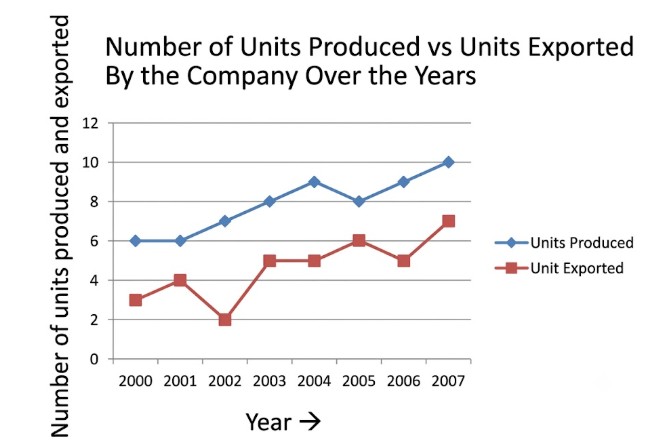
During which year did the units produced decline?
To determine the year in which the units produced declined, we need to analyze the trend of the 'Units Produced' line in the graph across the given years.
Correct Option: D) 2004–2005
What percentage of 1 is 6\( \frac{3}{4} \)?
To find what percentage a number \(X\) is of another number \(Y\), we use the formula: \(\frac{X}{Y} \times 100\%\). In this problem, we need to find what percentage \(6\frac{3}{4}\) is of \(1\). First, convert the mixed fraction to an improper fraction or a decimal, then apply the percentage formula.
The given number is \(6\frac{3}{4}\).
\[ 6\frac{3}{4} = 6 + \frac{3}{4} = \frac{6 \times 4}{4} + \frac{3}{4} = \frac{24}{4} + \frac{3}{4} = \frac{24 + 3}{4} = \frac{27}{4} \]\[ 6\frac{3}{4} = 6 + 0.75 = 6.75 \]
We need to find what percentage \(6\frac{3}{4}\) (or \(6.75\)) is of \(1\). Using the formula \(\frac{\text{Part}}{\text{Whole}} \times 100\%\):
\[ \text{Percentage} = \frac{6.75}{1} \times 100\% \]\[ \text{Percentage} = 6.75 \times 100\% \]\[ \text{Percentage} = 675\% \]Correct Option: C) 675