
The question asks to identify the biological process where pyruvate is converted into ethanol and carbon dioxide. This specific conversion is characteristic of a type of anaerobic respiration.
The overall reaction for alcoholic fermentation from glucose is:
\[ \text{C}_6\text{H}_{12}\text{O}_6 \xrightarrow{\text{Glycolysis}} 2 \text{ Pyruvate} \xrightarrow{\text{Fermentation}} 2 \text{ Ethanol} + 2 \text{ CO}_2 + \text{Energy} \]
Specifically, the conversion from pyruvate is:
\[ 2 \text{ Pyruvate} \xrightarrow{\text{Pyruvate Decarboxylase}} 2 \text{ Acetaldehyde} + 2 \text{ CO}_2 \]
\[ 2 \text{ Acetaldehyde} + 2 \text{ NADH} \xrightarrow{\text{Alcohol Dehydrogenase}} 2 \text{ Ethanol} + 2 \text{ NAD}^+ \]
This process is known as fermentation.
C) Fermentation — This is the correct answer. Alcoholic fermentation is the biological process where pyruvate is converted into ethanol and carbon dioxide in the absence of oxygen, typically carried out by yeast and some bacteria.
This question asks for the product formed when calcium oxide (quicklime) reacts with water. This is a classic combination reaction in chemistry, often referred to as the slaking of lime. We need to recall the chemical formula for calcium oxide and water, and then determine the product based on their chemical properties.
\[ \text{CaO(s)} + \text{H}_2\text{O(l)} \rightarrow \text{Ca(OH)}_2\text{(aq)} \]
The product formed is calcium hydroxide, which is commonly known as slaked lime.
Correct Option: B) Calcium hydroxide
When calcium oxide (quicklime) reacts with water, it forms calcium hydroxide (slaked lime). This is a combination reaction and is highly exothermic.
To find the total price of 5 kg of apples and 3 kg of bananas, we first need to determine the price per kg for both fruits. The price of bananas is given directly. The price of apples is given in relation to the price of bananas. Once we have the price per kg for each, we multiply by the respective quantities and sum them up.
Price per kg of bananas:
Given that the price of bananas is Rs \(x\) per kg.
Price per kg of apples:
The price per kg of apples is Rs 5 more than the price per kg of bananas.
Total price of 5 kg of apples:
Multiply the price per kg of apples by 5.
Total price of 3 kg of bananas:
Multiply the price per kg of bananas by 3.
Total price of 5 kg of apples and 3 kg of bananas:
Add the total price of apples and the total price of bananas.
The total price is \(8x + 25\).
A) \(8x + 25\) is the correct expression for the total price of 5 kg of apples and 3 kg of bananas.
A group of numbers/symbols is coded using letters as per the table given below and the conditions which follow. The correct combination of codes follows.
| Number/symbol | 7 | @ | 3 | S | ^ | 7 | 6 | 4 | % | & | # | 2 | * | 9 |
| Code Letter | G | O | K | I | R | M | A | T | L | D | F | B | Q | O |
Conditions:
(i) If the first element is a symbol and the last element is a number, the codes for these two (the first and the last elements) are to be interchanged.
(ii) If the first element is an odd number and the last element is an even number, the first and last elements are to be coded as ©.
(iii) If both the second and third elements are perfect squares, the third element is to be coded as the code for the second element.
What will be the code for 7 % # @ 4?
The problem requires us to code a given sequence of numbers/symbols based on a provided table and a set of conditions. We need to first find the base codes from the table and then apply the conditions sequentially to modify these codes if applicable.
Correct Option: C) ©LFO©
To solve this problem, we will first assume a convenient cost price for one dozen bananas. Then, we will calculate the total cost price, the number of good bananas, and the selling price for each lot of good bananas. Finally, we will determine the total selling price and compare it with the total cost price to find the overall profit or loss percentage.
Let the cost price (CP) of one dozen bananas be Rs. 100.
Total number of dozens purchased = 50 dozen.
Total Cost Price (TCP) = \(50 \times 100 = \text{Rs. } 5000\).
Number of spoiled bananas = 5 dozen.
Number of good bananas = \(50 - 5 = 45\) dozen.
Two-thirds of good bananas = \(\frac{2}{3} \times 45 = 30\) dozen.
These were sold at a profit of 20% per dozen.
Selling Price (SP) per dozen for this lot = \(100 + (20\% \text{ of } 100) = 100 + 20 = \text{Rs. } 120\).
Total SP for the first lot = \(30 \times 120 = \text{Rs. } 3600\).
Remaining good bananas = \(45 - 30 = 15\) dozen.
These were sold at a profit of 5% per dozen.
Selling Price (SP) per dozen for this lot = \(100 + (5\% \text{ of } 100) = 100 + 5 = \text{Rs. } 105\).
Total SP for the second lot = \(15 \times 105 = \text{Rs. } 1575\).
Total Selling Price (TSP) = SP of first lot + SP of second lot
TSP = \(3600 + 1575 = \text{Rs. } 5175\).
Since TSP (Rs. 5175) > TCP (Rs. 5000), there is a profit.
Profit = TSP - TCP = \(5175 - 5000 = \text{Rs. } 175\).
Profit percentage = \(\frac{\text{Profit}}{\text{TCP}} \times 100\)
Profit percentage = \[\frac{175}{5000} \times 100 = \frac{175}{50} = 3.5\%\].
Correct Option: A) 3.5% gain
The question asks about the interest rate for loans provided under the SAFE (SIDBI Assistance to Facilitate Emergency) response against Corona Virus scheme, launched by SIDBI in March 2020. This requires specific knowledge of the scheme's details.
C) 5%
The SAFE (SIDBI Assistance to Facilitate Emergency) response against Corona Virus scheme, launched by SIDBI in March 2020, provided loans at an interest rate of 5% per annum. This was a concessional rate aimed at supporting MSMEs during the pandemic.
Given that ΔABC and ΔADE are similar, which of the following options is necessarily true?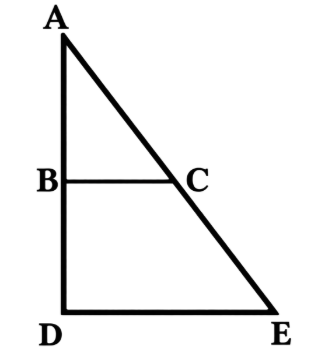
\(\frac{AB}{AD}=\frac{BC}{DE}\)
\(\frac{EC}{AC}=\frac{AD}{DE}\)
\(\frac{BC}{BD}=\frac{CE}{DE}\)
\(\frac{BC}{BD}=\frac{AB}{AC}\)
To solve this problem, we need to use the properties of similar triangles. Similar triangles have corresponding angles equal and corresponding sides in proportion.
Correct Option: A) \[\frac{AB}{AD} = \frac{BC}{DE}\]
The problem asks us to find the missing number in a series based on the relationship between pairs of numbers. We need to identify the pattern connecting the first and second numbers, and the third and fourth numbers, and then apply the same pattern to the fifth number to find the sixth.
C) 66 — The pattern observed is that the second number is obtained by multiplying the first number by 6. Applying this pattern to 11, we get \(11 \times 6 = 66\).
To find the current flowing through the circuit, we first need to determine the total equivalent resistance of the circuit. The problem states that the resistance of the circuit is maximum, which implies that all five resistors are connected in series. Once the total resistance is found, Ohm's Law can be applied to calculate the current.
Determine the connection type for maximum resistance: For resistors to have maximum equivalent resistance, they must be connected in series. In a series connection, the total resistance is the sum of individual resistances.
Calculate the total equivalent resistance (\(R_{\text{total}}\)): There are five resistors, each with a resistance of \(5 \, \Omega\).
\[ R_{\text{total}} = R_1 + R_2 + R_3 + R_4 + R_5 \] \[ R_{\text{total}} = 5 \, \Omega + 5 \, \Omega + 5 \, \Omega + 5 \, \Omega + 5 \, \Omega \] \[ R_{\text{total}} = 5 \times 5 \, \Omega \] \[ R_{\text{total}} = 25 \, \Omega \]Apply Ohm's Law to find the current (\(I\)): Ohm's Law states that \(V = I \times R\), where \(V\) is the voltage, \(I\) is the current, and \(R\) is the resistance. We are given the battery voltage \(V = 15 \, \text{V}\) and we calculated \(R_{\text{total}} = 25 \, \Omega\).
\[ I = \frac{V}{R_{\text{total}}} \] \[ I = \frac{15 \, \text{V}}{25 \, \Omega} \] \[ I = \frac{3}{5} \, \text{A} \] \[ I = 0.6 \, \text{A} \]Correct Option: C) 0.6 A
The calculation shows that the current flowing through the circuit is \(0.6 \, \text{A}\).
A) 0.4 A — This value would be obtained if the total resistance were \(37.5 \, \Omega\) (\(15 \, \text{V} / 0.4 \, \text{A}\)), which is not the case here.
B) 0.9 A — This value would be obtained if the total resistance were approximately \(16.67 \, \Omega\) (\(15 \, \text{V} / 0.9 \, \text{A}\)), which is incorrect.
D) 0.8 A — This value would be obtained if the total resistance were \(18.75 \, \Omega\) (\(15 \, \text{V} / 0.8 \, \text{A}\)), which is also incorrect.
Which of the following statements is INCORRECT about the properties of ionic compounds?
Ionic compounds have high melting and boiling points.
Electrovalent compounds are generally soluble in water and insoluble in petrol.
Ionic compounds are solids because of the weak force of attractions between positive and negative ions.
Ionic compounds are generally brittle and break into pieces when pressure is applied.
The question asks to identify the INCORRECT statement regarding the properties of ionic compounds. We need to evaluate each option based on the known characteristics of ionic compounds.
Correct Option: C) Ionic compounds are solids because of the weak force of attractions between positive and negative ions.
This statement is incorrect. Ionic compounds are solids due to strong electrostatic forces of attraction, not weak ones. These strong forces result in a rigid crystal lattice structure.