Which of the following relations correctly represents magnification (m) produced by a convex mirror?
To determine the correct relation for magnification (m) produced by a convex mirror, we need to recall the characteristics of images formed by convex mirrors. Convex mirrors always form virtual, erect, and diminished images, regardless of the object's position.
A) 0 < m < 1 — This correctly represents the magnification for a convex mirror, as the image is always virtual, erect, and diminished. An erect image implies positive magnification, and a diminished image implies magnification less than 1.
The question asks to identify the first Indian personality to launch their own Non-Fungible Token (NFT) collection in 2021. This requires knowledge of significant events in the Indian celebrity and cryptocurrency space.
Correct Option: B) Amitabh Bachchan
Amitabh Bachchan became the first Indian celebrity to launch his own NFT (Non-Fungible Token) collection in November 2021. His collection, named "Madhushala" after his father's poetry, included recited poems, signed posters, and other digital memorabilia, which were auctioned successfully.
The question asks to identify the state government that released the State Policy for Children 2021 in November 2021, focusing on the prevention and protection of children from violence, abuse, and exploitation. This requires knowledge of recent policy announcements by Indian state governments.
Correct Option: C) Tamil Nadu — The Tamil Nadu government launched the State Policy for Children 2021 in November 2021, with the explicit aim of ensuring the prevention and protection of children from all forms of violence, abuse, and exploitation.
The “Stree Manoraksha Project” was launched by the Union Minister for Women and Child Development, Smriti Zubin Irani, in collaboration with:
The question asks about the collaborative partner for the "Stree Manoraksha Project" launched by the Union Minister for Women and Child Development. To answer this, one needs to recall or identify the specific institution that partnered with the Ministry for this initiative.
A) NIMHANS — The "Stree Manoraksha Project" was launched by the Ministry of Women and Child Development in collaboration with the National Institute of Mental Health and Neurosciences (NIMHANS), Bengaluru. The project aims to improve the mental health of women, particularly those in One Stop Centres (OSCs), by training their functionaries.
To solve this problem, we first need to determine the cost price (CP) of the TV. We are given the selling price (SP) and the loss percentage. Once we have the cost price, we can calculate the new selling price required to achieve a 15% gain.
Calculate the Cost Price (CP):
Given:
If there is a 15% loss, it means the selling price is \(100\% - 15\% = 85\%\) of the cost price.
So, we can write the formula:
\[ \text{SP} = \text{CP} \times \left(1 - \frac{\text{Loss Percentage}}{100}\right) \]Substituting the given values:
\[ 18,700 = \text{CP} \times \left(1 - \frac{15}{100}\right) \] \[ 18,700 = \text{CP} \times \left(\frac{85}{100}\right) \]Now, solve for CP:
\[ \text{CP} = \frac{18,700 \times 100}{85} \] \[ \text{CP} = \frac{1,870,000}{85} \] \[ \text{CP} = 22,000 \]So, the Cost Price of the TV is Rs 22,000.
Calculate the new Selling Price (\(\text{SP}_2\)) for a 15% gain:
We want to gain 15% on the Cost Price (CP).
The new selling price will be \(100\% + 15\% = 115\%\) of the cost price.
Using the formula:
\[ \text{SP}_2 = \text{CP} \times \left(1 + \frac{\text{Gain Percentage}}{100}\right) \]Substituting the calculated CP and desired gain percentage:
\[ \text{SP}_2 = 22,000 \times \left(1 + \frac{15}{100}\right) \] \[ \text{SP}_2 = 22,000 \times \left(\frac{115}{100}\right) \] \[ \text{SP}_2 = 220 \times 115 \] \[ \text{SP}_2 = 25,300 \]Therefore, the selling price of the TV to gain 15% should be Rs 25,300.
A) Rs 25,300 is the correct selling price to achieve a 15% gain after determining the cost price from the initial loss scenario.
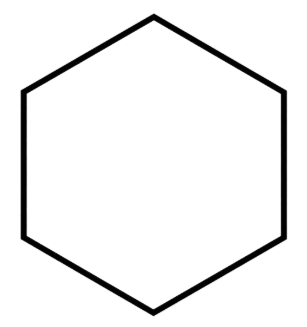
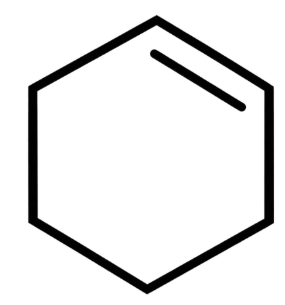
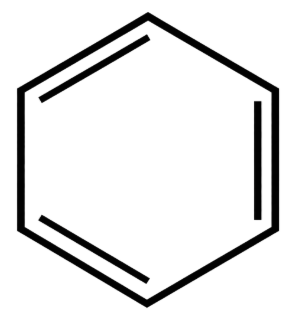
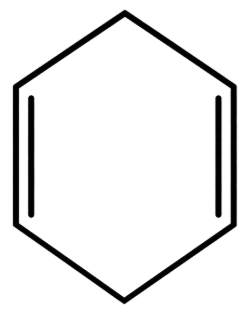
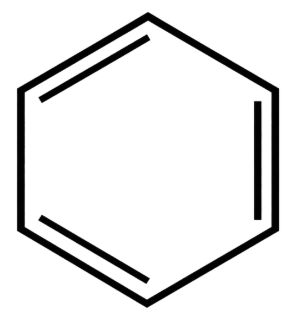
Which of the following is the correct structure of a benzene molecule?
Benzene is a well-known aromatic compound with a unique structure characterized by a six-carbon ring with alternating double bonds. This structure is often represented by a hexagon with three double bonds.
Correct Option: C) The diagram shows a hexagon with alternating double bonds, which is the correct representation of benzene.
Each of K, L, M, N and P has an exam on a different day of a week starting from Monday and ending on Sunday of the same week. No exam is held on Friday and Saturday. Only two persons have exams between N and M. L’s exam is held on Wednesday. Only one person has an exam between N and L. P’s exam is held on Sunday.
Whose exam is held on Monday?
The problem requires us to find which two numbers, when interchanged in the given equation, make the equation mathematically correct. We will test each option by swapping the specified numbers and then evaluating the expression using the order of operations (BODMAS/PEMDAS).
The given equation is:
\[ 11 + 13 \times 3 - 14 \div 7 = 44 \]First, let's evaluate the original equation to see if it's already correct:
Since \(48 \neq 44\), the original equation is incorrect. Now we test the options.
A) 11 and 13
Interchange 11 and 13 in the equation:
\[ 13 + 11 \times 3 - 14 \div 7 \]Since \(44 = 44\), interchanging 11 and 13 makes the equation correct.
B) 11 and 7
Interchange 11 and 7:
\[ 7 + 13 \times 3 - 14 \div 11 \]Since \(44.73 \neq 44\), this option is incorrect.
C) 14 and 13
Interchange 14 and 13:
\[ 11 + 14 \times 3 - 13 \div 7 \]Since \(51.15 \neq 44\), this option is incorrect.
D) 14 and 11
Interchange 14 and 11:
\[ 14 + 13 \times 3 - 11 \div 7 \]Since \(51.43 \neq 44\), this option is incorrect.
Which of the following is the RHS of the equation:
\(\sqrt{\frac{1+\sin A}{1-\sin A}}\)
secA + tanA
secA + cotA
sinA + cosA
\(\frac{1}{\operatorname{cosec} A}\)
To simplify the given expression \(\sqrt{\frac{1+\sin A}{1-\sin A}}\), we will use the technique of rationalizing the denominator. This involves multiplying the numerator and the denominator inside the square root by the conjugate of the denominator, which is \(1+\sin A\). Then, we will use trigonometric identities to simplify the expression further.
Start with the given expression:
\[ \sqrt{\frac{1+\sin A}{1-\sin A}} \]Multiply the numerator and denominator inside the square root by \(1+\sin A\) to rationalize the denominator:
\[ \sqrt{\frac{(1+\sin A)(1+\sin A)}{(1-\sin A)(1+\sin A)}} \]Simplify the numerator and denominator. The numerator becomes \((1+\sin A)^2\). The denominator is in the form \((a-b)(a+b) = a^2-b^2\), so it becomes \(1^2 - \sin^2 A = 1 - \sin^2 A\).
\[ \sqrt{\frac{(1+\sin A)^2}{1-\sin^2 A}} \]Recall the fundamental trigonometric identity: \(\sin^2 A + \cos^2 A = 1\), which implies \(1 - \sin^2 A = \cos^2 A\).
Substitute this into the expression:
\[ \sqrt{\frac{(1+\sin A)^2}{\cos^2 A}} \]Take the square root of the numerator and the denominator separately:
\[ \frac{\sqrt{(1+\sin A)^2}}{\sqrt{\cos^2 A}} = \frac{1+\sin A}{|\cos A|} \]Assuming A is an acute angle (or in a quadrant where \(\cos A > 0\)), we can write \(|\cos A| = \cos A\).
\[ \frac{1+\sin A}{\cos A} \]Separate the fraction into two terms:
\[ \frac{1}{\cos A} + \frac{\sin A}{\cos A} \]Recall the definitions of \(\sec A = \frac{1}{\cos A}\) and \(\tan A = \frac{\sin A}{\cos A}\).
Substitute these identities into the expression:
\[ \sec A + \tan A \]A) \(\sec A + \tan A\) is the simplified form of the given expression, as derived in the step-by-step solution.
The problem asks us to calculate the potential difference across the ends of a conductor given the current flowing through it and its resistance. We can use Ohm's Law, which states that the potential difference (\(V\)) across a conductor is directly proportional to the current (\(I\)) flowing through it, provided the temperature and other physical conditions remain constant. The constant of proportionality is the resistance (\(R\)).
Since 1 mA = \(10^{-3}\) A, we convert 2.5 mA to Amperes:
\[ I = 2.5 \text{ mA} = 2.5 \times 10^{-3} \text{ A} \]Ohm's Law is given by the formula:
\[ V = I \times R \]Since 1 V = 1000 mV, or \(10^{-3}\) V = 1 mV, we have:
\[ V = 5 \times 10^{-3} \text{ V} = 5 \text{ mV} \]Thus, the potential difference across the ends of the conductor is 5 mV.
A) 5 mV — This is the correct potential difference calculated using Ohm's Law after converting the current to Amperes.