
A statement is given followed by two arguments I and II. Read the statement and the arguments carefully and select the appropriate answer from the given options.
Statement:
The government is proposing a ban on the export of wheat for the next 4 weeks in order to contain the rising prices in domestic markets.
Arguments:
I. Floods in various parts of the country have resulted in a steep drop in the output of wheat crop this season.
II. Ban on export of wheat will result in significant penalties in the international markets on non-fulfilment of existing contracts.
Argument II weakens, while argument I strengthens the statement
Both arguments I and II weaken the statement
Argument I weakens, while argument II strengthens the statement
Both arguments I and II strengthen the statement
The problem asks us to evaluate two arguments in relation to a given statement. We need to determine if each argument strengthens or weakens the statement. The statement proposes a ban on wheat exports to control rising domestic prices. We must analyze how each argument impacts the validity or desirability of this proposed ban.
Correct Option: A) Argument II weakens, while argument I strengthens the statement
The question asks about a significant merger in the Indian banking sector that occurred in January 2022. This type of question tests knowledge of recent financial news and regulatory actions, which is common in competitive exams.
Correct Option: A) Unity Small Finance Bank
The Reserve Bank of India (RBI) approved the scheme for the amalgamation of the Punjab and Maharashtra Co-operative (PMC) Bank with Unity Small Finance Bank Ltd. This merger became effective on January 25, 2022. All branches of PMC Bank started functioning as branches of Unity Small Finance Bank Ltd. from that date.
The question asks to identify the specific vaccine developed by Zydus Cadila that received Emergency Use Authorization (EUA) from the Drug Controller General of India (DCGI) in August 2021. This requires knowledge of current affairs related to COVID-19 vaccines and their developers.
Correct Option: A) ZyCoV-D is the correct answer. Zydus Cadila received EUA for ZyCoV-D, the world's first plasmid DNA vaccine for COVID-19, in August 2021.
The question asks to identify the month in which the Indian festival of Makar Sankranti is celebrated. This is a factual question about Indian culture and festivals.
B) January is the correct answer. Makar Sankranti is celebrated every year in January, usually on the 14th or 15th of the month.
The question asks about the vesting of executive powers of the Union as per Article 53 of the Indian Constitution. This requires direct knowledge of constitutional provisions.
Correct Option: A) Article 53 of the Constitution of India clearly states that the executive power of the Union shall be vested in the President.
The question asks why mitochondria are considered a "weird" organelle. This implies looking for unique characteristics that set them apart from most other organelles in a eukaryotic cell. We need to evaluate each option based on the distinct features of mitochondria.
B) Because they contain ribosomes and DNA. This is the most accurate reason why mitochondria are considered "weird" or unusual. Most other organelles in eukaryotic cells do not possess their own DNA or ribosomes. This self-replicating and self-sustaining capability, to a certain extent, makes them distinct.
Study the given diagram carefully and answer the following question.
The numbers in different sections indicate the number of persons in different professions.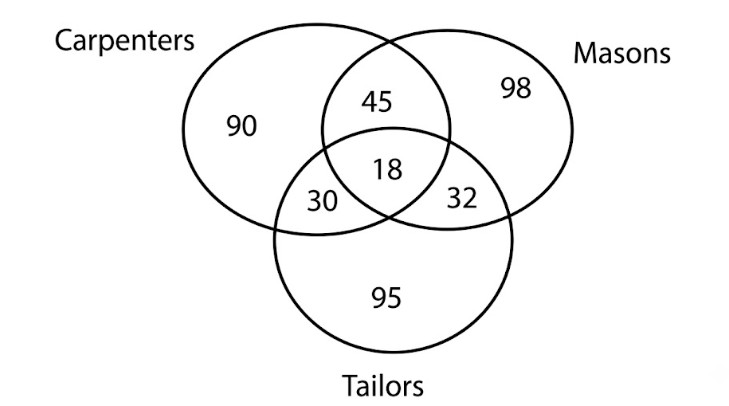
How many Masons are Tailors as well?
To determine how many Masons are also Tailors, we need to analyze the overlapping sections of the Venn diagram that represent both professions.
Correct Option: A) 50
A is an element whose position in the modern periodic table is inconsistent based on its properties. Its electronic configuration is similar to that of metals, but it exists in the form of diatomic molecules. B is the element that comes immediately after sodium in the third period and belongs to Group C in the modern periodic table.
Identify A, B, and C.
A = Hydrogen, B = Mg, C = 2
A = Lithium, B = K, C = 1
A = Lanthanides, B = Ne, C = 3
A = Helium, B = Al, C = 13
The question asks to identify three elements/groups (A, B, C) based on their properties and position in the modern periodic table. We need to analyze the given descriptions for A, B, and C and match them with the options provided.
A) A = Hydrogen, B = Mg, C = 2. This option correctly identifies Hydrogen as the element with inconsistent properties (like metals but diatomic non-metal), Magnesium as the element immediately following Sodium in the third period, and Group 2 as the group to which Magnesium belongs.
To find the day of the week for a future date, we need to calculate the total number of days between the given date and the target date. Then, we find the remainder when this total number of days is divided by 7 (since there are 7 days in a week). This remainder, known as the 'odd days', will tell us how many days forward from the starting day the target day falls.
Calculate the number of days remaining in August 2021:
August has 31 days. The given date is 10 August. So, the number of remaining days in August is:
Calculate the number of days in September 2021 until the target date:
The target date is 18 September. So, the number of days in September is:
Calculate the total number of days between 10 August and 18 September:
\[ \text{Total days} = \text{Days in August} + \text{Days in September} = 21 + 18 = 39 \text{ days} \]Calculate the number of odd days:
Divide the total number of days by 7 to find the remainder:
Determine the day of the week for 18 September:
The given day for 10 August 2021 was Tuesday. We need to move forward by 4 days from Tuesday.
So, 18 September 2021 will be a Saturday.
Correct Option: B) Saturday
Select the option that is related to the fifth number in the same way as the second number is related to the first number and the fourth number is related to the third number.
15 : 24 :: 35 : 48 :: 63 :?
The problem presents a series of number pairs and asks us to find the missing number in the last pair based on the relationship observed in the previous pairs. We need to identify the pattern connecting the first number to the second number in each given pair.
Let's look for a relationship between 15 and 24. We can observe that:
Here, the second number is related to the square of the next consecutive integer minus 1, compared to the first number which is the square of an integer minus 1.
Alternatively, we can see that \(15 = 3 \times 5\) and \(24 = 4 \times 6\). This means the first number is a product of two consecutive odd numbers, and the second number is a product of two consecutive even numbers, where the even numbers are one greater than the odd numbers.
Let's try another pattern for 15 and 24:
This pattern seems promising. The first number is \(n^2 - 1\) and the second number is \((n+1)^2 - 1\).
Let's apply the pattern identified above to the second pair:
This matches the given second pair (35 : 48). So, the pattern is confirmed: if the first number is \(n^2 - 1\), the second number is \((n+1)^2 - 1\).
D) 80 — Based on the identified pattern where the first number is \(n^2 - 1\) and the second number is \((n+1)^2 - 1\), for 63 (\(8^2 - 1\)), the corresponding number is \(9^2 - 1 = 80\).