
We need to find Arun's present age. We are given two pieces of information: the age difference between Arun and Kiran, and a relationship between their ages five years ago. We can set up a system of linear equations based on this information and solve for their present ages.
So, Arun's present age is 30 years.
A) 30 is the correct answer, as calculated above.
The question asks to identify the country developing 'NavIC', an independent regional navigation satellite system. This requires knowledge of global navigation satellite systems and their respective developing nations.
C) India is correct because NavIC (Navigation with Indian Constellation) is India's own regional navigation satellite system, developed and operated by ISRO.
To answer this question, we need to recall the enactment years of each of the mentioned laws and policies in India and then arrange them in chronological order from earliest to latest.
Arranging these chronologically:
This sequence matches option D.
D) Information Technology Act (2000), Right to Information Act (2005), Right to Education Act (2009/2010), Rights of Persons with Disabilities Act (2016) is the correct chronological order.
The question asks for the standard definition of a government budget. We need to recall the key characteristics of a budget, specifically its periodicity and what it estimates.
Correct Option: B) an annual statement of the estimated receipts and expenditure of the government over the fiscal year
To find the missing number in the series, we need to identify the pattern of differences between consecutive terms. This usually involves checking for arithmetic progressions, geometric progressions, or more complex patterns involving increasing or decreasing differences.
The second-order differences are constant and equal to \(0.8\). This means the differences between terms are increasing by \(0.8\) each time.
Correct Option: D) 4
This question asks about the primary form of nitrogenous waste excreted by aquatic animals like fish. The answer depends on the toxicity of the waste product and the availability of water for its dilution and removal.
C) Ammonia — Fish and other aquatic animals excrete ammonia because it is highly soluble in water and can be rapidly diluted and flushed away from their bodies, primarily through their gills. This is an energy-efficient way to dispose of nitrogenous waste in an aquatic environment.
To solve this problem, we need to substitute the given mathematical signs from each option into the equation sequentially and then evaluate the expression using the BODMAS/PEMDAS rule. The option that results in a balanced equation will be the correct answer.
The given expression is: \(32 * 16 * 8 * 2 * 3 * 5 * 5\)
Substitute the signs:
\[ 32 - 16 + 8 \div 2 \times 3 = 5 + 5 \]Evaluate the left side (LHS):
\[ 32 - 16 + (8 \div 2) \times 3 \] \[ 32 - 16 + 4 \times 3 \] \[ 32 - 16 + 12 \] \[ 16 + 12 = 28 \]Evaluate the right side (RHS):
\[ 5 + 5 = 10 \]Since \(28 \neq 10\), Option A is incorrect.
Substitute the signs:
\[ 32 + 16 - 8 \div 2 \times 3 = 5 + 5 \]Evaluate the left side (LHS):
\[ 32 + 16 - (8 \div 2) \times 3 \] \[ 32 + 16 - 4 \times 3 \] \[ 32 + 16 - 12 \] \[ 48 - 12 = 36 \]Evaluate the right side (RHS):
\[ 5 + 5 = 10 \]Since \(36 \neq 10\), Option B is incorrect.
Substitute the signs:
\[ 32 - 16 + 8 \div 2 = 3 \times 5 + 5 \]Evaluate the left side (LHS):
\[ 32 - 16 + (8 \div 2) \] \[ 32 - 16 + 4 \] \[ 16 + 4 = 20 \]Evaluate the right side (RHS):
\[ (3 \times 5) + 5 \] \[ 15 + 5 = 20 \]Since \(20 = 20\), Option C balances the equation.
Correct Option: C) \(-, +, \div, =, \times, +\)
When these signs are substituted, the equation becomes \(32 - 16 + 8 \div 2 = 3 \times 5 + 5\). Evaluating both sides:
LHS: \(32 - 16 + (8 \div 2) = 32 - 16 + 4 = 16 + 4 = 20\)
RHS: \((3 \times 5) + 5 = 15 + 5 = 20\)
Since LHS = RHS, this option is correct.
Substitute the signs:
\[ 32 - 16 + 8 \times 2 = 3 \div 5 + 5 \]Evaluate the left side (LHS):
\[ 32 - 16 + (8 \times 2) \] \[ 32 - 16 + 16 \] \[ 16 + 16 = 32 \]Evaluate the right side (RHS):
\[ (3 \div 5) + 5 \] \[ 0.6 + 5 = 5.6 \]Since \(32 \neq 5.6\), Option D is incorrect.
In the following Venn diagram, the rectangle represents 'fruits', the triangle represents 'sour tasting eatables', and the square represents 'yellow coloured eatables'.
Select the option which represents the number of sour tasting yellow fruits.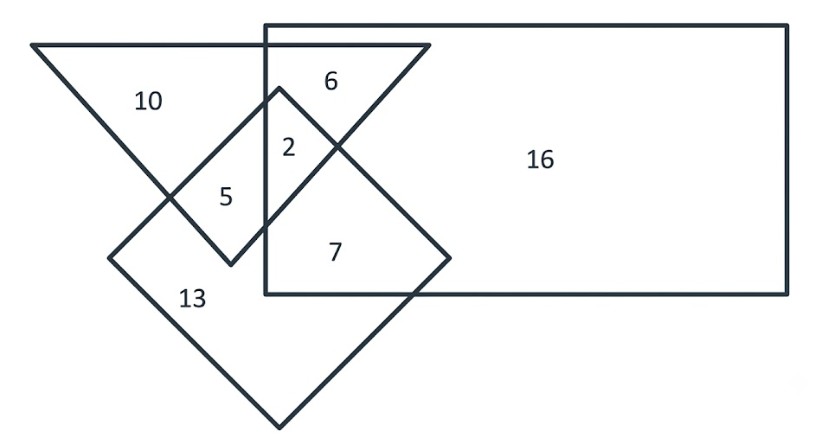
To find the number of sour tasting yellow fruits, we need to identify the intersection of all three sets: fruits, sour tasting eatables, and yellow coloured eatables.
Correct Option: A) 2
The problem asks us to find the value of 'p' given a set of numbers and their arithmetic mean. We will use the formula for the arithmetic mean, which states that the mean is the sum of all observations divided by the number of observations.
\[ \text{Arithmetic Mean} = \frac{\text{Sum of all observations}}{\text{Number of observations}} \]
\[ 11 = \frac{11 + 15 + 13 + p + 10}{5} \]
\[ 11 + 15 + 13 + 10 = 49 \]
So, the equation becomes:
\[ 11 = \frac{49 + p}{5} \]
\[ 11 \times 5 = 49 + p \]
\[ 55 = 49 + p \]
Subtract 49 from both sides to isolate 'p':
\[ p = 55 - 49 \]
\[ p = 6 \]
B) 6 — By applying the formula for the arithmetic mean and solving the resulting equation, we find that the value of p is 6.