
The question asks to identify the correct group of fundamental rights from the given alternatives. We need to recall the fundamental rights enshrined in Part III of the Indian Constitution and check which of the given options correspond to these rights.
Correct Option: C) A, B and D
This question tests the fundamental relationship between the focal length and the radius of curvature for spherical mirrors. For any spherical mirror (convex or concave), the focal length is half of its radius of curvature. We will use this relationship to find the radius of curvature given the focal length.
The focal length of the convex mirror, \(f = 2 \text{ m}\).
For a spherical mirror, the focal length (\(f\)) is half of its radius of curvature (\(R\)). This can be expressed as:
\[ f = \frac{R}{2} \]or equivalently,
\[ R = 2f \]Using the formula \(R = 2f\), we substitute the given value of \(f = 2 \text{ m}\):
\[ R = 2 \times (2 \text{ m}) \] \[ R = 4 \text{ m} \]For a convex mirror, the focal length is conventionally taken as positive. Since the given focal length is \(+2 \text{ m}\), the radius of curvature will also be positive, \(+4 \text{ m}\). The magnitude is what is asked in the question.
C) 4.0 m — The radius of curvature is twice the focal length. Given \(f = 2 \text{ m}\), \(R = 2 \times 2 \text{ m} = 4 \text{ m}\).
To find the ratio between the LCM (Least Common Multiple) and HCF (Highest Common Factor) of a set of numbers, we first need to calculate the LCM and HCF of those numbers. Then, we will express them as a ratio.
The HCF is the product of the lowest powers of the common prime factors. In this case, the only common prime factor is 5, and its lowest power is \(5^1\).
\[ \text{HCF}(5, 15, 20) = 5^1 = 5 \]The LCM is the product of the highest powers of all prime factors involved in the numbers.
The prime factors are 2, 3, and 5.
The ratio is \(\text{LCM} : \text{HCF}\).
\[ \text{Ratio} = 60 : 5 \]Divide both sides of the ratio by their greatest common divisor, which is 5.
\[ \frac{60}{5} : \frac{5}{5} = 12 : 1 \]C) 12 : 1 is the correct ratio between the LCM and HCF of 5, 15, and 20.
In the given figure, line a is parallel to line b. Find the value of x.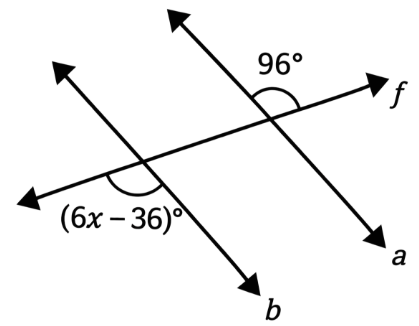
To find the value of \(x\), use the properties of parallel lines and the angles formed by a transversal.
Correct Option: C) 22°
To find the approximate value, we will round off each number in the given equation to the nearest whole number and then perform the calculations.
The original equation is \(3.01^3 \div 2.99 \times 6.01 = ?\)
After approximation, it becomes:
\[ 3^3 \div 3 \times 6 = ? \]The calculated approximate value is \(54\).
Correct Option: C) 54
The approximate value of the expression is \(54\).
To arrange numbers in ascending order, we need to compare their values from smallest to largest. For decimal numbers, it's helpful to align them by their decimal points and compare digit by digit from left to right. For whole numbers, we compare the number of digits first, then the digits themselves.
Starting with the smallest group and then ordering within each group:
\(7.005, 7.050, 7.500, 70.50, 75, 705.0, 7050\)
D) 7.005, 7.050, 7.500, 70.50, 75, 705.0, 7050
If sin²x + 3 cos²x = 2, and (0° < x < 90°), find the value of cosec x.
\(\sqrt{3}\)
2
\(\frac{2\sqrt{3}}{3}\)
\(\sqrt{2}\)
The problem requires us to find the value of \(\text{cosec } x\) given an equation involving \(\text{sin } x\) and \(\text{cos } x\), and a range for \(x\). We will use the fundamental trigonometric identity \(\text{sin}^2 x + \text{cos}^2 x = 1\) to simplify the given equation and solve for \(\text{sin } x\). Once \(\text{sin } x\) is found, we can determine \(\text{cosec } x\) using the reciprocal identity \(\text{cosec } x = 1/\text{sin } x\).
Given the equation:
\[ \text{sin}^2 x + 3 \text{cos}^2 x = 2 \]We know the fundamental trigonometric identity:
\[ \text{sin}^2 x + \text{cos}^2 x = 1 \]Rewrite the given equation by splitting \(3 \text{cos}^2 x\) as \( \text{cos}^2 x + 2 \text{cos}^2 x\):
\[ \text{sin}^2 x + \text{cos}^2 x + 2 \text{cos}^2 x = 2 \]Substitute \(\text{sin}^2 x + \text{cos}^2 x = 1\) into the equation:
\[ 1 + 2 \text{cos}^2 x = 2 \]Subtract 1 from both sides:
\[ 2 \text{cos}^2 x = 2 - 1 \]\[ 2 \text{cos}^2 x = 1 \]Solve for \(\text{cos}^2 x\):
\[ \text{cos}^2 x = \frac{1}{2} \]Take the square root of both sides to find \(\text{cos } x\):
\[ \text{cos } x = \pm \sqrt{\frac{1}{2}} = \pm \frac{1}{\sqrt{2}} \]The problem states that \(0^\circ < x < 90^\circ\). In this range (the first quadrant), all trigonometric ratios are positive. Therefore, \(\text{cos } x\) must be positive:
\[ \text{cos } x = \frac{1}{\sqrt{2}} \]We need to find \(\text{cosec } x\). First, let's find \(\text{sin } x\). We can use the identity \(\text{sin}^2 x + \text{cos}^2 x = 1\):
\[ \text{sin}^2 x + \left(\frac{1}{\sqrt{2}}\right)^2 = 1 \]\[ \text{sin}^2 x + \frac{1}{2} = 1 \]\[ \text{sin}^2 x = 1 - \frac{1}{2} \]\[ \text{sin}^2 x = \frac{1}{2} \]Take the square root of both sides:
\[ \text{sin } x = \pm \sqrt{\frac{1}{2}} = \pm \frac{1}{\sqrt{2}} \]Since \(0^\circ < x < 90^\circ\), \(\text{sin } x\) must be positive:
\[ \text{sin } x = \frac{1}{\sqrt{2}} \]Finally, find \(\text{cosec } x\) using the reciprocal identity \(\text{cosec } x = 1/\text{sin } x\):
\[ \text{cosec } x = \frac{1}{\frac{1}{\sqrt{2}}} \]\[ \text{cosec } x = \sqrt{2} \]D) The calculated value of \(\text{cosec } x\) is \(\sqrt{2}\).
This question tests understanding of basic economic concepts related to production periods. The key distinction lies in whether all factors of production can be varied or if some remain fixed.
Correct Option: A) short run production
Study the given bar graph and answer the following question.
The given bar graph depicts the number of movie tickets sold on four days.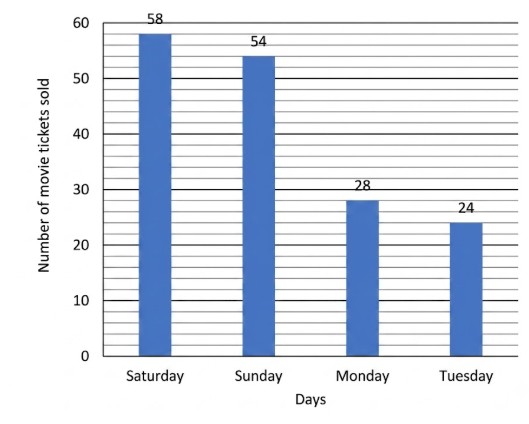
If the average number of tickets sold on Monday, Tuesday and Wednesday was 31, what was the number of tickets sold on Wednesday?
To find the number of tickets sold on Wednesday, use the average formula given for Monday, Tuesday, and Wednesday. The bar graph provides the number of tickets sold on Monday and Tuesday.
Correct Option: A) 41
To find the width of the rectangle, we will use the given information about the relationship between its width and length, and its perimeter. We will set up an equation using the formula for the perimeter of a rectangle and solve for the unknown dimension.
Correct Option: C) 8 cm