
The question asks about the winner of the Men's Singles title at the All England Badminton Championship 2022. This is a factual recall question related to current affairs in sports.
Correct Option: A) Viktor Axelsen
Viktor Axelsen of Denmark won the Men's Singles title at the All England Badminton Championship 2022 by defeating India's Lakshya Sen in the final.
The question asks to identify a non-biodegradable substance among the given options. Biodegradable substances are those that can be decomposed by natural processes and microorganisms, while non-biodegradable substances cannot.
Correct Option: D) Nylon is a synthetic polymer and is non-biodegradable. It persists in the environment for a very long time, contributing to pollution.
The polarity of an electromagnet is determined by the direction of the magnetic field lines it produces. This direction is directly linked to the direction of the current flowing through its coil. We can use the right-hand thumb rule to understand this relationship.
A) direction of current. Changing the direction of current directly reverses the magnetic field lines, thereby reversing the polarity of the electromagnet.
The graph of y = 9x² + 16:
touches the x-axis at \( \frac{4}{3} \)
either intersects or touches the x-axis
intersects the x-axis at -\( \frac{4}{3} \) and \( \frac{4}{3} \)
neither intersects nor touches the x-axis
To determine if a graph intersects or touches the x-axis, we need to find the values of \(x\) for which \(y=0\). For a quadratic equation of the form \(ax^2 + bx + c = 0\), the nature of the roots (and thus the intersection with the x-axis) is determined by the discriminant, \(\Delta = b^2 - 4ac\).
The given equation is \(y = 9x^2 + 16\). To find where the graph intersects or touches the x-axis, we set \(y=0\):
\[ 9x^2 + 16 = 0 \]Subtract 16 from both sides:
\[ 9x^2 = -16 \]Divide by 9:
\[ x^2 = -\frac{16}{9} \]We are looking for a real number \(x\) such that its square is a negative number. However, the square of any real number (positive or negative) is always non-negative (greater than or equal to zero). Therefore, there is no real value of \(x\) that satisfies \(x^2 = -\frac{16}{9}\).
Since there are no real solutions for \(x\), the graph of the equation \(y = 9x^2 + 16\) does not intersect or touch the x-axis.
The equation is \(y = 9x^2 + 0x + 16\). Comparing this to the standard quadratic form \(ax^2 + bx + c\), we have:
Calculate the discriminant \(\Delta = b^2 - 4ac\):
\[ \Delta = (0)^2 - 4(9)(16) \] \[ \Delta = 0 - 576 \] \[ \Delta = -576 \]Since the discriminant \(\Delta = -576\) is less than 0 (\(\Delta < 0\)), there are no real roots for the equation \(9x^2 + 16 = 0\). This means the graph does not intersect or touch the x-axis.
D) neither intersects nor touches the x-axis. This is correct because setting \(y=0\) leads to \(x^2 = -16/9\), which has no real solutions for \(x\). Alternatively, the discriminant \(\Delta = -576 < 0\), indicating no real roots.
The given pie chart shows the expenses of a family in a month.
Read the chart and answer the question that follows.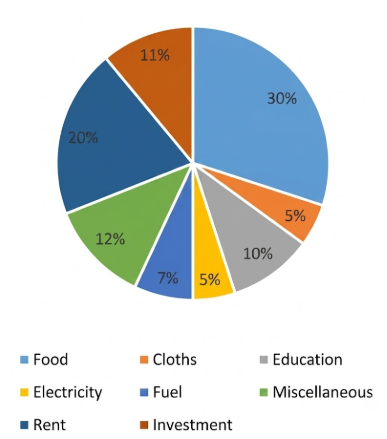
What is the central angle for total expenditure on fuel, miscellaneous and investment?
To find the central angle for the total expenditure on fuel, miscellaneous, and investment, we need to calculate the sum of their percentages and convert this sum into a central angle using the formula for pie charts.
Correct Option: D) 108°
To find the size of the image formed by a concave lens, we will use the lens formula and the magnification formula. First, we'll calculate the image distance using the lens formula, and then use this image distance to find the magnification and subsequently the image size.
The lens formula is given by:
\[ \frac{1}{f} = \frac{1}{v} - \frac{1}{u} \]Rearranging the formula to solve for \(v\):
\[ \frac{1}{v} = \frac{1}{f} + \frac{1}{u} \]\[ \frac{1}{v} = \frac{1}{-25 \, \text{cm}} + \frac{1}{-50 \, \text{cm}} \]\[ \frac{1}{v} = -\frac{1}{25 \, \text{cm}} - \frac{1}{50 \, \text{cm}} \]Find a common denominator (50):
\[ \frac{1}{v} = -\frac{2}{50 \, \text{cm}} - \frac{1}{50 \, \text{cm}} \]\[ \frac{1}{v} = -\frac{3}{50 \, \text{cm}} \]\[ v = -\frac{50}{3} \, \text{cm} \approx -16.67 \, \text{cm} \]The magnification formula for a lens is:
\[ m = \frac{h_i}{h_o} = \frac{v}{u} \]Rearranging the formula to solve for \(h_i\):
\[ h_i = h_o \times \frac{v}{u} \]\[ h_i = 3.0 \, \text{cm} \times \frac{-\frac{50}{3} \, \text{cm}}{-50 \, \text{cm}} \]\[ h_i = 3.0 \, \text{cm} \times \frac{1}{3} \]\[ h_i = 1.0 \, \text{cm} \]Correct Option: D) 1.0 cm
The question asks to identify the correct statement about the Rajya Sabha, which is the upper house of the Indian Parliament. We need to evaluate each option based on the constitutional provisions and characteristics of the Rajya Sabha.
Correct Option: D) It is called upper house of parliament and it never dissolves.
The problem presents two letter-cluster pairs and asks to identify an option that follows the same logical relationship. We need to find the pattern between the letters in the given pairs and then apply that pattern to the options.
The question asks about the genetic material passed from one generation to the next. This requires identifying the molecule responsible for carrying hereditary information in most living organisms.
Correct Option: C) DNA. Deoxyribonucleic acid (DNA) is the molecule that carries the genetic instructions used in the growth, development, functioning, and reproduction of all known living organisms and many viruses. It is inherited from one generation to the next.
Mr. X travelled 220 km, 250 km and 140 km at a speed of 11 km/h, 5 km/h and 7 km/h, respectively. Find his average speed in km/h.
7 \( \frac{7}{9} \)
6 \( \frac{5}{9} \)
6 \( \frac{7}{9} \)
6 \( \frac{2}{9} \)
To find the average speed, we need to calculate the total distance traveled and the total time taken. The average speed is then given by the formula: Average Speed = Total Distance / Total Time.
The total distance is the sum of the distances traveled in each segment.
\[ \text{Total Distance} = 220 \text{ km} + 250 \text{ km} + 140 \text{ km} = 610 \text{ km} \]Time = Distance / Speed
The total time is the sum of the times taken for each segment.
\[ \text{Total Time} = 20 \text{ hours} + 50 \text{ hours} + 20 \text{ hours} = 90 \text{ hours} \]Average Speed = Total Distance / Total Time
\[ \text{Average Speed} = \frac{610 \text{ km}}{90 \text{ hours}} = \frac{61}{9} \text{ km/h} \]To convert \( \frac{61}{9} \) to a mixed fraction, divide 61 by 9.
\( 61 \div 9 = 6 \) with a remainder of \( 7 \).
So, \[\frac{61}{9} = 6 \frac{7}{9} \text{ km/h}\].
C) 6 \( \frac{7}{9} \) is the correct average speed calculated.