
The problem asks us to identify the next letter in a given series: E, J, O, T, ?. This is a letter series problem, which typically involves finding a pattern in the alphabetical positions of the letters.
C) Y is the 25th letter of the alphabet, which follows the established pattern of adding 5 to the numerical position of the previous letter.
Internet was started in India on:
11th August, 1995
15th August, 1995
9th August, 1996
8th August, 1994
The question asks for the date when the internet was launched in India. This is a factual question requiring knowledge of a specific historical event related to technology in India.
Correct Option: B) 15th August, 1995
The internet was officially launched for public use in India by Videsh Sanchar Nigam Limited (VSNL) on 15th August 1995. This marked a significant milestone in India's technological development, making internet services accessible to the general public for the first time.
Study the given pattern carefully and select the number that can replace the question mark (?) in it.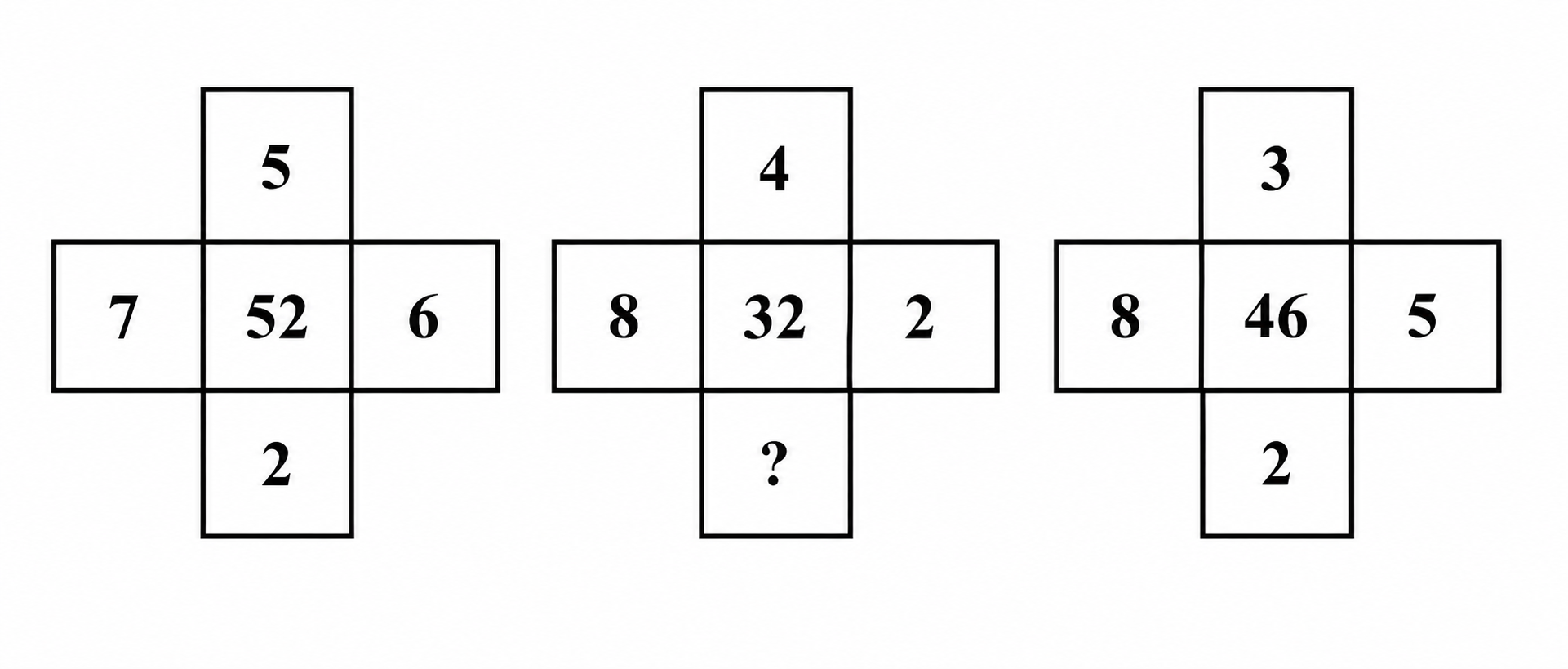
This problem involves simple interest. We are given the simple interest for a certain period as a percentage of the principal and need to find the time it takes for the simple interest to become equal to the principal. We will use the simple interest formula to first find the rate of interest and then use that rate to calculate the required time.
Let the Principal be \(P\).
According to the problem, the simple interest (SI) for 7 years is 56% of the principal.
So, \( \text{SI} = 56\% \text{ of } P = \frac{56}{100} P \)
The formula for simple interest is \( \text{SI} = \frac{P \times R \times T}{100} \), where \(R\) is the rate of interest per annum and \(T\) is the time in years.
Substitute the given values into the simple interest formula:
\[ \frac{56}{100} P = \frac{P \times R \times 7}{100} \]Now, we can solve for \(R\):
\[ 56 P = P \times R \times 7 \]\[ 56 = R \times 7 \]\[ R = \frac{56}{7} \]\[ R = 8\% \]Next, we need to find the time (\(T'\)) when the simple interest will be equal to the principal. So, \( \text{SI} = P \).
Using the simple interest formula again with \( \text{SI} = P \) and \( R = 8\% \):
\[ P = \frac{P \times 8 \times T'}{100} \]Solve for \(T'\):
\[ 1 = \frac{8 \times T'}{100} \]\[ 100 = 8 \times T' \]\[ T' = \frac{100}{8} \]\[ T' = \frac{25}{2} \]\[ T' = 12.5 \text{ years} \]Convert 12.5 years into years and months:
\( 12.5 \text{ years} = 12 \text{ years} + 0.5 \text{ years} \)
\( 0.5 \text{ years} = 0.5 \times 12 \text{ months} = 6 \text{ months} \)
So, \( T' = 12 \text{ years and } 6 \text{ months} \).
Correct Option: B) 12 years 6 months
The question asks about the correct statement regarding the Khilafat Movement in India. We need to recall the historical context and objectives of this movement to identify the correct option.
B) It was a movement in support of the Turkish Sultan
This statement is correct. The Khilafat Movement was indeed launched by Indian Muslims to protest against the harsh terms imposed on the Ottoman Empire by the Treaty of Sèvres after World War I, which threatened the position of the Ottoman Sultan as the Caliph (Khalifa) of all Muslims.
Study the given pattern carefully and select the number that can replace the question mark (?) in it.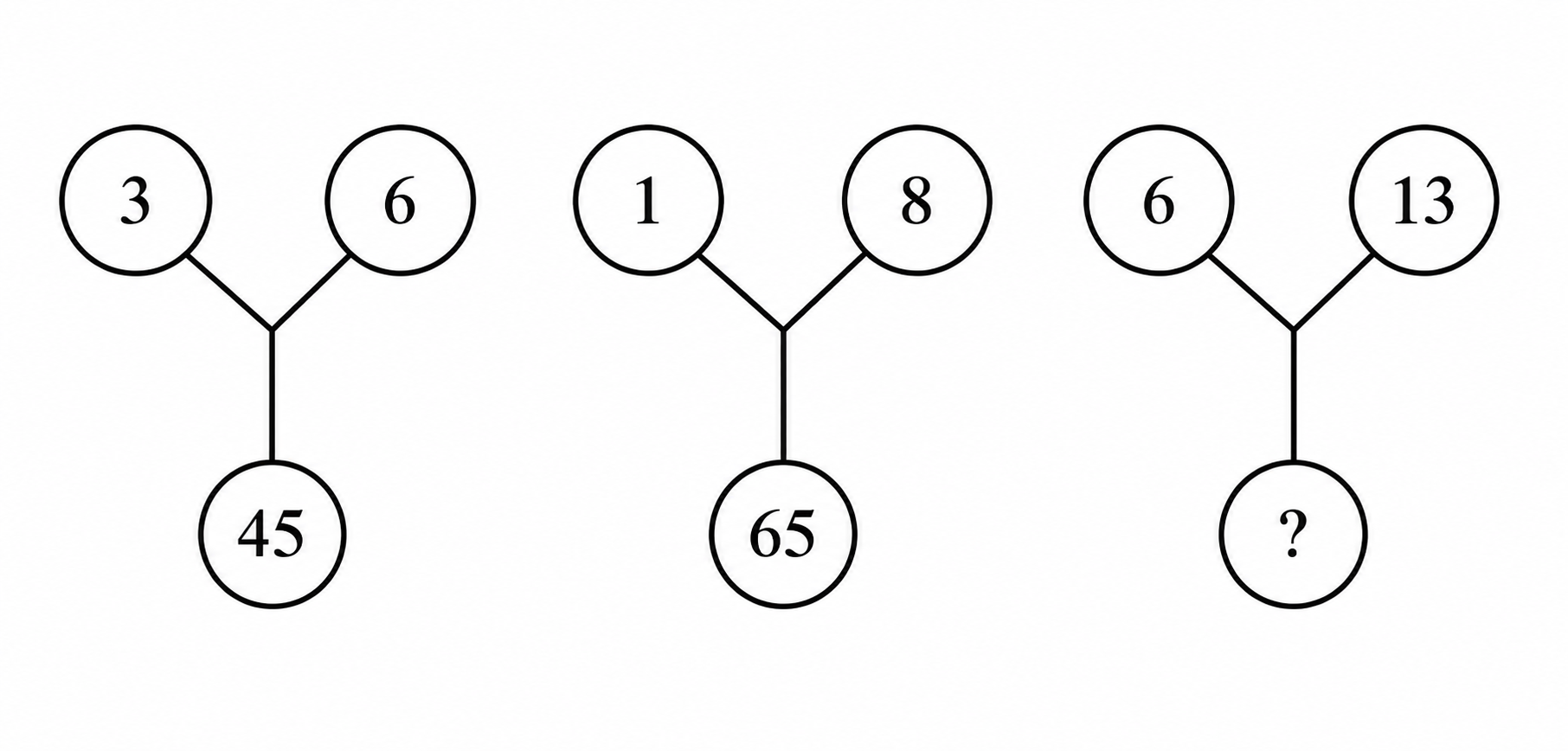
The diagram consists of three sets of numbers arranged in a Y-shape. The pattern involves a mathematical operation applied to the two numbers at the top to produce the number at the bottom.
Correct Option: B) 205
The question asks to identify the Indian city known as the "Detroit of Asia" and the "Automobile Capital" of India. This requires knowledge of the industrial landscape and common epithets associated with major Indian cities.
A) Chennai — Chennai is widely recognized as the "Detroit of Asia" and the "Automobile Capital" of India due to the presence of major automobile manufacturers and component suppliers, including Ford, Hyundai, Renault-Nissan, BMW, Daimler, Ashok Leyland, and others.
The problem provides the ratio of a person's income to expenditure and the actual income. We need to find the savings. We can use the given ratio to determine the expenditure and then calculate savings using the formula: Savings = Income - Expenditure.
Alternatively, we can find the ratio of savings directly. If Income is 9 parts and Expenditure is 5 parts, then Savings = Income - Expenditure = 9 - 5 = 4 parts. So the ratio of Income : Expenditure : Savings is 9 : 5 : 4.
If 9 parts = ₹27,000, then 1 part = ₹27,000 / 9 = ₹3,000.
Therefore, Savings = 4 parts = \(4 \times \text{₹}3,000 = \text{₹}12,000\).
D) ₹12,000 is the correct savings amount calculated.
The question asks to identify a renewable energy resource from the given options. We need to understand the definition of renewable and non-renewable resources and then classify each option accordingly.
D) Syngas. When produced from renewable biomass, syngas is considered a renewable energy resource.
The problem asks us to identify the logical relationship between two statements: one about increased police vigilance and another about reduced petty crimes. We need to determine if one is a cause and the other an effect, or if they are both effects of a common cause, or if they are independent.
A) Statement I is the likely cause and statement II is its likely effect. This option correctly identifies the logical flow. Increased police presence and monitoring (vigilance) are measures taken to deter crime, and a reduction in crime is a direct and expected consequence of such measures. Therefore, Statement I (increased vigilance) is the cause, and Statement II (reduced crimes) is the effect.