
Study the given pattern carefully and select the number from among the given options that can replace the question mark (?).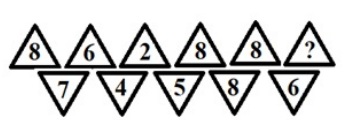
To solve this pattern-based problem, we need to identify the relationship between the numbers in the triangles. Each pair of triangles seems to follow a specific rule.
Correct Option: B) 4
The question asks to identify the longest river in the world. This is a factual question based on geographical knowledge.
The approximate lengths of the rivers are:
Based on these widely accepted figures, the Nile River is the longest.
B) Nile — The Nile River, flowing through northeastern Africa, is traditionally considered the longest river in the world, with a length of approximately \(6,650 \text{ km}\).
The problem involves a coding-decoding pattern where a word is assigned a numerical value. We need to identify the rule used to convert the letters of the word "ALBINISM" into the number 79 and then apply the same rule to the word "NEURON". Typically, such problems involve assigning numerical values to letters based on their alphabetical position (A=1, B=2, ..., Z=26) and then performing some arithmetic operation (sum, product, sum of squares, etc.).
A) 87 is the correct answer because, by assigning numerical values to each letter based on its position in the alphabet (A=1, B=2, etc.) and summing them up, we get 79 for ALBINISM and 87 for NEURON.
This problem involves calculating the cost price of two articles given their selling price and the percentage gain or loss. When two articles are sold at the same selling price, and one is sold at a certain percentage gain and the other at the same percentage loss, there is always a net loss. The total loss can be calculated by finding the cost price of each article and then comparing the total cost price with the total selling price.
The selling price (SP) of the first article is ₹4,000, and there is a gain of 15%.
\[ \text{SP} = \text{CP} \times \left(1 + \frac{\text{Gain}\%}{100}\right) \]\[ 4000 = \text{CP}_1 \times \left(1 + \frac{15}{100}\right) \]\[ 4000 = \text{CP}_1 \times \left(\frac{115}{100}\right) \]\[ \text{CP}_1 = 4000 \times \frac{100}{115} = \frac{400000}{115} = \frac{80000}{23} \approx 3478.26 \]The selling price (SP) of the second article is ₹4,000, and there is a loss of 15%.
\[ \text{SP} = \text{CP} \times \left(1 - \frac{\text{Loss}\%}{100}\right) \]\[ 4000 = \text{CP}_2 \times \left(1 - \frac{15}{100}\right) \]\[ 4000 = \text{CP}_2 \times \left(\frac{85}{100}\right) \]\[ \text{CP}_2 = 4000 \times \frac{100}{85} = \frac{400000}{85} = \frac{80000}{17} \approx 4705.88 \]Since each article was sold for ₹4,000,
\[ \text{Total SP} = 4000 + 4000 = 8000 \]Since Total CP > Total SP, there is a loss.
\[ \text{Loss} = \text{Total CP} - \text{Total SP} \]\[ \text{Loss} = \frac{3200000}{391} - 8000 \]\[ \text{Loss} = \frac{3200000 - (8000 \times 391)}{391} \]\[ \text{Loss} = \frac{3200000 - 3128000}{391} \]\[ \text{Loss} = \frac{72000}{391} \approx 184.143 \]The loss is approximately ₹184.143, which rounds to ₹184.
When two articles are sold at the same selling price, and one is sold at a gain of x% and the other at a loss of x%, there is always a loss. The percentage loss is given by:
\[ \text{Loss}\% = \left(\frac{x}{10}\right)^2 \% \]\[ \text{Loss}\% = \left(\frac{15}{10}\right)^2 \% = (1.5)^2 \% = 2.25\% \]This is the percentage loss on the total selling price. So, the total loss amount is:
\[ \text{Loss Amount} = \text{Total SP} \times \frac{\text{Loss}\%}{100} \]\[ \text{Loss Amount} = (4000 + 4000) \times \frac{2.25}{100} \]\[ \text{Loss Amount} = 8000 \times 0.0225 \]\[ \text{Loss Amount} = 180 \]However, this formula gives the percentage loss with respect to the total cost price if the cost prices were equal. When the selling prices are equal, the formula for the net loss percentage on the total selling price is not directly \((x/10)^2\). The correct formula for the net loss percentage on the total transaction (relative to total CP) when SP is same is:
\[ \text{Net Loss}\% = \frac{x^2}{100 - x^2} \times 100 \% \]\[ \text{Net Loss}\% = \frac{15^2}{100^2 - 15^2} \times 100 \% \text{ (This formula is for total CP, not SP)} \]The simpler approach is to calculate the total CP and total SP directly.Let's re-evaluate the loss percentage formula for when SP is the same. The overall loss percentage is given by:
\[ \text{Overall Loss}\% = \frac{\text{Loss}^2}{100^2 - \text{Loss}^2} \times 100 \% \]This formula is for the overall loss percentage on the total cost price. Let's use the direct method as it's more straightforward and less prone to misapplication of formulas.The direct calculation of total loss is ₹184.143, which rounds to ₹184.
C) ₹184 loss — The total loss calculated is approximately ₹184.143, which rounds to ₹184.
To find the number of divisors of a number, we first express the number as a product of its prime factors. Once we have the prime factorization in the form \(N = p_1^{a_1} \cdot p_2^{a_2} \cdot \ldots \cdot p_k^{a_k}\), the total number of divisors is given by the product of one more than each exponent: \((a_1+1)(a_2+1)\ldots(a_k+1)\).
First, we find the prime factors of 120.
\[ 120 = 2 \times 60 \]\[ 120 = 2 \times 2 \times 30 \]\[ 120 = 2 \times 2 \times 2 \times 15 \]\[ 120 = 2 \times 2 \times 2 \times 3 \times 5 \]So, the prime factorization of 120 is \(2^3 \times 3^1 \times 5^1\).The number is in the form \(p_1^{a_1} \cdot p_2^{a_2} \cdot p_3^{a_3}\), where \(p_1=2\), \(a_1=3\); \(p_2=3\), \(a_2=1\); and \(p_3=5\), \(a_3=1\).
The number of divisors is given by the formula \((a_1+1)(a_2+1)(a_3+1)\).
\[ \text{Number of divisors} = (3+1)(1+1)(1+1) \]\[ \text{Number of divisors} = (4)(2)(2) \]\[ \text{Number of divisors} = 16 \]Thus, there are 16 divisors for the number 120.
A) 16 — The prime factorization of 120 is \(2^3 \times 3^1 \times 5^1\). Using the formula \((a_1+1)(a_2+1)(a_3+1)\), the number of divisors is \((3+1)(1+1)(1+1) = 4 \times 2 \times 2 = 16\).
This question asks us to evaluate the strength of two arguments regarding whether parents should buy war-type video games for their children. We need to determine if each argument provides a valid and relevant reason to support or oppose the idea.
Correct Option: D) Both the arguments are strong.
What is the maximum value of a given item per kg out of the given years of the given table:
| Year | Quantity (in kg) |
Value (in ₹) |
| 1993 | 110 | 230 |
| 1994 | 95 | 210 |
| 1995 | 125 | 340 |
| 1996 | 130 | 430 |
To find the maximum value per kg, we need to calculate the value per kg for each given year and then identify the highest among them. The value per kg is calculated by dividing the total value by the total quantity for each year.
Correct Option: A) 3.3 is the maximum value per kg, occurring in the year 1996 (approximately ₹3.3076/kg).
When a solid is molded from one shape to another, its volume remains constant. We are given the volume of a cube and the ratio of the dimensions of the cuboid it is molded into. We will use the volume formula for a cuboid and the given ratio to find the actual dimensions.
Correct Option: C) 9 cm
What is the value of \( \frac{7}{9} \) − \( \frac{11}{12} \)+ \( \frac{13}{16} \) −\( \frac{1}{8} \) ?
\( \frac{79}{144} \)
\( \frac{150}{144} \)
\( \frac{144}{79} \)
\( \frac{34}{144} \)
To solve this problem, we need to perform addition and subtraction of fractions. The key step is to find a common denominator for all fractions, which is the Least Common Multiple (LCM) of the denominators. Once a common denominator is found, we convert each fraction to an equivalent fraction with this common denominator and then perform the operations.
First, list the prime factorization of each denominator:
To find the LCM, take the highest power of each prime factor present:
\[ \text{LCM}(9, 12, 16, 8) = 2^4 \times 3^2 = 16 \times 9 = 144 \]Substitute the equivalent fractions back into the original expression:
\[ \frac{112}{144} - \frac{132}{144} + \frac{117}{144} - \frac{18}{144} \]\[ = \frac{112 - 132 + 117 - 18}{144} \]\[ = \frac{(112 + 117) - (132 + 18)}{144} \]\[ = \frac{229 - 150}{144} \]\[ = \frac{79}{144} \]A) \( \frac{79}{144} \) is the correct result obtained after finding the common denominator and performing the arithmetic operations.
The question asks to identify the highest waterfall in the world on land. This requires knowledge of world geography and famous waterfalls.
Correct Option: A) Angel
Angel Falls (Salto Ángel) in Venezuela is the world's highest uninterrupted waterfall, with a height of 979 meters (3,212 feet) and a plunge of 807 meters (2,648 feet). It drops over the edge of the Auyán-tepui mountain in Canaima National Park.