The given series is 4, 5, 7, 13, 37, _____. We need to find the pattern in the differences between consecutive terms or the relationship between terms to determine the next number in the series.
The differences are 1, 2, 6, 24. Let's look for a pattern in these differences.
It appears that each subsequent difference is obtained by multiplying the previous difference by an increasing integer (2, 3, 4, ...).
Following this pattern, the next multiplier should be 5. So, the next difference will be:
\[ 24 \times 5 = 120 \]To find the next term in the original series, we add this predicted difference to the last given term (37):
\[ 37 + 120 = 157 \]Thus, the next number in the series is 157.
Correct Option: B) 157
The question asks to identify the personality who was awarded the Bharat Ratna in 2019 for contributions in education, health, and rural self-reliance. This requires knowledge of the Bharat Ratna recipients for the year 2019 and their primary fields of work.
A) Nanaji Deshmukh — He was posthumously awarded the Bharat Ratna in 2019 for his exemplary contributions to society, particularly in the fields of education, health, and rural self-reliance through his work with organizations like Deendayal Research Institute.
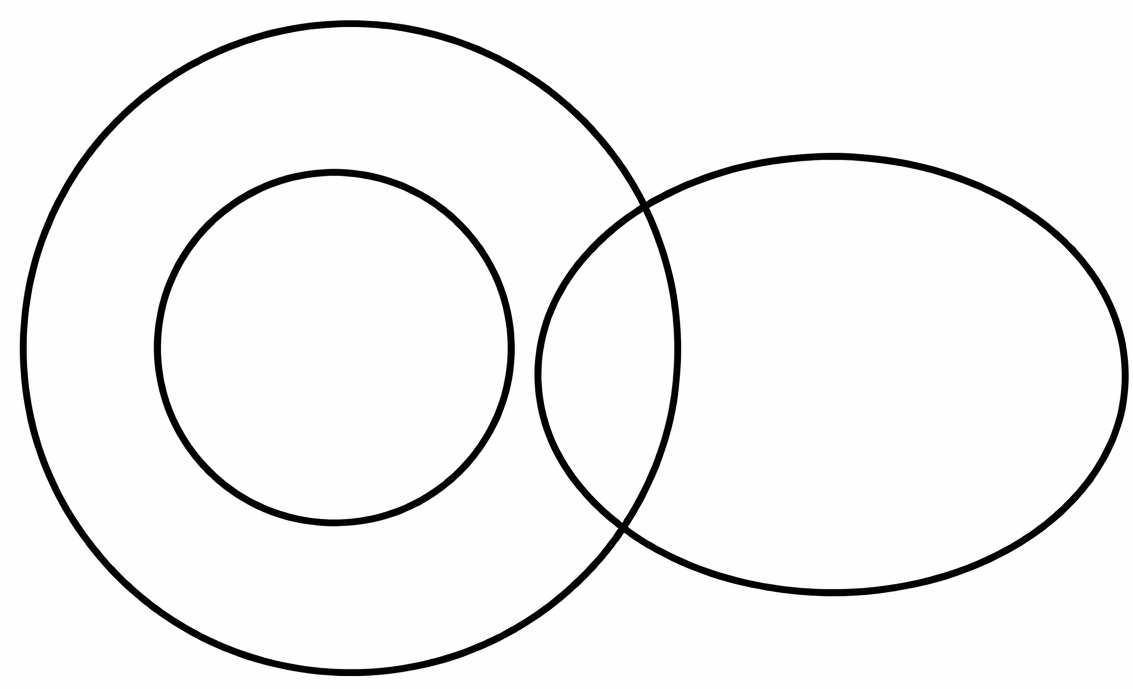
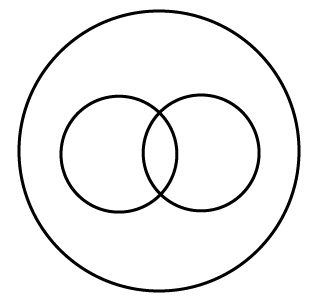
Select the Venn diagram that best represents the relationship between the following classes.
Milky Way, Jupiter, Earth
To solve this problem, we need to understand the hierarchical relationship between the classes: Milky Way, Jupiter, and Earth. The Milky Way is a galaxy that contains our solar system, which includes Jupiter and Earth as planets. Therefore, Jupiter and Earth are part of the Milky Way but are separate entities from each other.
Correct Option: C) The diagram shows two separate circles inside a larger circle, representing Jupiter and Earth within the Milky Way.
The question asks to identify the incorrectly paired region and its associated grassland. This requires knowledge of the major grasslands of the world and their geographical locations.
Based on this evaluation, the incorrect pairing is Argentina – Prairies.
Correct Option: B) Argentina – Prairies
If ₹1,313 is divided into three parts proportional to \( \frac{1}{3} \) : \( \frac{3}{5} \) : \( \frac{3}{4} \), then the second part is _____.
To divide a sum of money into parts proportional to given fractions, first convert the fractional ratio into a simple whole number ratio by finding the Least Common Multiple (LCM) of the denominators. Then, sum the parts of this simplified ratio and use it to find the value of each part.
The money is to be divided in the ratio \[\frac{1}{3} : \frac{3}{5} : \frac{3}{4}\].
The denominators are 3, 5, and 4. The LCM of 3, 5, and 4 is \(3 \times 5 \times 4 = 60\).
Multiply each fraction by the LCM (60):
\[ \left( \frac{1}{3} \times 60 \right) : \left( \frac{3}{5} \times 60 \right) : \left( \frac{3}{4} \times 60 \right) \]\[ 20 : 36 : 45 \]Sum of the parts \( = 20 + 36 + 45 = 101 \).
The total amount to be divided is ₹1,313. The second part corresponds to the ratio 36 out of the total sum of 101 parts.
\[ \text{Second Part} = \frac{\text{Second Ratio Part}}{\text{Sum of Ratio Parts}} \times \text{Total Amount} \]\[ \text{Second Part} = \frac{36}{101} \times 1313 \]\[ \text{Second Part} = 36 \times 13 \]\[ \text{Second Part} = \text{₹}468 \]A) ₹468 is the correct answer. The calculation shows that the second part is ₹468.
To find the overall gain percent, we need to calculate the total cost price and the total selling price for a certain quantity of milk and water mixture. We will consider a convenient quantity of pure milk to simplify calculations, then account for the water added and the increased selling price.
Assume a Cost Price (CP) for pure milk:
Let the cost price of 1 litre of pure milk be Rs. 100.
\[ \text{CP of 1 litre of milk} = \text{Rs. } 100 \]Calculate the Cost Price for the initial quantity of milk:
The vendor starts with 5 litres of milk. So, the cost price of 5 litres of pure milk is:
\[ \text{CP of 5 litres of milk} = 5 \times \text{Rs. } 100 = \text{Rs. } 500 \]Determine the quantity of water added:
The vendor adds 3 litres of water to every 5 litres of milk. The cost of water is considered Rs. 0.
\[ \text{Quantity of water} = 3 \text{ litres} \]Calculate the total volume of the mixture:
The total volume of the mixture to be sold is the sum of milk and water:
\[ \text{Total volume} = 5 \text{ litres (milk)} + 3 \text{ litres (water)} = 8 \text{ litres} \]Calculate the Selling Price (SP) per litre of the mixture:
The vendor sells milk at 20% more than the cost price of pure milk. So, the selling price per litre of the mixture (which is sold as milk) is:
\[ \text{SP per litre} = \text{CP of 1 litre of milk} + 20\% \text{ of CP of 1 litre of milk} \] \[ \text{SP per litre} = \text{Rs. } 100 + (0.20 \times \text{Rs. } 100) = \text{Rs. } 100 + \text{Rs. } 20 = \text{Rs. } 120 \]Calculate the total Selling Price (SP) of the mixture:
The total volume of the mixture is 8 litres, and each litre is sold at Rs. 120.
\[ \text{Total SP} = 8 \text{ litres} \times \text{Rs. } 120/\text{litre} = \text{Rs. } 960 \]Calculate the overall gain:
The overall gain is the total selling price minus the total cost price (cost of water is 0).
\[ \text{Overall Gain} = \text{Total SP} - \text{Total CP} = \text{Rs. } 960 - \text{Rs. } 500 = \text{Rs. } 460 \]Calculate the overall gain percent:
Gain percent is calculated with respect to the actual cost price of the milk.
\[ \text{Gain Percent} = \left( \frac{\text{Overall Gain}}{\text{Total CP}} \right) \times 100 \] \[ \text{Gain Percent} = \left( \frac{\text{Rs. } 460}{\text{Rs. } 500} \right) \times 100 \] \[ \text{Gain Percent} = \frac{460}{5} = 92\% \]Thus, the vendor's overall gain percent is 92%.
B) 92% is the correct overall gain percent.
A) 25% — This would be the gain if the vendor added water and sold at cost price, or if the ratios were different. For example, if 5 litres of milk (CP 500) became 8 litres of mixture sold at CP (Rs 100/litre), SP would be 800, gain 300, %gain = (300/500)*100 = 60%. If only 20% profit was made on 5 litres of milk (Rs 100 profit), and no water was added, it would be 20%. This option is incorrect.
C) 80% — This would be the gain if the vendor only added water (3 litres to 5 litres of milk) and sold the mixture at the cost price of milk. In that case, CP = Rs. 500, SP = 8 litres * Rs. 100/litre = Rs. 800. Gain = Rs. 300. Gain % = (300/500)*100 = 60%. If the selling price was 80% more than cost price without water, it would be 80%. This option is incorrect.
D) 60% — This would be the gain if the vendor only added 3 litres of water to 5 litres of milk and sold the mixture at the original cost price of milk (Rs. 100 per litre). In this scenario, the cost price of 5 litres of milk is Rs. 500. The total volume becomes 8 litres. If sold at Rs. 100 per litre, the total selling price would be Rs. 800. The gain would be Rs. 300. The gain percent would be \((300/500) \times 100 = 60\%\). However, the vendor also sells at 20% more than the cost price, so this option is incorrect.
This question asks for the full form of the acronym MCB, which is a common electrical safety device. Understanding common abbreviations in electrical engineering and general knowledge is crucial for competitive exams.
A) Miniature Circuit Breaker — This is the universally accepted full form of MCB. It accurately describes the device's function (circuit breaker) and its typical size relative to older, larger circuit breakers (miniature).
We need to first find the initial rate of simple interest using the given principal, amount, and time. Once the initial rate is known, we will increase it by 3% and then calculate the new amount for the same principal and time.
D) ₹1,242 is the correct amount ₹900 will become in 4 years with the increased interest rate.
Two ships are sailing in the sea on two sides of a lighthouse. The angles of elevation of top of the lighthouse as observed from the two ships are 30° and 45° respectively. If the light house is 90 m high, then the distance between the two ships is _____.
90\(\sqrt{3}\)m
90(\(\sqrt{3}\) + 1) m
100 m
90(\(\sqrt{3}\) - 1) m
This problem involves trigonometry, specifically the concept of angles of elevation. We need to use the tangent function to relate the height of the lighthouse to the distances of the ships from its base. Since the ships are on opposite sides of the lighthouse, the total distance between them will be the sum of their individual distances from the lighthouse.
Let the height of the lighthouse be \(h\). Given \(h = 90 \text{ m}\).
Let the position of the lighthouse be point A, and its top be point B. Let the two ships be at points C and D, on opposite sides of the lighthouse.
The angle of elevation from ship C to the top of the lighthouse is \(30^\circ\). In the right-angled triangle \(\triangle ABC\), we have:
\[ \tan(30^\circ) = \frac{\text{Opposite}}{\text{Adjacent}} = \frac{AB}{AC} \]\[ \frac{1}{\sqrt{3}} = \frac{90}{AC} \]\[ AC = 90\sqrt{3} \text{ m} \]The angle of elevation from ship D to the top of the lighthouse is \(45^\circ\). In the right-angled triangle \(\triangle ABD\), we have:
\[ \tan(45^\circ) = \frac{\text{Opposite}}{\text{Adjacent}} = \frac{AB}{AD} \]\[ 1 = \frac{90}{AD} \]\[ AD = 90 \text{ m} \]Since the two ships are on opposite sides of the lighthouse, the distance between them is the sum of their distances from the base of the lighthouse:
\[ \text{Distance between ships} = AC + AD \]\[ \text{Distance between ships} = 90\sqrt{3} + 90 \]\[ \text{Distance between ships} = 90(\sqrt{3} + 1) \text{ m} \]B) 90(\(\sqrt{3}\) + 1) m is the correct answer, as calculated by summing the distances of the two ships from the base of the lighthouse.
0.002 is what percent of 0.12?
To find what percentage one number is of another, we can set up a fraction where the first number is the numerator and the second number is the denominator. Then, we multiply this fraction by 100 to express it as a percentage.
Correct Option: B) \( \frac{5}{3} \) %