
To find the minimum value of the given trigonometric expression, we can use the fundamental trigonometric identity \( \sin^2\theta + \cos^2\theta = 1 \). By substituting \( \sin^2\theta = 1 - \cos^2\theta \) or \( \cos^2\theta = 1 - \sin^2\theta \), we can express the entire expression in terms of a single trigonometric function squared. Then, we can use the known range of \( \sin^2\theta \) or \( \cos^2\theta \) to find the minimum value.
The given expression is \( 11\sin ^{2}\theta + 12\cos ^{2}\theta \).
We know the identity \( \sin ^{2}\theta + \cos ^{2}\theta = 1 \). We can rewrite \( 12\cos ^{2}\theta \) as \( 11\cos ^{2}\theta + \cos ^{2}\theta \) or \( 12\sin ^{2}\theta - \sin ^{2}\theta \).
Let's rewrite the expression by splitting one of the terms:
\[ 11\sin ^{2}\theta + 12\cos ^{2}\theta = 11\sin ^{2}\theta + 11\cos ^{2}\theta + \cos ^{2}\theta \]Factor out 11 from the first two terms:
\[ 11(\sin ^{2}\theta + \cos ^{2}\theta) + \cos ^{2}\theta \]Substitute \( \sin ^{2}\theta + \cos ^{2}\theta = 1 \) into the expression:
\[ 11(1) + \cos ^{2}\theta = 11 + \cos ^{2}\theta \]Now, we need to find the minimum value of \( 11 + \cos ^{2}\theta \). We know that the range of \( \cos \theta \) is \( [-1, 1] \).
Therefore, the range of \( \cos ^{2}\theta \) is \( [0, 1] \). This means the minimum value of \( \cos ^{2}\theta \) is 0 and the maximum value is 1.
To find the minimum value of the expression \( 11 + \cos ^{2}\theta \), we substitute the minimum value of \( \cos ^{2}\theta \), which is 0:
\[ \text{Minimum value} = 11 + 0 = 11 \]C) 11 is the minimum value of the expression \( 11\sin ^{2}\theta + 12\cos ^{2}\theta \).
Select the Venn diagram that best represents the relationship between the following classes. Women, Married women, Lady doctor.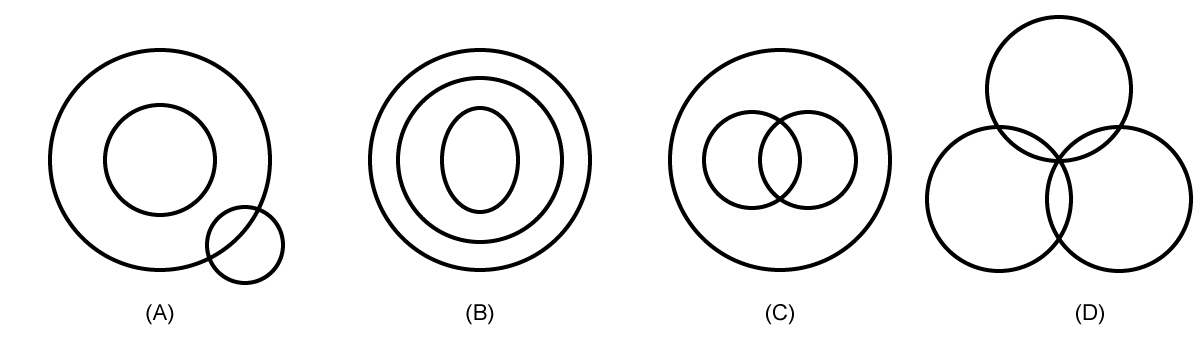
To determine the correct Venn diagram, we need to understand the relationships between the classes: Women, Married women, and Lady doctor. We will analyze how these categories overlap or are contained within each other.
Correct Option: B) The diagram shows three concentric circles, accurately representing the hierarchical subset relationships.
If sin θ − cosec θ = \(\sqrt{2}\), then the value of \( \sin ^{3}\theta - \operatorname{cosec} ^{3}\theta \) is:
2\(\sqrt{3}\)
0
\(\frac{1}{\sqrt{2}}\)
5\(\sqrt{2}\)
The problem provides an equation involving \(\sin \theta\) and \(\operatorname{cosec} \theta\) and asks for the value of an expression involving \(\sin^3 \theta\) and \(\operatorname{cosec}^3 \theta\). We can use the algebraic identity for the difference of cubes, \(a^3 - b^3 = (a-b)(a^2+ab+b^2)\), or alternatively, \(a^3 - b^3 = (a-b)^3 + 3ab(a-b)\). Since \(\operatorname{cosec} \theta = \frac{1}{\sin \theta}\), the product \(\sin \theta \cdot \operatorname{cosec} \theta = 1\), which simplifies the expressions significantly.
Given the equation:
\[ \sin \theta - \operatorname{cosec} \theta = \sqrt{2} \]We need to find the value of \(\sin^3 \theta - \operatorname{cosec}^3 \theta\). Let \(a = \sin \theta\) and \(b = \operatorname{cosec} \theta\). Then the given equation is \(a - b = \sqrt{2}\), and we need to find \(a^3 - b^3\).
Recall the algebraic identity for the difference of cubes:
\[ a^3 - b^3 = (a-b)^3 + 3ab(a-b) \]Substitute \(a = \sin \theta\) and \(b = \operatorname{cosec} \theta\) into the identity:
\[ \sin^3 \theta - \operatorname{cosec}^3 \theta = (\sin \theta - \operatorname{cosec} \theta)^3 + 3(\sin \theta)(\operatorname{cosec} \theta)(\sin \theta - \operatorname{cosec} \theta) \]We know that \(\operatorname{cosec} \theta = \frac{1}{\sin \theta}\), so the product \(\sin \theta \cdot \operatorname{cosec} \theta = 1\).
Substitute the given value \(\sin \theta - \operatorname{cosec} \theta = \sqrt{2}\) and the product \(\sin \theta \cdot \operatorname{cosec} \theta = 1\) into the equation from Step 4:
\[ \sin^3 \theta - \operatorname{cosec}^3 \theta = (\sqrt{2})^3 + 3(1)(\sqrt{2}) \]Calculate \( (\sqrt{2})^3 \):
\[ (\sqrt{2})^3 = \sqrt{2} \cdot \sqrt{2} \cdot \sqrt{2} = 2\sqrt{2} \]Substitute this back into the expression:
\[ \sin^3 \theta - \operatorname{cosec}^3 \theta = 2\sqrt{2} + 3\sqrt{2} \]Combine the terms:
\[ \sin^3 \theta - \operatorname{cosec}^3 \theta = 5\sqrt{2} \]D) \(5\sqrt{2}\) is the calculated value for \(\sin^3 \theta - \operatorname{cosec}^3 \theta\).
The question asks for the name of an approach that uses DNA differences to determine evolutionary relationships, based on the principle that more distantly related organisms will have accumulated more genetic differences over time. This concept is central to molecular evolutionary studies.
Correct Option: C) Molecular phylogeny — This approach uses molecular data, such as DNA sequences, to infer evolutionary relationships between organisms. The principle is that the accumulation of genetic differences (mutations) in DNA over time can be used as a measure of evolutionary distance. Organisms that diverged longer ago will have more differences in their DNA.
To find the maximum capacity of a container that can exactly measure the contents of two pots, we need to find the Highest Common Factor (HCF) of their capacities. The capacities are given in litres, and the options are in cubic centimetres (cc). Therefore, we will first find the HCF in litres and then convert it to cc.
Capacity of the first pot = 132 litres
Capacity of the second pot = 69 litres
We can use the prime factorization method or the Euclidean algorithm.
Prime factorization of 132:
\[ 132 = 2 \times 2 \times 3 \times 11 \]Prime factorization of 69:
\[ 69 = 3 \times 23 \]The common prime factor is 3.
So, the HCF of 132 and 69 is 3.
This means the maximum capacity of the container in litres is 3 litres.
We know that 1 litre = 1000 cubic centimetres (cc).
Therefore, 3 litres = \(3 \times 1000\) cc = 3000 cc.
The calculated maximum capacity is 3000 cc, which matches option C.
C) 3000 cc is the maximum capacity of a container that can exactly measure the content of the two pots.
The sum of two numbers is 40. Their HCF and LCM are 2 and 102, respectively. The sum of the reciprocals of the same two numbers is:
\( \frac{5}{17} \)
\( \frac{10}{51} \)
\( \frac{7}{19} \)
\( \frac{8}{19} \)
We are given the sum of two numbers, their HCF (Highest Common Factor), and their LCM (Least Common Multiple). We need to find the sum of the reciprocals of these two numbers. We will use the fundamental relationship between two numbers, their HCF, and LCM, along with algebraic manipulation to solve the problem.
Let the two numbers be \(a\) and \(b\).
From the problem statement, we are given:
A fundamental property of two numbers is that the product of the numbers is equal to the product of their HCF and LCM. That is:
\[ a \times b = \text{HCF}(a, b) \times \text{LCM}(a, b) \]Substitute the given values into this property:
\[ a \times b = 2 \times 102 \]\[ a \times b = 204 \]We need to find the sum of the reciprocals of the two numbers, which is \[\frac{1}{a} + \frac{1}{b}\].
Combine the reciprocals into a single fraction:
\[ \frac{1}{a} + \frac{1}{b} = \frac{b + a}{ab} \]Substitute the values we found for \(a+b\) and \(ab\):
\[ \frac{b + a}{ab} = \frac{40}{204} \]Simplify the fraction \(\frac{40}{204}\) by dividing both the numerator and the denominator by their greatest common divisor. Both are divisible by 4:
\[ \frac{40 \div 4}{204 \div 4} = \frac{10}{51} \]Thus, the sum of the reciprocals of the two numbers is \( \frac{10}{51} \).
B) \( \frac{10}{51} \) is the correct answer, as derived from the properties of HCF, LCM, and algebraic simplification.
The question asks about the location of valence electrons within an atom. To answer this, we need to recall the basic structure of an atom and the definition of valence electrons.
D) outermost shell of an atom — This is the correct definition and location of valence electrons. They are the electrons in the highest occupied energy level of an atom.
The problem provides a ratio \(x : y = 4 : 3\) and asks for the value of another ratio \( (x^3 - y^3) : (x^3 + y^3) \). We can express \(x\) and \(y\) in terms of a common constant from the given ratio and then substitute these expressions into the required ratio to simplify it.
Express \(x\) and \(y\) using a constant:
Given the ratio \(x : y = 4 : 3\), we can write:
\[ \frac{x}{y} = \frac{4}{3} \]This implies that \(x\) and \(y\) can be represented as multiples of a common constant, say \(k\). So, let:
\[ x = 4k \] \[ y = 3k \]Calculate \(x^3\) and \(y^3\):
Substitute the expressions for \(x\) and \(y\) into their cubes:
\[ x^3 = (4k)^3 = 4^3 k^3 = 64k^3 \] \[ y^3 = (3k)^3 = 3^3 k^3 = 27k^3 \]Calculate \(x^3 - y^3\):
Subtract \(y^3\) from \(x^3\):
\[ x^3 - y^3 = 64k^3 - 27k^3 = (64 - 27)k^3 = 37k^3 \]Calculate \(x^3 + y^3\):
Add \(y^3\) to \(x^3\):
\[ x^3 + y^3 = 64k^3 + 27k^3 = (64 + 27)k^3 = 91k^3 \]Form the required ratio:
Now, form the ratio \( (x^3 - y^3) : (x^3 + y^3) \):
\[ \frac{x^3 - y^3}{x^3 + y^3} = \frac{37k^3}{91k^3} \]Since \(k \neq 0\) (otherwise \(x\) and \(y\) would be zero, making the ratio undefined), we can cancel \(k^3\) from the numerator and denominator:
\[ \frac{37k^3}{91k^3} = \frac{37}{91} \]So, the ratio is \(37 : 91\).
D) The calculated ratio is \(37 : 91\), which matches option D.
The question asks about the primary diet of Kharai Camels. This requires knowledge of the specific characteristics and habitat of this unique camel breed.
Therefore, mangroves are the main food source for Kharai Camels.
Correct Option: B) Mangroves
The question asks to identify the country that observes more than one time zone. This requires knowledge of the geographical extent and time zone policies of the listed countries.
A) USA. The United States of America, due to its vast geographical spread from east to west, officially uses multiple time zones. The contiguous U.S. has four main time zones: Eastern, Central, Mountain, and Pacific. Including Alaska and Hawaii, it has even more.