
The question asks to identify the book that is NOT authored by Amartya Sen. This requires knowledge of the prominent works of Amartya Sen, a Nobel laureate in Economics.
Correct Option: C) Poverty of India
The book Poverty of India was authored by V.M. Dandekar and Nilakantha Rath. It is a seminal work in Indian economics but not by Amartya Sen.
The problem presents a series of two-letter codes. We need to identify the pattern in the alphabetical positions of the letters to determine the next term in the series.
Correct Option: B) nd
The question asks about the specific Indian National Congress session where Mahatma Gandhi successfully advocated for the Non-Cooperation Movement, linking it with both Khilafat and Swaraj. To answer this, we need to recall the key Congress sessions around 1920 and their significant resolutions.
Correct Option: D) The Calcutta session (September 1920) was the special session where Mahatma Gandhi successfully moved the resolution for the Non-Cooperation Movement, linking it with the Khilafat issue and the demand for Swaraj. Although it was ratified later in Nagpur, the initial convincing and adoption happened in Calcutta.
Study the given pattern carefully and select the number that can replace the question mark (?) in it.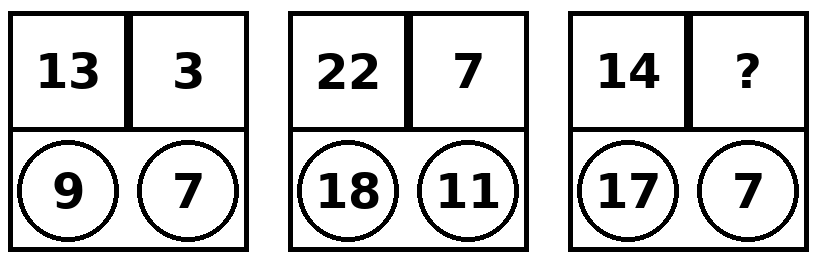
The diagram consists of three sets of boxes, each containing two numbers in the top row and two numbers in circles in the bottom row. The goal is to find the pattern between these numbers and determine the missing number.
\[ (14 + x) - 17 = 7 \]
\[ 14 + x = 24 \]
\[ x = 10 \]
Thus, the missing number is 10.
Correct Option: A) 10
The question asks for the basic unit of classification of living organisms. This refers to the lowest and most fundamental taxonomic rank in the Linnaean system of classification.
Correct Option: D) Species is considered the basic unit of classification because it represents a group of organisms that are reproductively isolated from other such groups and share a common gene pool.
This question asks about the economic concept derived when depreciation is subtracted from the Gross National Product (GNP). Understanding the definitions of key national income aggregates is crucial here.
Therefore, deducting depreciation from Gross National Product yields Net National Product.
A) Net National Product. As explained, NNP is precisely what remains after accounting for the consumption of fixed capital (depreciation) from GNP. It provides a more accurate picture of the net output available for consumption and investment.
The question asks about the colours of the tricolour flag designed during the Swadeshi Movement in Bengal. This requires knowledge of the historical details of the Indian national flag's evolution.
Therefore, the colours of this flag were red, green, and yellow.
Correct Option: A) red, green and yellow
This problem involves calculating the rate of simple interest given the principal amount, the final amount, and the time period. We will first find the simple interest earned, then use the simple interest formula to determine the rate of interest.
Simple Interest is the difference between the Amount and the Principal.
\[ \text{SI} = A - P \]\[ \text{SI} = \text{₹}31,500 - \text{₹}25,000 \]\[ \text{SI} = \text{₹}6,500 \]The formula for Simple Interest is:
\[ \text{SI} = \frac{P \times R \times T}{100} \]Correct Option: A) The rate of interest is 6.5%.
To find the time taken for a train to clear a platform, we need to calculate the total distance the train must travel, which is the sum of its own length and the length of the platform. Then, we convert the train's speed from km/h to m/s and use the formula \(\text{Time} = \frac{\text{Distance}}{\text{Speed}}\).
For the train to clear the platform completely, it must travel a distance equal to its own length plus the length of the platform.
\[ \text{Total Distance} (D) = L_p + L_t \]\[ D = 238 \text{ m} + 162 \text{ m} \]\[ D = 400 \text{ m} \]To convert km/h to m/s, multiply by \(\frac{5}{18}\).
\[ S = 120 \text{ km/h} \times \frac{5}{18} \text{ m/s per km/h} \]\[ S = \frac{120 \times 5}{18} \text{ m/s} \]\[ S = \frac{600}{18} \text{ m/s} \]\[ S = \frac{100}{3} \text{ m/s} \]Using the formula \(\text{Time} = \frac{\text{Distance}}{\text{Speed}}\):
\[ \text{Time} (T) = \frac{D}{S} \]\[ T = \frac{400 \text{ m}}{\frac{100}{3} \text{ m/s}} \]\[ T = \frac{400 \times 3}{100} \text{ s} \]\[ T = 4 \times 3 \text{ s} \]\[ T = 12 \text{ s} \]Correct Option: C) 12 seconds
To find the total loss, we need to calculate the selling price of the shares sold at a profit and the selling price of the shares sold at a loss. Then, we compare the total selling price with the total investment.
Calculate the total investment:
Total Investment \( = \text{₹}42,000 \)
Calculate the value of shares sold at a profit:
One-third of the total shares \( = \frac{1}{3} \times \text{₹}42,000 = \text{₹}14,000 \)
Profit percentage \( = 10\% \)
Profit amount \[= 10\% \text{ of } \text{₹}14,000 = \frac{10}{100} \times 14,000 = \text{₹}1,400\]
Selling Price (Profit) \( = \text{Cost Price} + \text{Profit} = \text{₹}14,000 + \text{₹}1,400 = \text{₹}15,400 \)
Calculate the value of remaining shares sold at a loss:
Remaining shares \( = \text{Total Investment} - \text{Shares sold at profit} = \text{₹}42,000 - \text{₹}14,000 = \text{₹}28,000 \)
Loss percentage \( = 10\% \)
Loss amount \[= 10\% \text{ of } \text{₹}28,000 = \frac{10}{100} \times 28,000 = \text{₹}2,800\]
Selling Price (Loss) \( = \text{Cost Price} - \text{Loss} = \text{₹}28,000 - \text{₹}2,800 = \text{₹}25,200 \)
Calculate the total selling price:
Total Selling Price \( = \text{Selling Price (Profit)} + \text{Selling Price (Loss)} \)
Total Selling Price \( = \text{₹}15,400 + \text{₹}25,200 = \text{₹}40,600 \)
Calculate the total loss:
Total Loss \( = \text{Total Investment} - \text{Total Selling Price} \)
Total Loss \( = \text{₹}42,000 - \text{₹}40,600 = \text{₹}1,400 \)
Correct Option: C) ₹1,400