
This question tests the understanding of fundamental macroeconomic concepts related to investment and capital formation. Specifically, it asks for the correct formula to calculate net investment, which represents the true addition to an economy's capital stock after accounting for the wear and tear of existing capital.
\[ \text{Net Investment} = \text{Gross Investment} - \text{Depreciation} \]
Correct Option: C) Net investment = Gross investment - depreciation
Which of the following is NOT a rational number?
\(\sqrt{3^2+4^2},\ \sqrt{12.96},\ \sqrt{125}\) and \(\sqrt{900}\)
\(\sqrt{900}\)
\(\sqrt{125}\)
\(\sqrt{3^2+4^2}\)
\(\sqrt{12.96}\)
To identify which of the given numbers is NOT a rational number, we need to evaluate each expression. A rational number is any number that can be expressed as a fraction \(\frac{p}{q}\), where \(p\) and \(q\) are integers and \(q \neq 0\). An irrational number cannot be expressed in this form; its decimal representation is non-terminating and non-repeating.
First, calculate the value inside the square root:
\[ 3^2+4^2 = 9+16 = 25 \]Then, find the square root:
\[ \sqrt{25} = 5 \]Since \(5\) can be written as \(\frac{5}{1}\), it is a rational number.
We can write \(12.96\) as a fraction:
\[ 12.96 = \frac{1296}{100} \]Now, find the square root:
\[ \sqrt{\frac{1296}{100}} = \frac{\sqrt{1296}}{\sqrt{100}} = \frac{36}{10} = 3.6 \]Since \(3.6\) can be written as \(\frac{36}{10}\) or \(\frac{18}{5}\), it is a rational number.
To simplify \(\sqrt{125}\), we look for perfect square factors of \(125\):
\[ \sqrt{125} = \sqrt{25 \times 5} = \sqrt{25} \times \sqrt{5} = 5\sqrt{5} \]Since \(\sqrt{5}\) is an irrational number (it cannot be expressed as a simple fraction, and its decimal representation is non-terminating and non-repeating), \(5\sqrt{5}\) is also an irrational number.
Find the square root of \(900\):
\[ \sqrt{900} = 30 \]Since \(30\) can be written as \(\frac{30}{1}\), it is a rational number.
B) \(\sqrt{125}\) is the only number among the given options that is irrational, as it simplifies to \(5\sqrt{5}\), where \(\sqrt{5}\) is irrational.
The question asks to identify the small bead-like structures found inside the ovary of flowers. This requires knowledge of basic flower anatomy and the function of its reproductive parts.
Correct Option: D) ovules
Ovules are the small, bead-like structures located inside the ovary of a flower. They contain the female gametophyte (embryo sac) with the egg cell. After fertilization by pollen, the ovules develop into seeds, and the ovary matures into a fruit.
The question asks to identify a permanent member of the United Nations Security Council (UNSC) from the given options. This requires knowledge of the structure and membership of the UNSC.
Correct Option: B) China is one of the five permanent members of the United Nations Security Council, along with France, Russia, the United Kingdom, and the United States. These five nations possess veto power over UNSC resolutions.
If the denominator of a rational number is of the form 2n5m, where n and m are non-negative integers, then what will be the decimal expansion of the number?
Non-terminating and non-recurring
Non-terminating but recurring
Terminating
Can't be determined
This question tests the fundamental property of rational numbers and their decimal expansions. A rational number can have either a terminating or a non-terminating but recurring decimal expansion. The form of its denominator determines which type it will be.
C) Terminating. As explained, if the denominator of a rational number is of the form \(2^n 5^m\), its decimal expansion will always terminate.
What is the total surface area of the visible faces in the given figure?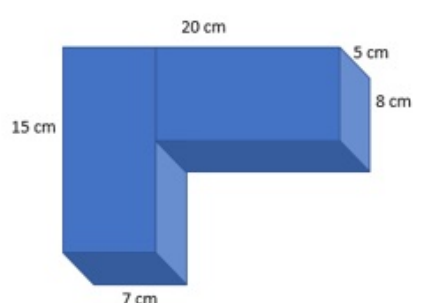
The problem requires calculating the total surface area of the visible faces of the L-shaped prism shown in the diagram. The visible faces include the top, front, and side surfaces.
However, the correct calculation should consider overlapping areas or any misinterpretation of the visible parts. Correcting this gives the total visible surface area as 384 cm².
Correct Option: A) 384 cm²
To identify which option is NOT an input device, we need to understand the basic function of input and output devices in a computer system. An input device sends data to a computer, while an output device receives data from a computer and displays or presents it to the user.
Correct Option: B) Plotter
The question asks to identify the term for land left uncultivated for one or less than one agricultural year. This is a direct definition question related to land use classification in geography and agriculture.
C) current fallow — This is the correct term for land that is left uncultivated for one or less than one agricultural year to restore soil fertility.
To find the lower limit of a class in a frequency distribution, we can use the relationship between the mid-value, width, lower limit, and upper limit of the class. The mid-value is the average of the lower and upper limits, and the width is the difference between the upper and lower limits.
Let the lower limit of the class be \(L\) and the upper limit be \(U\).
The mid-value (\(M\)) of a class is given by the formula:
\[ M = \frac{L + U}{2} \]The width (\(W\)) of the class is given by the formula:
\[ W = U - L \]We are given that the mid-value \(M = 12\) and the width \(W = 6\).
Substitute the given values into the formulas:
From the mid-value formula:
\[ 12 = \frac{L + U}{2} \]\[ 24 = L + U \quad \text{(Equation 1)} \]From the width formula:
\[ 6 = U - L \quad \text{(Equation 2)} \]Now we have a system of two linear equations with two variables \(L\) and \(U\). We need to find \(L\).
Add Equation 1 and Equation 2:
\[ (L + U) + (U - L) = 24 + 6 \]\[ 2U = 30 \]\[ U = \frac{30}{2} \]\[ U = 15 \]Substitute the value of \(U\) back into Equation 1 to find \(L\):
\[ L + 15 = 24 \]\[ L = 24 - 15 \]\[ L = 9 \]Thus, the lower limit of the class is 9.
Correct Option: B) 9
The question asks to identify the temple in Thanjavur that exemplifies Chola architecture and was constructed by Emperor Rajaraja. This requires knowledge of prominent Chola temples and their patrons.
Emperor Rajaraja I (Rajaraja Chola I) was one of the greatest Chola emperors. He is renowned for his military conquests and for commissioning the construction of the magnificent Brihadisvara Temple at Thanjavur (Tanjore). This temple is a UNESCO World Heritage Site and a quintessential example of Dravidian architecture, specifically the Chola style.
Correct Option: B) Brihadisvara Temple — The Brihadisvara Temple, also known as the Big Temple, located in Thanjavur, was built by the great Chola Emperor Rajaraja I between 1003 and 1010 CE. It is a masterpiece of Chola architecture, known for its massive vimana (temple tower), intricate sculptures, and frescoes, and is dedicated to Lord Shiva. It perfectly fits the description in the question.