
This problem involves the concept of work and time, specifically comparing the efficiencies of two individuals. We can use the relationship between efficiency, time, and work done. If one person is 'n' times as good a workman as another, their efficiency ratio is 'n:1', and consequently, the ratio of time taken to complete the same work will be '1:n'. We will set up equations based on this relationship and the given difference in time.
Understand the relationship between efficiency and time:
If Raju is thrice as good a workman as Ravi, it means Raju's efficiency is 3 times Ravi's efficiency. Efficiency is inversely proportional to the time taken to complete a work.
Let \(E_R\) be Raju's efficiency and \(E_{Ra}\) be Ravi's efficiency.
Given: \(E_R = 3 \times E_{Ra}\)
Let \(T_R\) be the time taken by Raju and \(T_{Ra}\) be the time taken by Ravi to complete the work.
Then, the ratio of their efficiencies is:
\[ \frac{E_R}{E_{Ra}} = \frac{3}{1} \]Determine the ratio of time taken:
Since efficiency is inversely proportional to time, the ratio of time taken will be the inverse of the ratio of efficiencies:
\[ \frac{T_R}{T_{Ra}} = \frac{1}{3} \]Set up variables for time:
Let \(T_R = x\) days and \(T_{Ra} = 3x\) days for some constant \(x\).
Use the given information about the difference in time:
Raju takes 20 days less than Ravi to complete the work. This can be written as:
\[ T_{Ra} - T_R = 20 \]Solve for \(x\):
Substitute the expressions for \(T_R\) and \(T_{Ra}\) into the equation:
\[ 3x - x = 20 \]\[ 2x = 20 \]\[ x = \frac{20}{2} \]\[ x = 10 \]Calculate the time taken by Ravi:
The time taken by Ravi is \(T_{Ra} = 3x\).
\[ T_{Ra} = 3 \times 10 \]\[ T_{Ra} = 30 \text{ days} \]B) 30 days is the correct answer. Ravi takes 30 days to complete the work, and Raju takes 10 days (which is 20 days less than Ravi).
The question asks to identify which of the given options is NOT a supercomputer. This requires knowledge of common supercomputers and general computing devices.
Correct Option: C) PDA
Study the given pattern carefully and select the number that can replace the question mark (?) in it.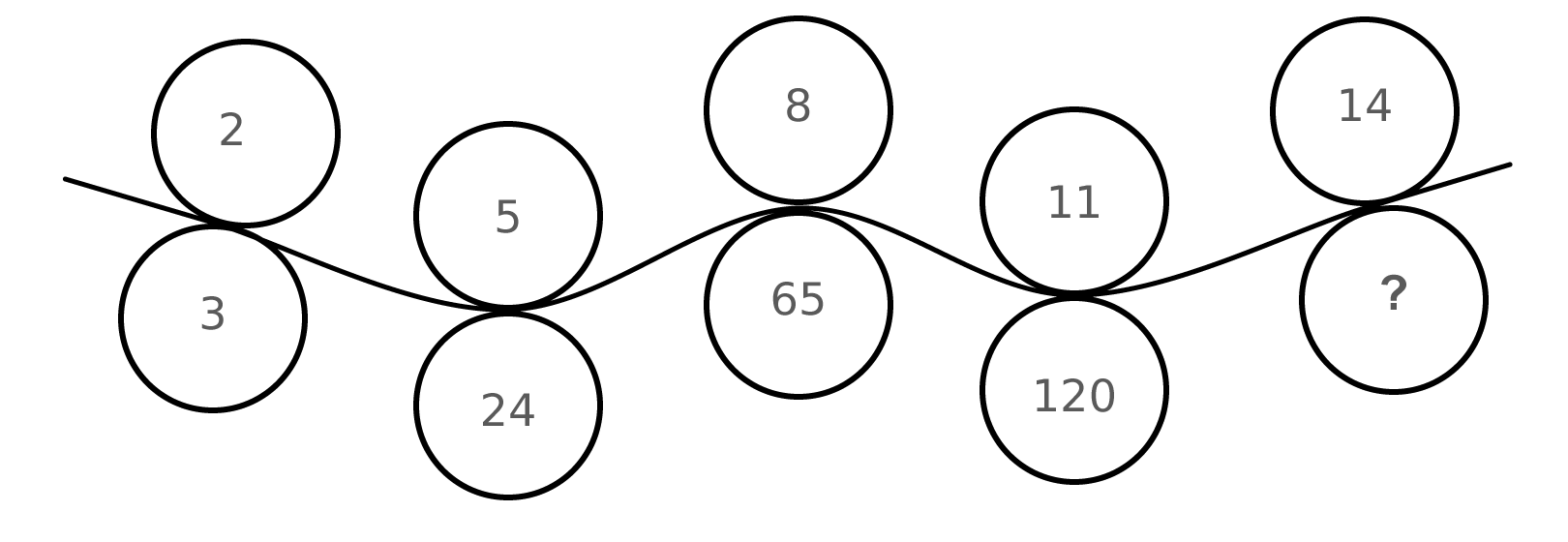
The pattern involves pairs of numbers where the product of the first two numbers in each pair results in the third number. We need to identify the missing number in the last pair using this pattern.
Correct Option: C) 195
This problem can be solved using the principle of inclusion-exclusion for sets, or by carefully counting the students in each category. We are given the number of students who speak each language individually, the number of students who speak exactly two languages, and the number of students who speak all three languages. We need to find the total number of students in the class.
Let E be the set of students who speak English, H for Hindi, and B for Bengali.
We are given that 1 student can speak all three languages.
\[ n(E \cap H \cap B) = 1 \]We are given that 2 students can speak exactly two languages. This means the sum of students who speak (English and Hindi only), (Hindi and Bengali only), and (English and Bengali only) is 2.
\[ n(E \cap H \text{ only}) + n(H \cap B \text{ only}) + n(E \cap B \text{ only}) = 2 \]Let's denote the number of students speaking exactly one language as \(N_1\), exactly two languages as \(N_2\), and exactly three languages as \(N_3\).
The total number of students in the class is given by the sum of students speaking exactly one language, exactly two languages, and exactly three languages.
\[ \text{Total students} = N_1 + N_2 + N_3 \]We know the sum of individual language speakers:
\[ n(E) + n(H) + n(B) = 6 + 15 + 6 = 27 \]This sum (\(n(E) + n(H) + n(B)\)) counts students who speak two languages twice and students who speak three languages thrice. The formula relating these quantities is:
\[ n(E \cup H \cup B) = n(E) + n(H) + n(B) - (n(E \cap H) + n(H \cap B) + n(E \cap B)) + n(E \cap H \cap B) \]Alternatively, we can express the sum of individual language speakers in terms of \(N_1\), \(N_2\), and \(N_3\):
\[ n(E) + n(H) + n(B) = N_1 + 2N_2 + 3N_3 \]Substitute the known values into this equation:
\[ 27 = N_1 + 2(2) + 3(1) \]\[ 27 = N_1 + 4 + 3 \]\[ 27 = N_1 + 7 \]\[ N_1 = 27 - 7 \]\[ N_1 = 20 \]Now, calculate the total number of students:
\[ \text{Total students} = N_1 + N_2 + N_3 \]\[ \text{Total students} = 20 + 2 + 1 \]\[ \text{Total students} = 23 \]A) 23 is the correct number of students in the class, calculated by summing the students who speak exactly one language, exactly two languages, and exactly three languages.
To find the correct mean, we first need to calculate the original (incorrect) sum of observations. Then, we adjust this sum by subtracting the incorrectly recorded values and adding the correct values. Finally, we divide the corrected sum by the total number of observations to get the correct mean.
Correct Option: D) 48.20
The question asks for the location of the research centres Maitri and Dakshin Gangotri. This requires knowledge of India's scientific research stations and their geographical placement.
Correct Option: B) Maitri and Dakshin Gangotri are India's permanent research stations located in Antarctica. These stations play a crucial role in various scientific studies, including glaciology, atmospheric sciences, and polar biology.
The problem asks us to find two numbers given their Highest Common Factor (HCF) and their product. We can use the fundamental relationship between two numbers, their HCF, and their Least Common Multiple (LCM): the product of two numbers is equal to the product of their HCF and LCM. Also, if the HCF of two numbers is \(H\), then the numbers can be expressed as \(Hx\) and \(Hy\), where \(x\) and \(y\) are coprime integers.
Let the two numbers be \(a\) and \(b\).
We are given that their HCF is 4. So, we can write the numbers as:
\[ a = 4x \]\[ b = 4y \]where \(x\) and \(y\) are coprime integers (i.e., their HCF is 1).
We are also given that their product is 48. So,
\[ a \times b = 48 \]Substitute the expressions for \(a\) and \(b\) into the product equation:
\[ (4x) \times (4y) = 48 \]\[ 16xy = 48 \]Solve for the product \(xy\):
\[ xy = \frac{48}{16} \]\[ xy = 3 \]Now we need to find pairs of coprime integers \((x, y)\) whose product is 3. The only pair of positive integers whose product is 3 and which are coprime is \((1, 3)\) (or \((3, 1)\)).
Using these values for \(x\) and \(y\), we can find the numbers \(a\) and \(b\):
In both cases, the pair of numbers is (4, 12).
Let's verify the HCF and product for (4, 12):
B) 4, 12 — The numbers 4 and 12 have an HCF of 4 and their product is \(4 \times 12 = 48\). This matches the given conditions.
The question asks to identify a disease caused by bacteria from the given options. This requires knowledge of the causative agents (bacteria, viruses, etc.) for common infectious diseases.
A) Diphtheria is caused by the bacterium Corynebacterium diphtheriae. This bacterium produces a toxin that can lead to severe complications, including breathing difficulties, heart problems, and nerve damage.
The question asks for the term that describes areas or regions of the world outside the sovereign jurisdiction of any single state, requiring common international governance. We need to identify the correct concept from the given options.
Correct Option: A) global commons — These are areas of the Earth that are not owned by any single nation and are considered to be the shared heritage of humankind, requiring international cooperation for their management and preservation.
To solve this equation, we need to follow the order of operations, often remembered by the acronym PEMDAS/BODMAS (Parentheses/Brackets, Exponents/Orders, Multiplication and Division (from left to right), Addition and Subtraction (from left to right)). We will start from the innermost parentheses and work our way outwards.
First, solve the innermost parentheses:
\[ (2 + 2) = 4 \]Substitute this value back into the equation:
\[ 2 - [2 - \{2 - 2(4)\}] \]Next, perform the multiplication inside the curly braces:
\[ 2(4) = 8 \]Substitute this value back:
\[ 2 - [2 - \{2 - 8\}] \]Now, solve the expression inside the curly braces:
\[ \{2 - 8\} = -6 \]Substitute this value back into the equation:
\[ 2 - [2 - (-6)] \]Simplify the expression inside the square brackets. Remember that subtracting a negative number is equivalent to adding a positive number:
\[ [2 - (-6)] = [2 + 6] = 8 \]Finally, perform the last subtraction:
\[ 2 - 8 = -6 \]B) The final result of the calculation is -6.