
The question asks for the term used to describe a positively charged ion. This is a fundamental concept in chemistry related to atomic structure and ionization.
B) cation — A cation is an ion with a net positive charge, formed when an atom loses one or more electrons.
To find out when the bells will toll together again, we need to find the least common multiple (LCM) of their individual ringing intervals. Once we have the LCM, we can determine how many times they will toll together within the given time frame.
Correct Option: B) 2 times after the starting time
The denominator of a fraction is 2 more than the numerator. When the numerator is multiplied by 3 and the denominator is multiplied by 2 the fraction becomes \( \frac{1}{2} \). The given fraction is:
\( \frac{2}{3} \)
\( \frac{1}{3} \)
\( \frac{1}{4} \)
\( \frac{2}{5} \)
We need to find the original fraction based on the given conditions. We will set up algebraic equations using the information provided and solve for the numerator and denominator.
Let the numerator of the fraction be \(x\).
According to the first condition, the denominator is 2 more than the numerator. So, the denominator is \(x + 2\).
The original fraction can be written as \( \frac{x}{x+2} \).
According to the second condition, when the numerator is multiplied by 3 and the denominator is multiplied by 2, the new fraction becomes \( \frac{1}{2} \).
So, the new numerator is \(3x\).
The new denominator is \(2(x+2)\).
Set up the equation based on the new fraction:
\[ \frac{3x}{2(x+2)} = \frac{1}{2} \]Now, solve this equation for \(x\):
\[ 2 \times (3x) = 1 \times 2(x+2) \]\[ 6x = 2x + 4 \]Subtract \(2x\) from both sides:
\[ 6x - 2x = 4 \]\[ 4x = 4 \]Divide by 4:
\[ x = \frac{4}{4} \]\[ x = 1 \]So, the numerator is \(1\).
The denominator is \(x+2 = 1+2 = 3\).
Therefore, the original fraction is \( \frac{1}{3} \).
Correct Option: B) \( \frac{1}{3} \)
Devesh leaves his home every day at 7 a.m. and reaches office at 8:30 a.m. One day he left his home at 7 a.m. but travelled a fifth of the distance at \( \frac{5}{6} \) of the usual speed and the rest of the distance at \( \frac{6}{5} \) of the usual speed. Approximately at what time did Devesh reach office on that day?
We need to calculate the total time taken by Devesh on the specific day when his speed changed for different parts of the journey. First, we'll determine the usual time taken. Then, we'll calculate the time taken for each segment of the journey on the given day and sum them up to find the total time.
C) 8:21 a.m. is the closest approximation to 8:21.6 a.m.
To find the area of a sector, we use the formula that relates the sector's angle to the full circle's angle (360 degrees) and the total area of the circle. The area of a circle is given by \(\pi r^2\), where \(r\) is the radius. The area of a sector is a fraction of the total area, determined by the ratio of the sector's central angle to 360 degrees.
The area of a sector is given by:
\[ \text{Area of Sector} = \frac{\theta}{360^\circ} \times \pi r^2 \]Using \(\pi = \frac{22}{7}\), we have:
\[ \text{Area of Sector} = \frac{40^\circ}{360^\circ} \times \frac{22}{7} \times (21 \text{ cm})^2 \]Since \(63 \div 9 = 7\), we get:
\[ \text{Area of Sector} = 22 \times 7 \]\[ \text{Area of Sector} = 154 \text{ cm}^2 \]B) 154
To solve this problem, we need to recall the formula for the area of an equilateral triangle. We will then calculate the original area and the new area after the side length is tripled, and finally compare them to find the ratio.
Formula for the area of an equilateral triangle:
The area of an equilateral triangle with side length \(a\) is given by the formula:
Original Area:
Let the original side of the equilateral triangle be \(a_1\). The original area (\(A_1\)) will be:
New Side Length:
The problem states that the side of the equilateral triangle is made three times the original side. So, the new side length (\(a_2\)) will be:
New Area:
Now, we calculate the new area (\(A_2\)) using the new side length \(a_2\):
Compare Original and New Areas:
From step 2, we know that \(A_1 = \frac{\sqrt{3}}{4} a_1^2\). Substituting this into the expression for \(A_2\):
Correct Option: C) 9 times of the original area
The Pie Chart represents the share of savings and expenses under different heads, from the monthly salary of Manish.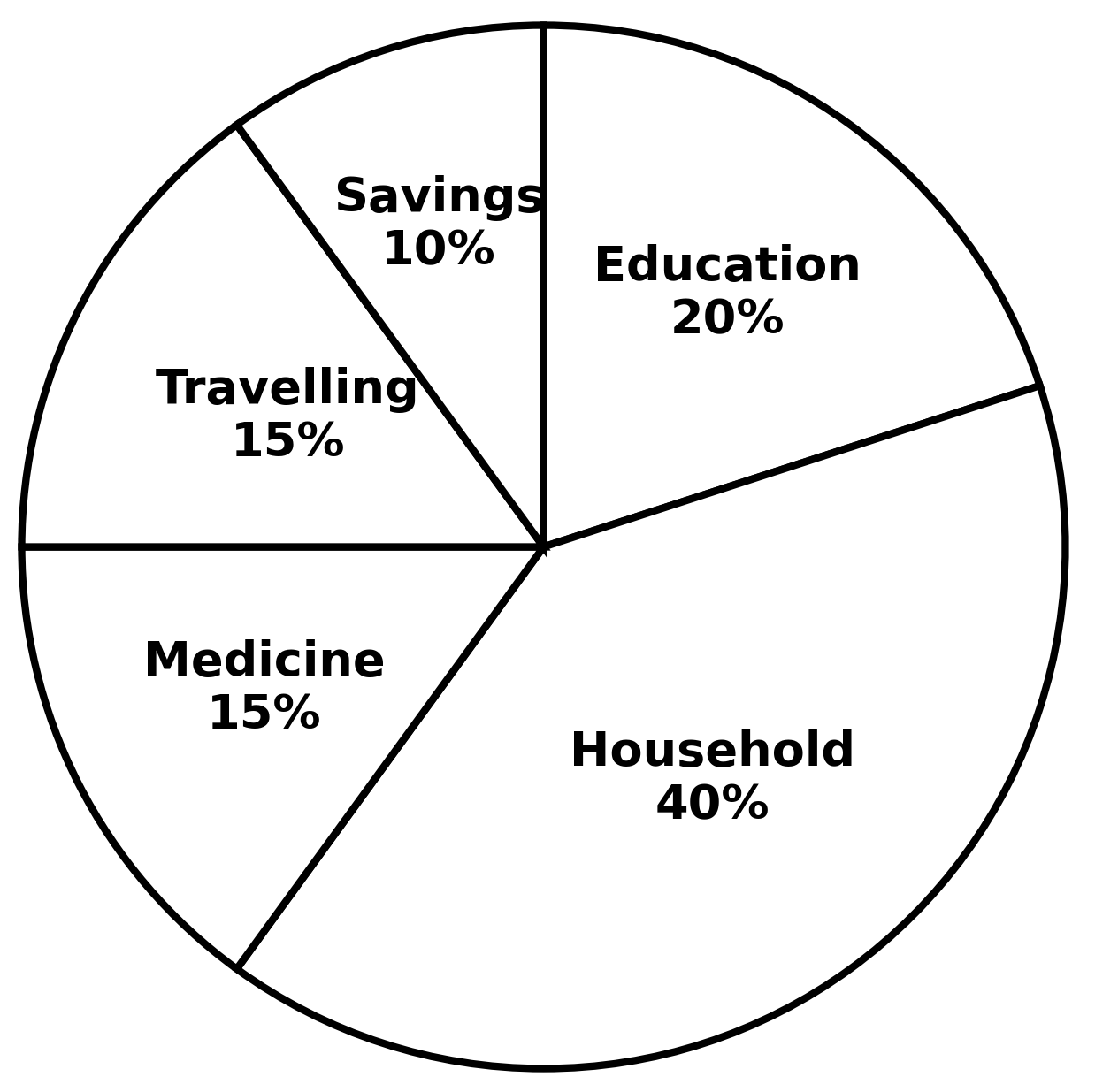
If Manish's salary is ₹50,000 and he wishes to double his monthly savings and spend 50% of the balance amount on his Household expenses, by what amount would he need to reduce on the other expenses.
We need to determine how much Manish must reduce his other expenses to double his savings and allocate 50% of the remaining amount to household expenses.
Correct Option: B) ₹5,000
We need to find the principal sum given the difference between compound interest (CI) and simple interest (SI) for 2 years at a specific rate. We can use the direct formula for the difference between CI and SI for 2 years, or calculate CI and SI separately and then find the principal.
Identify the given values:
Recall the formula for the difference between CI and SI for 2 years:
The formula for the difference between compound interest and simple interest for 2 years is:
\[ \text{CI} - \text{SI} = P \left( \frac{R}{100} \right)^2 \]Substitute the given values into the formula:
\[ 20 = P \left( \frac{4}{100} \right)^2 \]Simplify the equation:
\[ 20 = P \left( \frac{1}{25} \right)^2 \] \[ 20 = P \times \frac{1}{625} \]Solve for \(P\):
\[ P = 20 \times 625 \] \[ P = 12500 \]So, the sum is ₹12,500.00.
Simple Interest (SI) for 2 years:
\[ \text{SI} = \frac{P \times R \times T}{100} = \frac{P \times 4 \times 2}{100} = \frac{8P}{100} = \frac{2P}{25} \]Compound Interest (CI) for 2 years:
Amount \(A = P \left(1 + \frac{R}{100}\right)^T\)
\[ A = P \left(1 + \frac{4}{100}\right)^2 = P \left(1 + \frac{1}{25}\right)^2 = P \left(\frac{26}{25}\right)^2 = P \frac{676}{625} \] \[ \text{CI} = A - P = P \frac{676}{625} - P = P \left(\frac{676 - 625}{625}\right) = P \frac{51}{625} \]Difference between CI and SI:
\[ \text{CI} - \text{SI} = P \frac{51}{625} - \frac{2P}{25} \] To subtract, find a common denominator (625): \[ \text{CI} - \text{SI} = P \frac{51}{625} - \frac{2P \times 25}{625} = P \frac{51}{625} - P \frac{50}{625} = P \frac{1}{625} \]Equate to the given difference:
\[ P \frac{1}{625} = 20 \] \[ P = 20 \times 625 = 12500 \]Correct Option: C) ₹12,500.00
The question asks to identify the Indian spice for which the Indian government successfully challenged a US patent, leading to its revocation. This is a well-known case related to traditional knowledge and intellectual property rights.
C) Turmeric — The Indian government, through CSIR, successfully challenged a US patent on turmeric for its wound-healing properties, leading to its revocation based on prior art and traditional knowledge.
The question asks to identify the type of pollution that primarily causes diseases related to the respiratory system. We need to consider how each type of pollution interacts with the human body, specifically the respiratory system.
Correct Option: C) Air pollution causes various diseases related to the respiratory system because pollutants are inhaled directly into the lungs, leading to conditions like asthma, bronchitis, and lung cancer.