
This problem involves analyzing logical statements and conclusions. We need to determine which conclusions logically follow from the given statements, treating the statements as absolutely true, even if they contradict common knowledge. We can use Venn diagrams or direct logical deduction to evaluate each conclusion.
This statement implies that if something is a mammal, it must be a cow. Conversely, it means that no other animal apart from cows can be a mammal. All mammals are cows, but not all cows are necessarily mammals (though in this context, it's usually interpreted as a strict equivalence or that the set of mammals is a subset of cows, and cows are the only members of mammals). A clearer interpretation for syllogisms is: All Mammals are Cows. (Mammals \(\subset\) Cows).
This statement clearly indicates that the set of scientists and the set of mammals have no common elements. They are mutually exclusive. (Scientists \(\cap\) Mammals = \(\emptyset\)).
Since neither Conclusion 1 nor Conclusion 2 can be logically derived from the given statements, the correct option is that neither follows.
Correct Option: D) Neither conclusion 1 nor conclusion 2 follow
3 + 2\(\sqrt{5}\) is:
a natural number
a rational number
an irrational number
a complex number
To determine the nature of the given number \(3 + 2\sqrt{5}\), we need to understand the definitions of natural numbers, rational numbers, irrational numbers, and complex numbers. We will evaluate the components of the expression and then combine them to classify the final result.
Correct Option: C) an irrational number
The question asks for the definition of a URL. We need to identify the option that accurately describes what a URL is in the context of the internet.
Correct Option: A) Address of the web page displayed on the internet. A URL (Uniform Resource Locator) is essentially the address that identifies a specific resource (like a web page, image, or video) on the internet and tells the web browser where to find it.
To maximize the value of the expression \(1@2@3@4@5@6\), we need to strategically place multiplication (\(*\)) and addition (\(+\)) operators. According to the order of operations (BODMAS/PEMDAS), multiplication is performed before addition. Therefore, to get the largest possible result, we should try to multiply the largest numbers together and add the smaller numbers to this product.
\[ 2 \times 3 \times 4 \times 5 \times 6 = 6 \times 4 \times 5 \times 6 = 24 \times 5 \times 6 = 120 \times 6 = 720 \]
\[ 1 + 720 = 721 \]
This arrangement \(1 + 2 \times 3 \times 4 \times 5 \times 6\) gives \(721\). Any other arrangement, such as multiplying \(1\) with other numbers, would likely reduce the sum. For example, if we did \(1 \times 2 \times 3 \times 4 \times 5 + 6\), the result would be \(120 + 6 = 126\), which is much smaller. Similarly, \(1 \times 2 + 3 \times 4 \times 5 \times 6\) would be \(2 + 720 = 722\), but this is not possible as we have to use all numbers in sequence. The expression is \(1@2@3@4@5@6\). We can make it \(1 + 2 \times 3 \times 4 \times 5 \times 6\).D) 721 is the maximum value. By placing a plus sign before the first number and multiplication signs for all subsequent numbers, we get \(1 + 2 \times 3 \times 4 \times 5 \times 6 = 1 + 720 = 721\). This strategy maximizes the product of the larger numbers and adds the smallest number to it, which is optimal due to the order of operations.
In any triangle ABC, a + b + c = 2s with usual notation, then Sin\( \frac{A}{2} \) =
\(\sqrt{\frac{(s-c)(s-a)}{ac}}\)
\(\sqrt{\frac{(s-b)(s-c)}{bc}}\)
\(\sqrt{\frac{(s-b)(s-c)}{s(s-a)}}\)
\(\sqrt{\frac{s(s-a)}{bc}}\)
This problem requires the application of the half-angle formulas in trigonometry for a triangle. We need to recall the standard formula for \(\sin\left(\frac{A}{2}\right)\) in terms of the sides of the triangle and the semi-perimeter.
For any triangle ABC, the half-angle formula for \(\sin\left(\frac{A}{2}\right)\) is given by:
\[ \sin\left(\frac{A}{2}\right) = \sqrt{\frac{(s-b)(s-c)}{bc}} \]The derived formula directly matches one of the options provided.
B) \(\sqrt{\frac{(s-b)(s-c)}{bc}}\)
This is the standard half-angle formula for \(\sin\left(\frac{A}{2}\right)\) in terms of the semi-perimeter and the sides of the triangle.
Looking at the following figure, where angle B and D are (7x-30)° and 5x° respectively, we can say that the value of x is: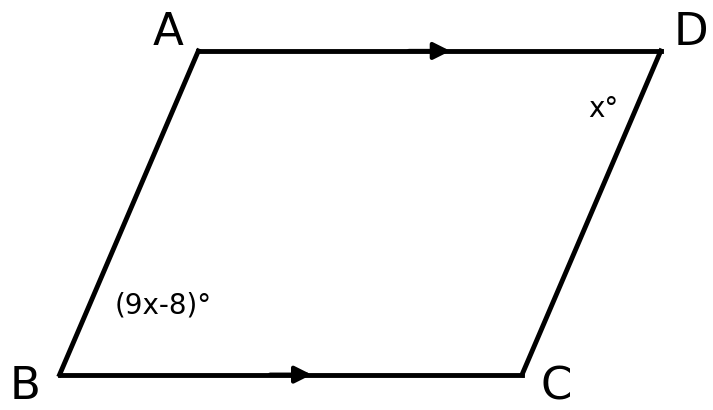
To find the value of \(x\), we need to use the property of a quadrilateral where the sum of all interior angles is \(360^\circ\).
Correct Option: B) 15°
To determine the gain or loss percentage, we need to establish a relationship between the cost price (CP) and selling price (SP) of a single article. We are given that the selling price of 9 articles is equal to the cost price of 15 articles. From this, we can find the CP and SP per article and then calculate the profit percentage.
Let \(\text{CP}\) be the cost price of one article and \(\text{SP}\) be the selling price of one article.
According to the problem statement, the selling price of 9 articles is equal to the cost price of 15 articles. We can write this as an equation:
\[ 9 \times \text{SP} = 15 \times \text{CP} \]Now, we can find the ratio of \(\text{SP}\) to \(\text{CP}\):
\[ \frac{\text{SP}}{\text{CP}} = \frac{15}{9} \]\[ \frac{\text{SP}}{\text{CP}} = \frac{5}{3} \]This implies that if \(\text{CP} = 3x\), then \(\text{SP} = 5x\) for some value \(x\). Since \(\text{SP} > \text{CP}\), there is a gain (profit).
Calculate the gain:
\[ \text{Gain} = \text{SP} - \text{CP} = 5x - 3x = 2x \]Calculate the gain percentage. The gain percentage is calculated on the cost price:
\[ \text{Gain Percentage} = \left( \frac{\text{Gain}}{\text{CP}} \right) \times 100\% \]\[ \text{Gain Percentage} = \left( \frac{2x}{3x} \right) \times 100\% \]\[ \text{Gain Percentage} = \left( \frac{2}{3} \right) \times 100\% \]\[ \text{Gain Percentage} = 0.6666... \times 100\% \]\[ \text{Gain Percentage} = 66.66...\% \]Rounding to one decimal place, the gain is approximately \(66.6\%\).
Correct Option: A) gain of 66.6% nearly
The question asks to identify the individual who presented the Interim Union Budget on February 1, 2019. This is a factual question related to Indian political and economic history, specifically concerning the Union Budget presentation.
Correct Option: B) Piyush Goyal presented the Interim Union Budget on February 1, 2019, as he was temporarily holding the additional charge of the Ministry of Finance due to Arun Jaitley's ill health.
The question asks to identify which European nation first discovered a sea-route to India. This is a historical fact related to the Age of Discovery and European expansion into Asia.
Correct Option: A) The Portuguese, led by Vasco da Gama, were the first Europeans to discover a direct sea-route to India in 1498.
The question asks for the total number of articles originally present in the Indian Constitution at the time of its implementation. This is a factual question related to the foundational structure of the Indian Constitution.
D) 395 - At its commencement on January 26, 1950, the Indian Constitution contained 395 articles.