To find the cost price when the selling price and profit percentage are given, we can use the formula relating these three quantities. The selling price is the cost price plus the profit. Since the profit is given as a percentage of the cost price, we can set up an equation to solve for the cost price.
Let the Cost Price (CP) of the table be \(P\).
The Selling Price (SP) of the table is given as ₹330.
The trader gains 10%. This means the profit is 10% of the Cost Price.
\[ \text{Profit} = 10\% \text{ of CP} = \frac{10}{100} \times P = 0.10P \]The Selling Price is the sum of the Cost Price and the Profit:
\[ \text{SP} = \text{CP} + \text{Profit} \]Substitute the known values and the expression for profit into the formula:
\[ 330 = P + 0.10P \]Combine the terms involving \(P\):
\[ 330 = 1.10P \]Solve for \(P\) (the Cost Price):
\[ P = \frac{330}{1.10} \] \[ P = \frac{3300}{11} \] \[ P = 300 \]So, the cost price of the table is ₹300.
Correct Option: C) ₹300
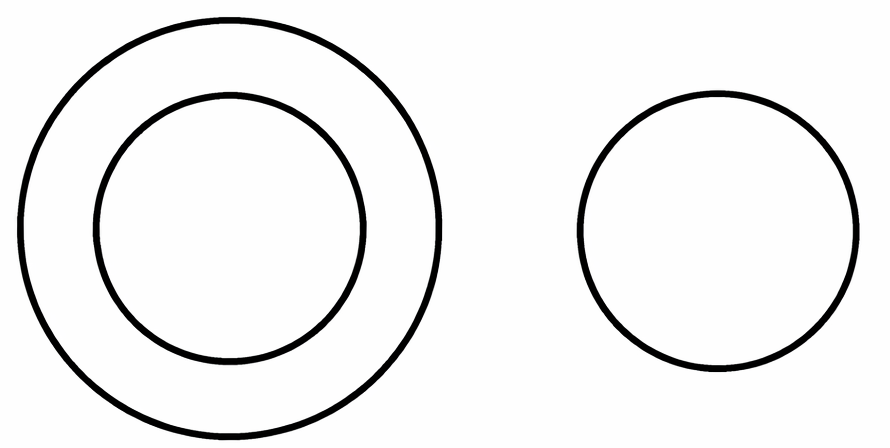
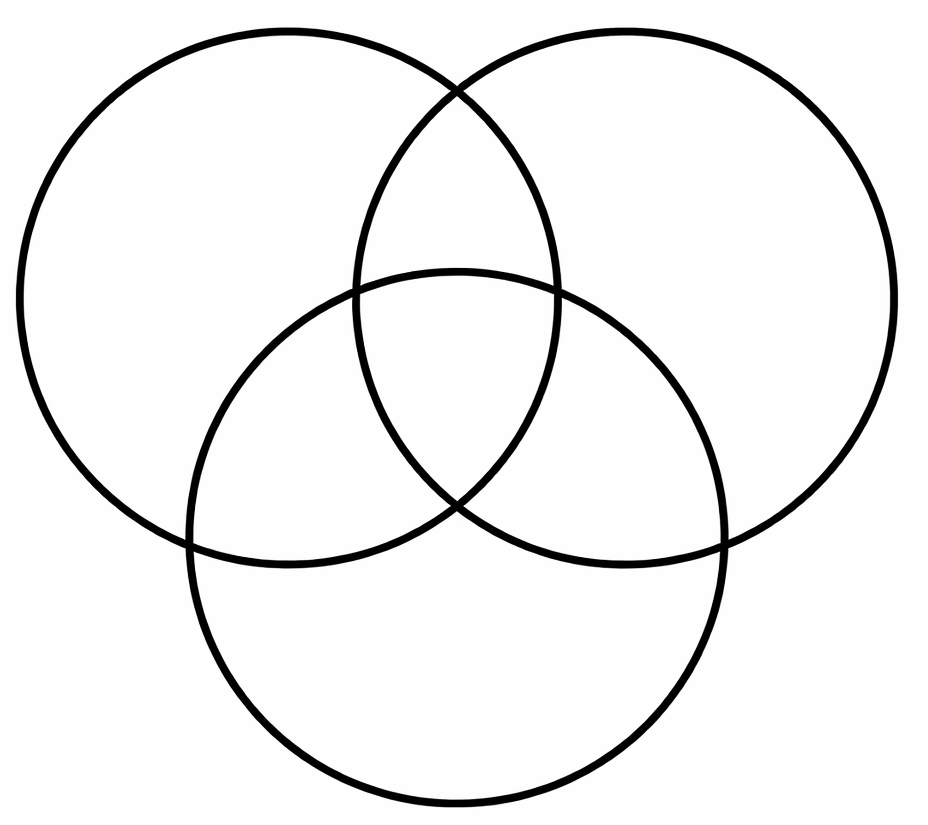
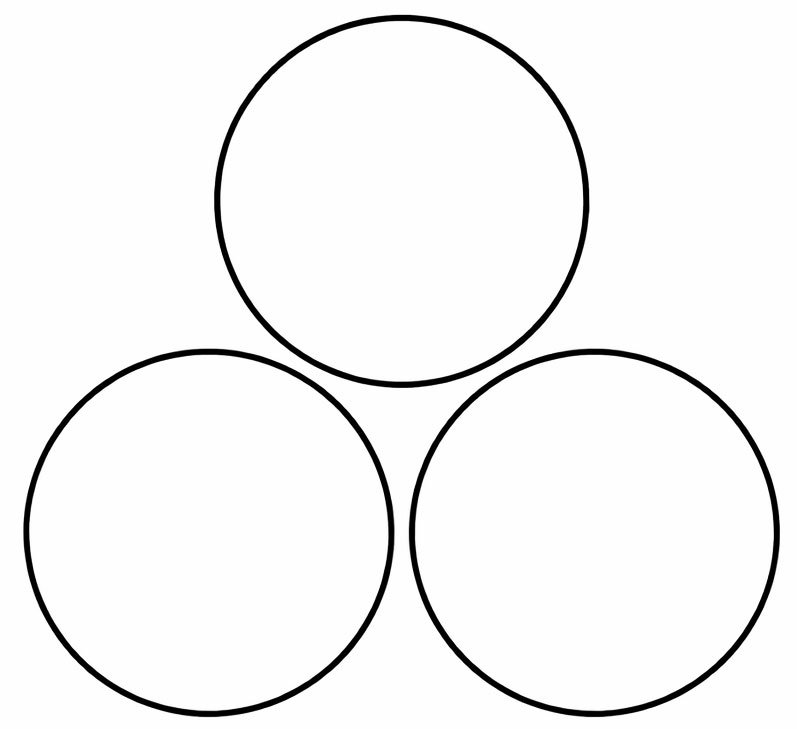
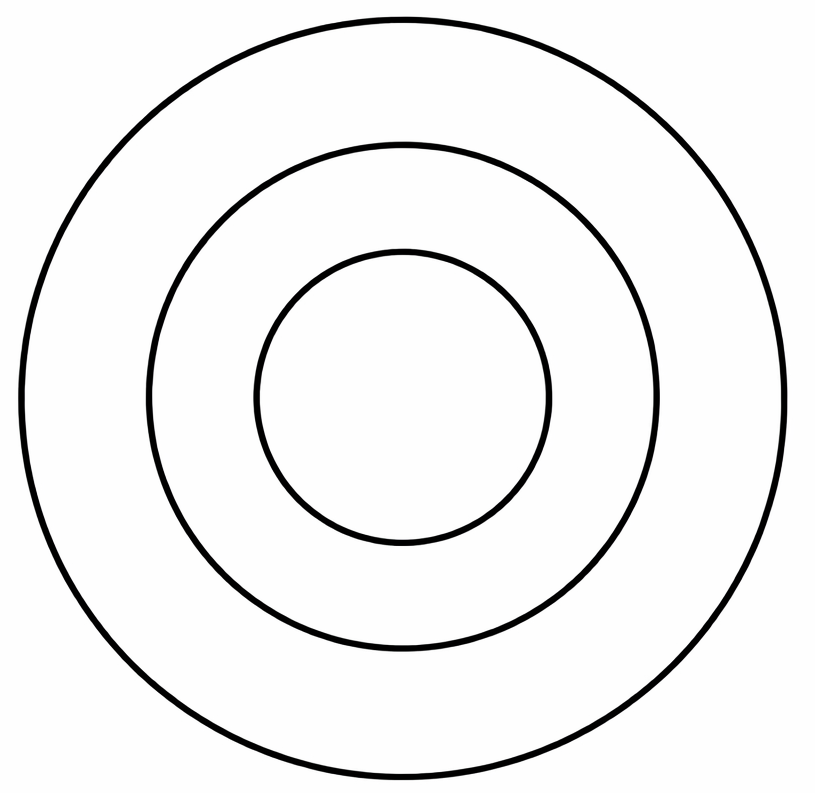
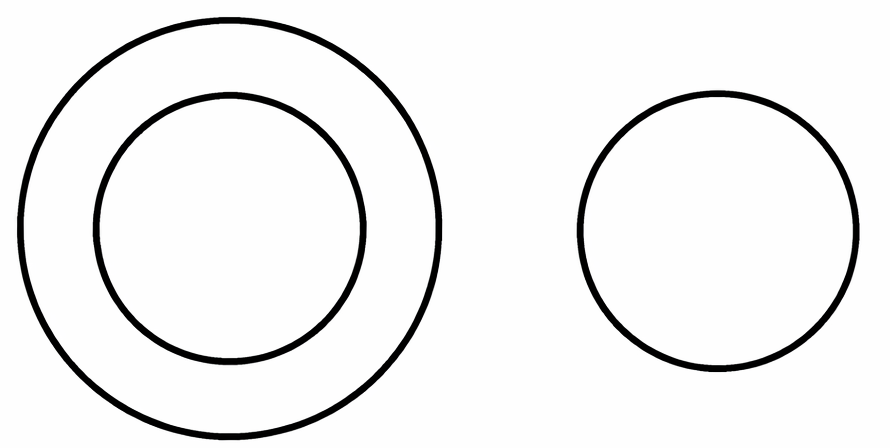
From among the options, select the Venn diagram which correctly depicts the relationship between the following three classes. Animal, fish, plant
To solve this question, we need to identify the correct Venn diagram that represents the relationship between the categories: Animal, Fish, and Plant. Understanding the hierarchy and relationships among these categories is crucial.
Correct Option: A) The diagram shows two nested circles on the left (fish inside animals) and a separate circle on the right for plants, correctly representing the relationships.
The question asks for the unit of magnetic flux. To answer this, we need to recall the standard SI units for various physical quantities related to electromagnetism.
D) Weber — The Weber (Wb) is the SI unit for magnetic flux. It is named after the German physicist Wilhelm Eduard Weber.
The question asks to identify the district in Uttarakhand where a glacier burst occurred on February 7, 2021, which subsequently damaged the Rishiganga dam on the Alaknanda River. This is a factual question related to a significant environmental disaster in India.
C) Chamoli is the correct answer. The glacier burst on February 7, 2021, which caused extensive damage, including to the Rishiganga dam, occurred in the Chamoli district of Uttarakhand.
The question asks for the year in which the International Fund for Agricultural Development (IFAD) was created. This is a factual question requiring knowledge of the establishment date of international organizations.
Correct Option: C) 1977. The International Fund for Agricultural Development (IFAD) was established in 1977 as a specialized agency of the United Nations dedicated to eradicating rural poverty in developing countries.
To find the frequency of a specific class in grouped data, we need to count how many data points fall within the range defined by that class. It's important to remember the convention for class intervals: the lower limit is inclusive, and the upper limit is exclusive for continuous data, unless otherwise specified. For the class 20–25, this means we count values greater than or equal to 20 but strictly less than 25.
Correct Option: B) 3 — The values 20, 21, and 23 fall within the class interval 20–25 (inclusive of 20, exclusive of 25). There are 3 such values.
The question asks for the headquarters of the International Renewable Energy Agency (IRENA). This is a factual question requiring knowledge of international organizations and their locations.
Correct Option: B) Abu Dhabi
This is a circular seating arrangement problem. We need to deduce the positions of the five persons based on the given clues and then identify who is to the left of Kunal.
B) Bhanu — As per the final arrangement, moving anti-clockwise from Kunal, we find Bhanu.
If \(\frac{\sqrt{5}-1}{\sqrt{5}+1}\)= a + b\(\sqrt{5}\), then find the value of a and b.
a = \( \frac{3}{2} \), b = −\( \frac{1}{2} \)
a = 0, b = 0
a = 0, b = \(\frac{\sqrt-{5}}{2}\)
a = \(\frac{\sqrt-{5}}{2}\), b = 0
To find the values of \(a\) and \(b\) in the given equation, we need to simplify the left-hand side expression by rationalizing the denominator. This involves multiplying the numerator and denominator by the conjugate of the denominator. Once simplified, we can equate the rational and irrational parts of the expression to find \(a\) and \(b\).
The given equation is:
\[ \frac{\sqrt{5}-1}{\sqrt{5}+1} = a + b\sqrt{5} \]To rationalize the denominator on the left-hand side, multiply the numerator and denominator by the conjugate of the denominator, which is \( \sqrt{5}-1 \):
\[ \frac{\sqrt{5}-1}{\sqrt{5}+1} \times \frac{\sqrt{5}-1}{\sqrt{5}-1} \]Apply the algebraic identities \((x-y)^2 = x^2 - 2xy + y^2\) for the numerator and \((x+y)(x-y) = x^2 - y^2\) for the denominator:
Numerator: \( (\sqrt{5}-1)^2 = (\sqrt{5})^2 - 2(\sqrt{5})(1) + (1)^2 = 5 - 2\sqrt{5} + 1 = 6 - 2\sqrt{5} \)
Denominator: \( (\sqrt{5}+1)(\sqrt{5}-1) = (\sqrt{5})^2 - (1)^2 = 5 - 1 = 4 \)
Substitute these back into the expression:
\[ \frac{6 - 2\sqrt{5}}{4} \]Simplify the fraction by dividing each term in the numerator by the denominator:
\[ \frac{6}{4} - \frac{2\sqrt{5}}{4} = \frac{3}{2} - \frac{1}{2}\sqrt{5} \]Now, equate this simplified expression with the right-hand side of the original equation:
\[ \frac{3}{2} - \frac{1}{2}\sqrt{5} = a + b\sqrt{5} \]By comparing the rational parts and the irrational parts, we get:
\( a = \frac{3}{2} \)
\( b = -\frac{1}{2} \)
A) \(a = \frac{3}{2}\), \(b = -\frac{1}{2}\) is the correct option as derived from the step-by-step simplification and comparison.
B) \(a = 0\), \(b = 0\) — This is incorrect because the simplified expression is not zero. The rational part is \( \frac{3}{2} \) and the irrational part is \( -\frac{1}{2}\sqrt{5} \).
C) \(a = 0\), \(b = \frac{\sqrt{-5}}{2}\) — This is incorrect. The rational part \(a\) is not 0, and the irrational part \(b\) is \( -\frac{1}{2} \), not \( \frac{\sqrt{-5}}{2} \). Also, \( \sqrt{-5} \) involves imaginary numbers, which are not present in the original expression.
D) \(a = \frac{\sqrt{-5}}{2}\), \(b = 0\) — This is incorrect. The rational part \(a\) is \( \frac{3}{2} \), not \( \frac{\sqrt{-5}}{2} \), and the irrational part \(b\) is \( -\frac{1}{2} \), not 0. Again, \( \sqrt{-5} \) is an imaginary number.
The question asks to identify the Speaker of the Second Lok Sabha. This requires knowledge of the history of the Indian Parliament and the individuals who held key positions.
Correct Option: D) M. Ananthasayanam Ayyangar was the Speaker of the Second Lok Sabha. He served as the Speaker from 1956 (during the First Lok Sabha, after G.V. Mavalankar's death) until 1962, covering the entire tenure of the Second Lok Sabha.