
Study the given pattern carefully and select the number that can replace the question mark (?) in it.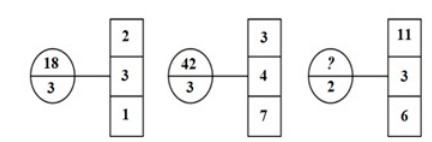
The diagram consists of circles and rectangles with numbers. The circle contains two numbers, and the rectangle is divided into three parts with numbers. We need to identify the pattern and find the missing number in the circle.
Correct Option: B) 40
This is a blood relation problem. We need to establish the relationships between the individuals mentioned in the problem statement step-by-step to determine how Anjali is related to Gita.
Correct Option: A) Husband's sister. Based on our step-by-step analysis, Anjali is the sister of Gita's husband, making her Gita's husband's sister.
The rectangle represents a set of calculations that are common across all the given equations. Identify the calculations involved and solve the fourth equation on the same basis:
7 ■ 3 = \( \frac{11}{2} \)
6 ■ 2 = \( \frac{13}{4} \)
5 ■ 3 = 8
a ■ b = ?
\(\frac{ab+1}{a}\)
\(\frac{ab}{a+b}\)
\(\frac{a+b}{ab-1}\)
\(\frac{ab+1}{a-b}\)
The problem asks us to identify a common mathematical operation represented by the symbol '■' based on three given equations and then apply that operation to a general expression \(a \text{ ■ } b\). We need to analyze the given equations to find a pattern or a formula that holds true for all of them.
D) \(\frac{ab+1}{a-b}\) is the correct expression as derived from the pattern observed in the given equations.
The question asks to identify the city with the second-largest population in India according to the 2011 Census. This requires knowledge of the population figures for major Indian cities as per the specified census.
According to the 2011 Census data:
Based on these figures, Mumbai was the most populous city, and Delhi was the second most populous city in India in 2011.
D) Delhi — According to the 2011 Census, Delhi (population ~11.03 million) was the second most populous city in India, after Mumbai.
The question asks for the best description of an equinox. We need to understand what an equinox signifies in terms of Earth's tilt relative to the Sun.
Correct Option: C) Neither of the poles is tilted towards sun.
This statement accurately describes the condition during an equinox. At this time, the Sun's rays fall directly on the equator, and the tilt of Earth's axis is perpendicular to the Sun's rays, meaning neither the North Pole nor the South Pole is leaning towards the Sun.
The problem involves decoding a word based on a given code. We need to identify the pattern or rule applied to transform "GOOFY" into "EMMDW" and then apply the same rule to transform "EMMA". This type of problem typically involves letter shifting or substitution based on alphabetical positions.
The pattern is consistent: each letter in the original word is shifted two positions backward in the alphabet to get the coded letter.
B) CKKY is the correct answer, as derived from applying the \( -2 \) shift rule to each letter of "EMMA".
The problem presents a series of equations with an unknown operator "➡". We need to deduce the function of this operator by analyzing the given equations and then apply it to the fourth equation to find the missing value.
I. \(9 \text{ ➡ } 3 = 32\)
II. \(6 \text{ ➡ } 7 = 47\)
III. \(13 \text{ ➡ } 3 = 44\)
Let the two numbers be \(A\) and \(B\). We are looking for a function \(f(A, B)\) such that \(A \text{ ➡ } B = f(A, B)\).
Consider common arithmetic operations: addition, subtraction, multiplication, division, and combinations thereof.
Let's try a combination involving multiplication and addition/subtraction.
From equation I: \(9 \text{ ➡ } 3 = 32\). If we multiply the first number by the second number and then add/subtract something, or multiply the first number by a constant and add/subtract the second number, etc.
Let's consider the pattern \((A \times B) + C\) or \((A \times C) + B\).
If we try \((A \times B) + \text{something}\):
\(9 \times 3 = 27\). To get \(32\), we need to add \(5\). So, \(27 + 5 = 32\).
Let's test this hypothesis on the other equations. The added number \(5\) could be a constant or related to \(A\) or \(B\).
If the rule is \((A \times B) + 5\):
II. \(6 \text{ ➡ } 7 = (6 \times 7) + 5 = 42 + 5 = 47\). This matches!
III. \(13 \text{ ➡ } 3 = (13 \times 3) + 5 = 39 + 5 = 44\). This also matches!
The pattern is consistent across all three given equations.
The rule for the operator "➡" is to multiply the two numbers and then add \(5\).
IV. \(12 \text{ ➡ } 3 = ?\)
Using the rule: \((12 \times 3) + 5\)
\(12 \times 3 = 36\)
\(36 + 5 = 41\)
The missing value is \(41\).
Correct Option: A) 41
The question asks to identify the incorrect statement regarding ultrasound waves. We need to evaluate each option based on the known properties and applications of ultrasound.
Correct Option: D) Ultrasound cannot be reflected back from defective locations
To find B's share of the profit, we need to calculate the ratio of the effective capital invested by A, B, and C. The effective capital is calculated by multiplying the investment amount by the duration for which it was invested. Since the profit is annual, the duration will be in months out of 12.
Calculate A's effective capital:
A invested ₹20,000 for the full year (12 months).
\[ \text{A's effective capital} = 20,000 \times 12 = \text{₹}2,40,000 \]Calculate B's effective capital:
B invested ₹16,000 for the full year (12 months).
\[ \text{B's effective capital} = 16,000 \times 12 = \text{₹}1,92,000 \]Calculate C's effective capital:
C joined after 8 months, meaning C invested for the remaining \(12 - 8 = 4\) months. C invested ₹15,000.
\[ \text{C's effective capital} = 15,000 \times 4 = \text{₹}60,000 \]Determine the ratio of effective capitals:
The ratio of effective capitals for A, B, and C is:
\[ \text{A} : \text{B} : \text{C} = 2,40,000 : 1,92,000 : 60,000 \]Simplify the ratio:
Divide all numbers by 1,000:
\[ 240 : 192 : 60 \]Divide by 12:
\[ 20 : 16 : 5 \]So, the ratio of their shares is \(20:16:5\).
Calculate B's share of the profit:
The total ratio parts are \(20 + 16 + 5 = 41\). The total annual profit is ₹4,100.
B's share is:
\[ \text{B's share} = \frac{\text{B's ratio part}}{\text{Total ratio parts}} \times \text{Total profit} \]\[ \text{B's share} = \frac{16}{41} \times 4,100 \]\[ \text{B's share} = 16 \times 100 = \text{₹}1,600 \]Correct Option: A) ₹1,600
We need to find the smallest whole number such that 60% of this number is greater than 6. We can set up an inequality to represent this condition and solve for the number. Then, we will check the given options to find the smallest whole number that satisfies the condition.
Thus, 11 is the smallest whole number whose 60% is more than 6.
Correct Option: D) 11