The question asks to identify which among the given options is NOT a high-level language. To answer this, we need to understand the distinction between high-level languages and low-level languages in computer programming.
Correct Option: B) Machine language is a low-level programming language, directly understood by the computer's CPU, and consists of binary code (0s and 1s). It is not a high-level language.
Simplify the following.
1 ÷ \(\left\{\frac{1}{2}+\frac{1}{3}+\frac{1}{6}\div\left(\frac{3}{4}-\frac{1}{3}\right)\right\}\)
\(\frac{36}{37}\)
\(\frac{32}{37}\)
\(\frac{30}{37}\)
\(\frac{35}{37}\)
To simplify the given expression, we need to follow the order of operations (BODMAS/PEMDAS). This means we first evaluate expressions inside parentheses, then division, and finally addition.
Correct Option: C) \(\frac{30}{37}\)
The question asks for the total sum of angles of all sections in a pie diagram. A pie diagram (or pie chart) is a circular statistical graphic, divided into slices to illustrate numerical proportion. The entire circle represents the whole, and the sum of all parts must equal the whole.
Correct Option: B) \(360^\circ\)
This is a syllogism problem. We need to analyze the given statements and determine which conclusions logically follow. We can use Venn diagrams or logical deduction to visualize the relationships between the categories.
This means that the entire set of 'mangoes' is contained within the set of 'tablets'. If we draw a Venn diagram, the circle for 'mangoes' would be completely inside the circle for 'tablets'.
This means that the entire set of 'tablets' is contained within the set of 'sweets'. In a Venn diagram, the circle for 'tablets' would be completely inside the circle for 'sweets'.
From Statement I, we have Mangoes \(\subset\) Tablets. From Statement II, we have Tablets \(\subset\) Sweets.
Combining these, we get Mangoes \(\subset\) Tablets \(\subset\) Sweets. This implies that the set of 'mangoes' is completely contained within the set of 'sweets'.
Since all mangoes are tablets, and all tablets are sweets, it logically follows that all mangoes must also be sweets. This conclusion is true.
If all mangoes are sweets, then there must be at least some sweets that are mangoes (specifically, all the mangoes are sweets). This is a direct implication of "All mangoes are sweets." If the set of mangoes is entirely within the set of sweets, then the intersection of sweets and mangoes is not empty (it contains all mangoes). Therefore, some sweets are mangoes. This conclusion is also true.
Correct Option: B) Both conclusions (1) and (2) follow.
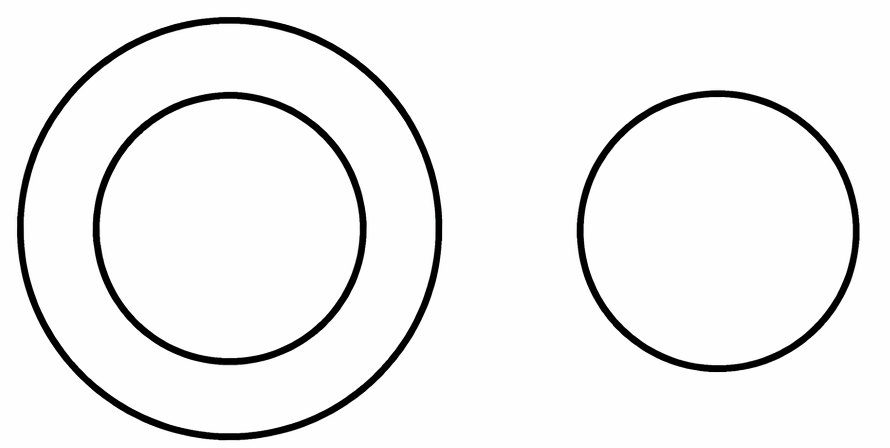
Select the Venn diagram that best represents the relationship between the following classes.
Medicine, Cancer, Disease
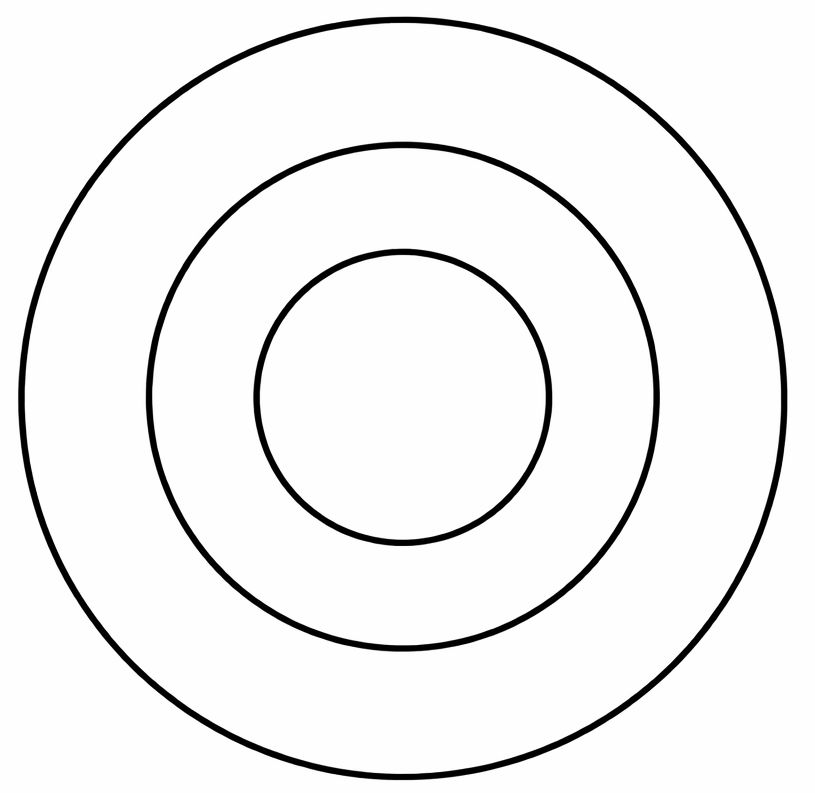
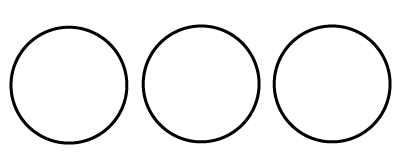
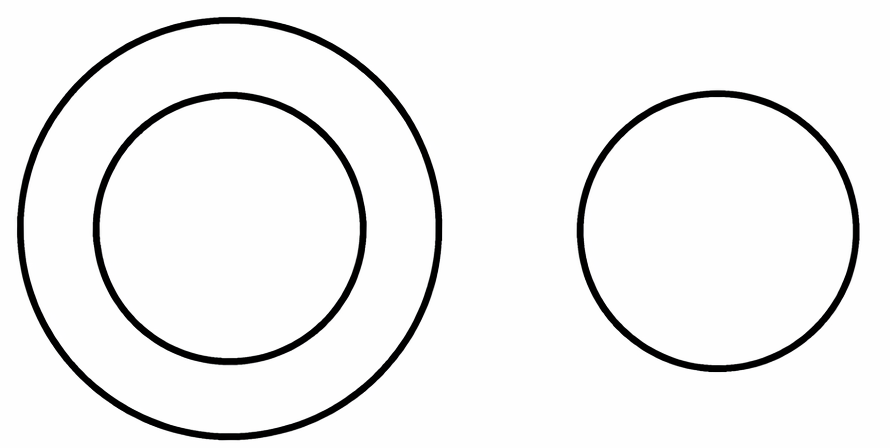
To determine the correct Venn diagram representing the relationship between Medicine, Cancer, and Disease, we need to understand how these categories interact with each other.
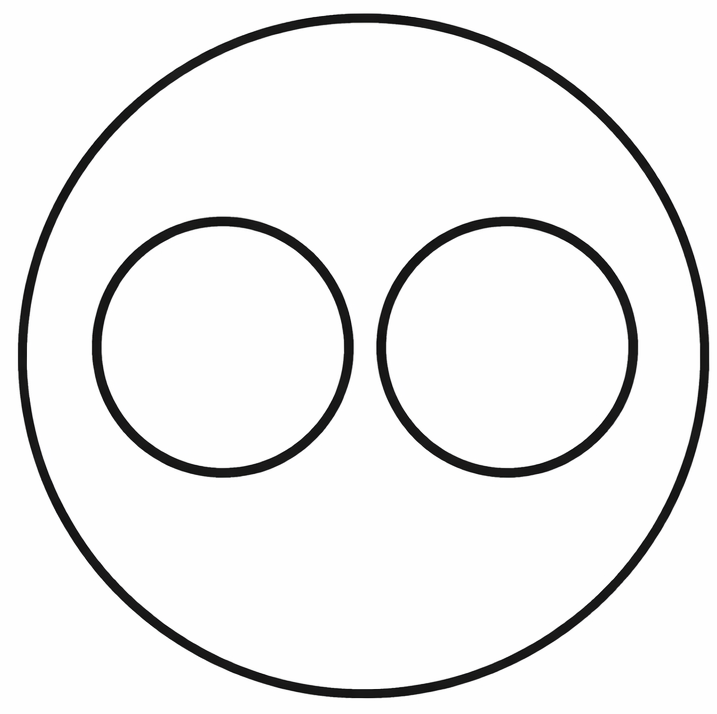
Option D shows two circles, with one circle representing Medicine and another circle showing Disease, which contains Cancer as a subset. This accurately represents the relationship.
Correct Option: D) The diagram correctly shows Medicine as a separate category and Cancer as a subset of Disease.
To find the selling price of the bat, we need to calculate the gain amount based on the given percentage and then add it to the cost price. The gain percentage is applied to the cost price.
The cost price of the bat is given as ₹800.
\[ \text{CP} = \text{₹}800 \]The bat was sold at a gain of 20%.
\[ \text{Gain Percentage} = 20\% \]The gain amount is 20% of the cost price.
\[ \text{Gain Amount} = \text{Gain Percentage} \times \text{CP} \]\[ \text{Gain Amount} = 20\% \times \text{₹}800 \]\[ \text{Gain Amount} = \frac{20}{100} \times 800 \]\[ \text{Gain Amount} = 20 \times 8 \]\[ \text{Gain Amount} = \text{₹}160 \]The selling price is the cost price plus the gain amount.
\[ \text{SP} = \text{CP} + \text{Gain Amount} \]\[ \text{SP} = \text{₹}800 + \text{₹}160 \]\[ \text{SP} = \text{₹}960 \]Correct Option: D) ₹960
To determine the colour of light in which photosynthesis is maximum, we need to understand how different wavelengths of light are absorbed by photosynthetic pigments, primarily chlorophyll.
Correct Option: B) Red
The question asks to identify a festival associated with harvest. We need to recall the primary significance of each given festival.
Based on the analysis, Pongal is clearly identified as a harvest festival.
Correct Option: B) Pongal is a prominent harvest festival celebrated primarily in South India, particularly in Tamil Nadu.
This is a syllogism problem. We need to evaluate the given conclusions based on the provided statements. We can use Venn diagrams to visualize the relationships described in the statements and then check if the conclusions logically follow.
Correct Option: B) Neither conclusion (1) nor (2) follows.
The question asks to identify a specific reform introduced during Lord Dalhousie's tenure in 1848. To answer this, one needs to recall the major policies and reforms associated with Lord Dalhousie and their respective timelines.
Based on the timeline and the policies, the Doctrine of Lapse fits the criteria.
D) Doctrine of Lapse — Lord Dalhousie introduced the Doctrine of Lapse in 1848. This policy allowed the British East India Company to annex any princely state whose ruler died without a natural male heir, claiming that the state's sovereignty "lapsed" to the paramount power. Satara was the first state annexed under this doctrine in 1848.