
The question asks to identify the disease caused by the fungus Puccinia graminis. This requires knowledge of common plant and human diseases and their causative agents.
Puccinia graminis is a well-known plant pathogen, specifically causing rust diseases in cereals. Among the options, "Black rust in wheat" is a classic example of a disease caused by this fungus.
Correct Option: B) Black rust in wheat
The problem is a coding-decoding question. We need to identify the pattern used to transform the word "SPECTROSCOPY" into "ESPRCTCOSYOP" and then apply the same pattern to the word "EXTRAVAGANZA".
Original word: S P E C T R O S C O P Y
Coded word: E S P R C T C O S Y O P
Let's number the letters of the original word:
S1 P2 E3 C4 T5 R6 O7 S8 C9 O10 P11 Y12
Now let's see how they map to the coded word:
E3 S1 P2 R6 C4 T5 C9 O7 S8 Y12 O10 P11
It appears the letters are grouped in sets of three and then rearranged. Let's examine the first three letters:
Now the next three:
Next three:
Next three:
The pattern is to take three consecutive letters (1 2 3) and rearrange them as (3 1 2).
Original word: E X T R A V A G A N Z A
Divide into groups of three:
T E X V R A A A G A N Z
A) TEXVRAAAGANZ is the correct answer as it matches the pattern derived from the example.
The question asks to identify the statement that is NOT true regarding National Highways in India. This requires knowledge about the longest and shortest national highways and the authority responsible for their management.
Based on the evaluation, statement A is the one that is not true.
Correct Option: A) NH-8 is the shortest national highway in India.
The problem asks us to identify implicit assumptions in a given statement. An implicit assumption is something that is taken for granted or presupposed by the statement, even if not explicitly stated. We need to evaluate each assumption to see if the statement logically depends on it.
A) Both, I and II are implicit. As analyzed above, both assumptions are fundamental to the statement's purpose and meaning. The instruction to not litter to keep the community clean relies on the understanding that littering causes dirtiness (Assumption I). The act of displaying the sign relies on the belief that people will notice and respond to it (Assumption II).
In what time will ₹1,000 become ₹1,331 at an interest rate of 10% per annum compounded annually?
This problem involves compound interest. We need to find the time period (\(n\)) for an initial principal amount (\(P\)) to grow to a final amount (\(A\)) at a given annual interest rate (\(R\)), compounded annually. The formula for compound interest is \(A = P \left(1 + \frac{R}{100}\right)^n\).
Correct Option: C) 3 years
This problem involves calculating the cost price of an article based on the profit percentages obtained from two different selling prices. We will set up equations for profit percentages and use the given difference to find the cost price.
Correct Option: D) ₹200
The cost of the article is found to be \(\text{₹}200\) by setting up equations for the profit percentages at two different selling prices and using the given difference in profit percentages.
The question asks to identify the Government of India mission launched in December 2014 with the objective of achieving full immunisation coverage for all children and pregnant women at a rapid pace. We need to evaluate each given option against this objective and launch date.
B) Mission Indradhanush was launched in December 2014 with the specific aim of rapidly increasing full immunisation coverage for children and pregnant women across India. It targets those who are unvaccinated or partially vaccinated against vaccine-preventable diseases.
This is a blood relations question. We need to trace the relationships described in the statement to determine how the boy's mother is related to Suresh. We will break down the statement into smaller, manageable parts and identify the individuals involved.
A) Maternal Aunt — As derived from the step-by-step analysis, the boy's mother is Suresh's maternal aunt.
The question asks for the date when the Constitution of India officially came into force. This is a factual question related to Indian history and polity, specifically the adoption and commencement of the Constitution.
Correct Option: B) 1950
Which of the following figures is different from the rest?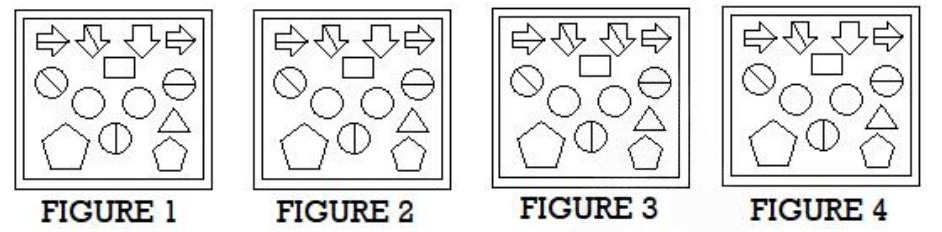
To determine which figure is different from the rest, we need to analyze the patterns and arrangements of shapes within each figure.
Figure 3 is different because its internal arrangement and orientation of shapes do not match the pattern seen in Figures 1, 2, and 4.
Correct Option: A) Figure 3