
The question describes a common optical phenomenon observed in deserts, where travelers perceive a sheet of water that isn't actually there. This phenomenon is a result of light bending due to temperature differences in the air, leading to an illusion. We need to identify the correct term for this specific optical illusion.
Correct Option: C) Mirage — A mirage is an optical phenomenon caused by the refraction of light through air layers of different temperatures and densities, creating an illusion of water or distant objects appearing in a distorted way.
This problem involves finding an unknown number given its relationship with another number, their HCF (Highest Common Factor), and LCM (Least Common Multiple). We will use the fundamental relationship between two numbers and their HCF and LCM, which states that the product of two numbers is equal to the product of their HCF and LCM.
Let the HCF of the two numbers be \(H\) and the LCM be \(L\).
According to the problem statement, the LCM is 24 times their HCF. So,
\[ L = 24H \quad \text{(Equation 1)} \]The sum of the HCF and LCM is 750. So,
\[ H + L = 750 \quad \text{(Equation 2)} \]Substitute Equation 1 into Equation 2:
\[ H + 24H = 750 \]\[ 25H = 750 \]Solve for \(H\):
\[ H = \frac{750}{25} \]\[ H = 30 \]Now, substitute the value of \(H\) back into Equation 1 to find \(L\):
\[ L = 24 \times 30 \]\[ L = 720 \]We are given that one of the numbers is 90. Let the two numbers be \(a\) and \(b\). We know \(a = 90\).
The fundamental property relating two numbers to their HCF and LCM is:
\[ a \times b = H \times L \]Substitute the known values into this equation:
\[ 90 \times b = 30 \times 720 \]Solve for \(b\):
\[ b = \frac{30 \times 720}{90} \]\[ b = \frac{30 \times 720}{3 \times 30} \]\[ b = \frac{720}{3} \]\[ b = 240 \]Thus, the other number is 240.
A) 240 is the correct answer, as calculated above.
The question asks to identify the next term in a given series of celestial bodies: Mercury, Venus, Earth. This series represents the planets in our solar system, ordered by their distance from the Sun. To solve this, we need to recall the order of the planets.
B) Mars is the fourth planet from the Sun, following Earth in the correct order of planets in our solar system.
The question asks to identify the movie that won the 'Best Motion Picture of the Year' award at the Oscars 2020. This requires knowledge of the Academy Awards (Oscars) results for that specific year.
The 92nd Academy Awards ceremony, honoring films released in 2019, took place on February 9, 2020. The South Korean film 'Parasite' made history by winning the 'Best Picture' award, becoming the first non-English language film to do so.
C) Parasite — 'Parasite' won the 'Best Motion Picture of the Year' (Best Picture) award at the 92nd Academy Awards ceremony in 2020.
In the given figure O is the centre of the circle. If ∠PAB = 35°, then find ∠ARS.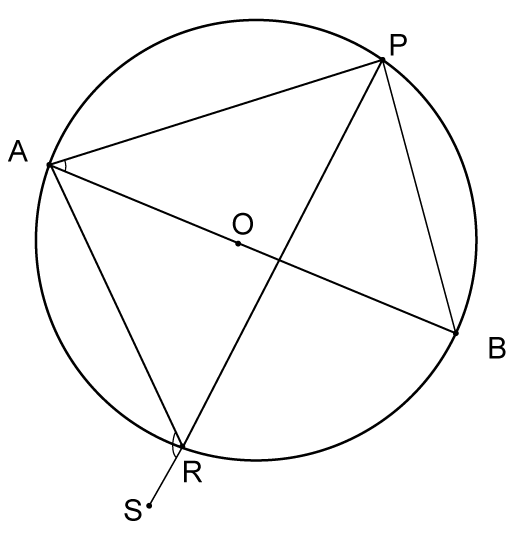
To find \( \angle ARS \), we use the properties of the circle and the given angles. Since \( O \) is the center of the circle, we can apply the properties of cyclic quadrilaterals and angles subtended by the same arc.
Correct Option: A) 125°
To find the length of the hall, we need to set up equations based on the given information. We are given the relationship between the length and breadth, and the perimeter of the hall. We will use the formula for the perimeter of a rectangle to solve for the unknown dimensions.
Define variables: Let the breadth of the hall be \(b\) meters. Let the length of the hall be \(l\) meters.
Formulate the first equation from the given relationship: The length of the hall is 7 m more than its breadth. So, \[ l = b + 7 \quad \text{(Equation 1)} \]
Formulate the second equation from the given perimeter: The perimeter of a rectangle is given by the formula \(P = 2(l + b)\). We are given that the perimeter \(P = 62\) m. So, \[ 2(l + b) = 62 \quad \text{(Equation 2)} \]
Solve the system of equations: From Equation 2, divide both sides by 2: \[ l + b = \frac{62}{2} \] \[ l + b = 31 \quad \text{(Equation 3)} \]
Substitute Equation 1 into Equation 3: Substitute \(l = b + 7\) into \(l + b = 31\): \[ (b + 7) + b = 31 \] \[ 2b + 7 = 31 \]
Solve for \(b\): Subtract 7 from both sides: \[ 2b = 31 - 7 \] \[ 2b = 24 \] Divide by 2: \[ b = \frac{24}{2} \] \[ b = 12 \text{ m} \] So, the breadth of the hall is 12 m.
Solve for \(l\): Substitute the value of \(b\) back into Equation 1: \[ l = b + 7 \] \[ l = 12 + 7 \] \[ l = 19 \text{ m} \] So, the length of the hall is 19 m.
Verify the answer (optional): Perimeter \(P = 2(l + b) = 2(19 + 12) = 2(31) = 62\) m. This matches the given perimeter, so our calculations are correct.
C) 19 m is the length of the hall.
The conversion of 0.0\(\overline{37}\) (repeating) in the form \( \frac{p}{q} \) is:
\( \frac{37}{999} \)
\( \frac{37}{990} \)
\( \frac{37}{1000} \)
\( \frac{37}{100} \)
To convert a repeating decimal into a fraction \( \frac{p}{q} \), we can use an algebraic method. We assign the given decimal to a variable, multiply it by powers of 10 to shift the decimal point, and then subtract the equations to eliminate the repeating part.
Let the given repeating decimal be \( x \):
\[ x = 0.0\overline{37} = 0.0373737... \quad \text{(Equation 1)} \]Since the non-repeating part is '0' (one digit) before the repeating block starts, multiply Equation 1 by \( 10^1 = 10 \) to move the decimal point past the non-repeating part:
\[ 10x = 0.373737... \quad \text{(Equation 2)} \]The repeating block is '37', which has two digits. Multiply Equation 2 by \( 10^2 = 100 \) to move the decimal point past one full repeating block:
\[ 100 \times (10x) = 100 \times (0.373737...) \] \[ 1000x = 37.373737... \quad \text{(Equation 3)} \]Subtract Equation 2 from Equation 3 to eliminate the repeating part:
\[ 1000x - 10x = 37.373737... - 0.373737... \] \[ 990x = 37 \]Solve for \( x \):
\[ x = \frac{37}{990} \]B) \( \frac{37}{990} \). This matches our calculated result.
This problem involves finding the value of a constant in a quadratic polynomial given a condition on the sum of the squares of its zeroes. We will use Vieta's formulas, which relate the coefficients of a polynomial to the sums and products of its roots (zeroes).
Identify the given polynomial and its coefficients.
The given polynomial is \( x^{2} + 9x + 3k \). Comparing this to the standard quadratic form \( ax^2 + bx + c \), we have:
Let the zeroes of the polynomial be \( \alpha \) and \( \beta \). Use Vieta's formulas to express the sum and product of the zeroes in terms of the coefficients.
Use the given condition: the sum of squares of the zeroes is 21.
We are given that \( \alpha^2 + \beta^2 = 21 \).
Relate \( \alpha^2 + \beta^2 \) to \( (\alpha + \beta) \) and \( \alpha \beta \).
We know the algebraic identity: \( (\alpha + \beta)^2 = \alpha^2 + \beta^2 + 2\alpha\beta \).
Rearranging this, we get: \( \alpha^2 + \beta^2 = (\alpha + \beta)^2 - 2\alpha\beta \).
Substitute the values from steps 2 and 3 into the identity from step 4.
\[ 21 = (-9)^2 - 2(3k) \]\[ 21 = 81 - 6k \]Solve the equation for \( k \).
\[ 6k = 81 - 21 \]\[ 6k = 60 \]\[ k = \frac{60}{6} \]\[ k = 10 \]D) 10 is the correct value for \( k \).
To find the new mean age, we first need to calculate the total sum of ages of the students. Then, we add the teacher's age to this sum to get the new total sum of ages. Finally, we divide the new total sum by the new total number of people (students + teacher) to find the new mean age.
D) 17 years — The calculated new mean age of the students and the teacher is 17 years.
The question asks about the agency responsible for clearing snow in high-altitude areas, which is a critical task for maintaining connectivity and defense in mountainous regions. We need to identify the organization specifically mandated for such infrastructure development and maintenance in border and high-altitude regions.
A) The Border Road Organisation is a premier road construction agency in India that develops and maintains road networks in border areas and high-altitude regions. Its duties include extensive snow clearance operations to keep vital routes open, especially during winter months, for both military and civilian use.